On-premise accounts work to appeal to consumers
Channel finds footing amid inflation, premiumization trends
Need to Know
- On-premise accounts are working to make visits feel “worth it” to consumers, from happy hour deals to specialty beverages.
- Premiumization and inflation are impacting the channel.
- Non-alcohol and ready-to-drink (RTD) cocktail formats remain popular with consumers for on-premise.
Beverage trends among consumers impact an array of channels, including on-premise accounts. Experts note that consumers are opting for establishments that feel “worth it” in terms of their time and money.
Matt Turczak, on-premise solutions manager at Chicago-based NielsenIQ (NIQ), notes that the on-premise channel has performed better by comparison in the past year.
“The on-premise channel has fared better than retail, though ‘better’ here means flat,” he says. “Alcohol dollar sales in U.S. bars and restaurants were flat over the 52 weeks ending June 13, while off-premise alcohol dollars fell 3.4%.”
Traffic is the encouraging part, Turczak shares.
“Ticket counts are up 3.5% year to date, but sales velocity in the average outlet is up less than half a percent,” he explains. “People are going out, but they’re spending more carefully once they get there. That’s important, because bars and restaurants generate roughly half of U.S. bev-alc dollars, and they’re where a lot of trial happens before a shopper ever buys the product at retail.”
Brian Sudano, CEO at S&D Insights LLC, Nowalk, Conn., says the on-premise channel is growing “at low single-digits,” while total beverage alcohol continues to decline in low- to mid-singles.
“This is a continued trend coming out of COVID-19, in which on-premise continues to out-perform off-premise,” he notes.
As for how inflation is impacting the on-premise market, Sudano says that inflation is not impacting the number of visits, which are up; however, he notes that inflation is impacting how much consumers drink during each visit, with visits offsetting drinks for each visit.
NIQ’s Turczak says that inflation shows more in what people order than in whether they go out.
“Among Americans drinking less when they’re out, saving money is the top reason (29%),” he shares. “Pre-drinking is another indicator. Twenty-seven percent of consumers always or often drink at home before going out, and a third of them order fewer drinks once they arrive.”
Price pressure hasn’t killed premium, though, Turczak says.
“Guests have a ‘less but better’ mindset: they’ll pay for a great drink, but they want to be sure it’s worth it,” he explains.
The experts share how on-premise operators are enticing consumers to visit establishments.
NIQ’s Turczak says they are working to make the visit feel worth the money.
“For example, mini cocktails, half-pours and flights are popular because they let guests try more without committing to a full-price, full-strength drink,” he notes. “Smaller pours also let operators feature premium liquor at a lower price point. Presentation counts, especially with younger guests who reward clean glassware, good ice and a serve that photographs well.”
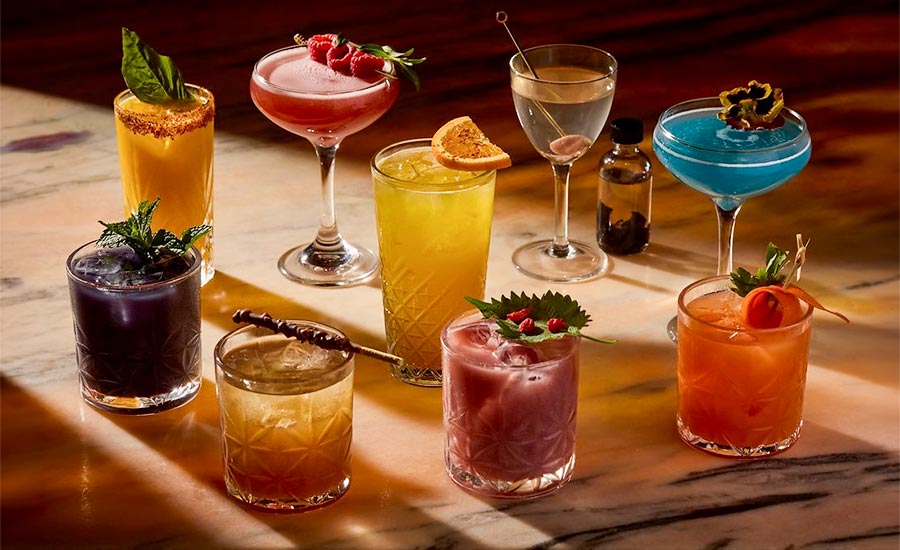 Image courtesy of Apotheke Mixology
Food-led venues continue to outperform drink-led formats, Turczak adds, because they line up with why people go out in the first place: to socialize and treat themselves.
S&D’s Sudano says that on-premise operators are “engaging consumers via different socializing formats and special nights, such as trivia, reverse happy hours, specialty drink specials, etc., to get people into the accounts.”
In terms of specific beverage alcohol trends driving on-premise sales, Sudano states that, from a macro perspective, RTDs have gained distribution and have become more prevalent in accounts.
“Premiumization continues to thrive despite consumer inflation pressure,” he adds.
Similarly, NIQ’s Turczak says that cocktails and RTDs are driving most on-premise sales.
“Riffs on classics like tequila-based espresso martinis or savory and spice-led concoctions keep menus interesting without asking guests to gamble on something unfamiliar,” he notes. “RTDs are growing in bars and restaurants, which matches what we see at retail, where RTDs have delivered 38% of innovation dollars in the first half of 2026. Curiosity drives sales, too: 41% of consumers tried a new drink at a bar or restaurant in the past month, including 67% of legal drinking age (LDA) Generation Z and 59% of millennials.”
Bars tend to be where brands get discovered, Turczak shares.
Among the alcohol categories, the experts note which has performed best within on-premise.
“Specialty drinks and cocktails continue to out-perform in the on-premise formats due to its formulation flexibility,” S&D’s Sudano says.
NIQ’s Turczak says that spirits, excluding RTDs, have delivered the strongest dollar share performance within bars and restaurants year-to-date.
“RTDs continue to gain momentum in the on-premise channel, increasing 0.2 share points year-to-date,” Turczak notes. “However, they are growing from a significantly smaller base than the beer, wine and spirits categories. Within beer, the category continues to consolidate as craft portfolios become more streamlined.”
At the same time, he says that domestic super-premium and import beer segments are experiencing positive share gains, while non-alcohol beer is growing rapidly from a relatively small base.
Specific alcohol trends influencing the channel include moderation, which Turczak considers to be the biggest trend that is changing how people drink in general.
“Guests have a ‘less but better’ mindset: they’ll pay for a great drink, but they want to be sure it’s worth it.”
– Matt Turczak, on-premise solutions manager at NielsenIQ
“One in four Americans expect to drink less this year than last,” he says. “Cannabis is a new factor. Forty percent of on-premise visitors have used cannabis in the past six months, and 87% of those users consume it alongside alcohol rather than instead of it.”
Operators should think of it as part of the same occasion, not a threat to it, Turczak suggests.
“Non-alc is now a standard part of the menu, and it isn’t replacing alcohol,” he says. “Ninety-four percent of non-alc buyers also buy traditional beer, wine or spirits. For most guests, an NA drink is one more option on the same night out.”
At retail, non-alc beer, wine and spirits now total just more than $1 billion, Turczak shares, with NA spirits up 40.7%, so guests are walking in already familiar territory with these products.
S&D’s Sudano notes that consumers’ desire for new flavor experiences continues to favor spirit cocktails and signature drink menus.
“Non-alcohol drinks, mocktails and NA beers continue to outperform and gain share,” he explains. “This fits with macros consumption trends.”
Looking ahead, Sudano says signature cocktails and white label beer will continue to gain traction.
“Look for RTD spirit distribution to continue as it fits with macro beverage alcohol trends,” he notes. “In addition, look for more functional offerings capitalizing on strength in electrolyte-enhanced products in alcohol.”
NIQ’s Turczak predicts more selectivity from guests and operators alike.
“Visitation intentions are positive, led by Gen Z and millennials, so the demand is there,” he says. “Private venues such as members’ clubs and airport lounges are growing as premium settings for trial.”
RTDs will stay a leading growth area, but as the segment matures, Turczak anticipates that differentiation in flavor, ABV and occasion will matter more than the number of launches.
“It will become more and more important for brands to make the decision easy with a clear reason to trade up, an option at every ABV and a serve worth talking about,” Turczak explains.
As consumers become more selective with their spending, it seems that on-premise operators will have to deliver a beverage worth the price.
Looking for a reprint of this article?
From high-res PDFs to custom plaques, order your copy today!