Spirits market faces shifting landscape, RTDs continue to drive growth
Low- and no-alcohol, premiumization trends continue to impact market
American rapper, record producer, and executive Dr. Dre in a 2013 Esquire article is quoted as saying: “I love the new technology. New things give you a reason to want to go to the studio. New challenges mean you have to keep up, you know?”
When it comes to the spirits market, experts note that the category similarly is facing new challenges and trends to keep up with, as the market landscape has shifted.
“2025 was a more challenging year for spirits,” says Mitch Madoff, head of retail partnerships at Keychain, New York. “After several years of steady premium-driven growth, the market felt real pressure from inflation, tighter consumer budgets, and a shift in consumer behavior, as more people chose to reduce or eliminate alcohol altogether.”
Yet, Madoff notes that ready-to-drink (RTD) cocktails showed strong growth in the past year despite broader industry challenges.
“Their variety of flavor options and on-the-go convenience align with younger consumers who are seeking flavorful, lower-sugar, lower-carb options that match their functional and better-for-you preferences,” he says.
Brian Sudano, CEO of S&D Insights LLC, Norwalk, Conn., describes the U.S. spirit market’s performance in the past year to be a “tale of two markets.”
“RTDs grew by about 20% in volume in 2025 while traditional spirits declined by around 6%,” he says. “Combined total spirits grew at around 1% as RTDs continue to gain share of total spirit volume. On a dollar basis, the spirit market declined near 3% as traditional spirits are more premium priced than RTDs.”
Kaleigh Theriault, director of BevAl thought leadership at NielsenIQ (NIQ), Chicago, notes that U.S. off-premise spirits dollar sales declined 1.8% year-over-year (YoY) for the 52 weeks ending Jan. 3, 2026, meanwhile 9 liter equivalized (EQ) volume was up 2.4%.
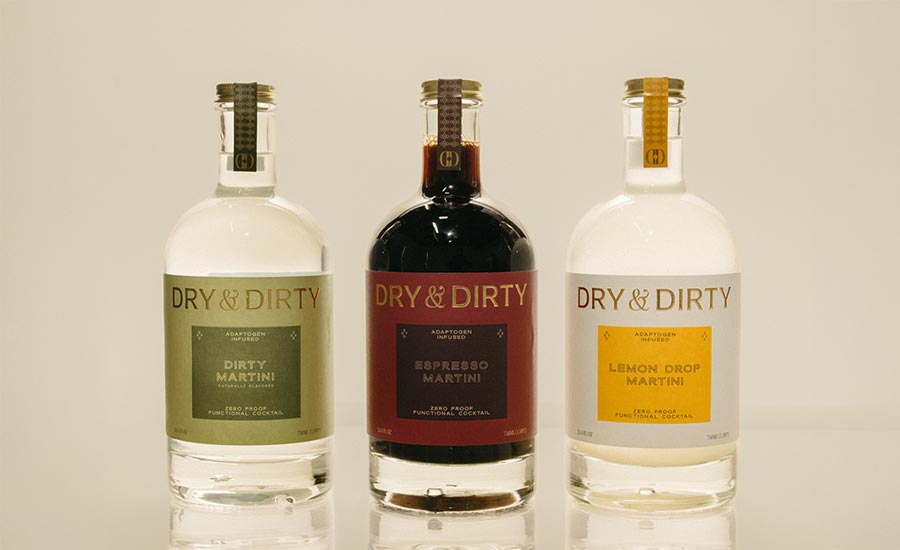 Dry & Dirty unveiled its first zero-proof, functional martini lineup with the launch of three expressions: Espresso Martini, Lemon Drop Martini, and Dirty Martini, each infused with adaptogens to enhance the experience, it notes.
 Image courtesy of Dry & Dirty
“Growth in spirits-based RTDs helped, but core spirits remained soft,” she says. “Spirits excluding RTDs declined 4.1% in dollars and 3.8% in volume.”
Theriault adds that the premium mindset is still strong with consumers but looks different from just growth in spirits price tiers.
“Consumers are opting for premium drinks, but less volume of drinks, as well as premium experiences in bars and restaurants,” she explains. “Premiumization is still a key theme: premium-plus (premium, super prem, ultra prem, and luxury) spirits make up 70% of spirits dollars (including RTDs). It’s increasingly supported by RTDs and ‘right-sized’ formats that make premium feel more accessible.”
S&D Insights’ Sudano explains that as economic pressure penetrated consumer purchase decisions, some trading down has occurred in the market.
“This is best demonstrated through volume shifting to RTDs,” he says. “However, traditional spirits premiumization has muted.”
Keychain’s Madoff says that despite economic pressures, consumers haven’t abandoned premium spirits but just are more selective about them.
“While overall alcohol consumption volume is down, many folks are reserving premium purchases for specific occasions, opting for quality over quantity,” he explains. “For consumers who are moderating their alcohol intake, that often means choosing higher-quality, more expensive options for the few occasions where they do indulge in spirits.”
The rise of low- and no-alcohol
Alongside consumer trends, the sober curious movement is having an impact on the market, experts note.
“Wellness-driven lifestyle shifts and broader conversations around moderation and sobriety are changing how consumers approach alcohol,” Keychain’s Madoff says. “Younger consumers are reducing their alcohol intake frequency and exploring non-alcoholic alternatives. On Keychain, non-alcoholic beverages saw explosive momentum last year, with 92% year-over-year growth.
“This ties back to the premiumization trend we’re seeing; as consumers drink less often, they’re upgrading to higher-quality spirits when they do indulge, and seeking equally sophisticated non-alcoholic options when they don’t,” Madoff continues. “Retailers and supermarkets around the country are expanding shelf space to meet that demand, and even legacy alcohol brands like Heineken and Budweiser have introduced alcohol-free lines to capture the sober-curious consumer.”
NIQ’s Kaleigh Theriault, however, notes that non-alcohol (NA) spirits remain relatively small in off-premise but have continued on the upside for cocktails on menus in bars and restaurants.
“Non-alcohol beer/wine/spirits surpassed $1.01 billion in off-premise sales (up 19.2%), showing moderation is growing,” she says. “Importantly, 95% of non-alcoholic buyers also buy alcohol, so it’s often a complement, not a replacement.”
S&D Insights’ Sudano explains that the sober curious movement had gained momentum prior to 2026; yet, he notes that beverage alcohol grew in early 2026 versus strong declines in 2025.
“Although NA spirits have been experiencing strong double-digit growth, it remains a very small part of the category at around half a percentage point versus NA beer, which is greater than 1% of beer,” he explains.
Other trends such as weight loss management facilitated by GLP-1s are impacting the market, Sudano notes, however, this trend has moderated in the early part of this year as reflected by flat new prescription growth.
Additionally, Sudano points to consumers substituting beverage alcohol with THC hemp beverages. This also has moderated as a result of pending federal ban of Delta products, he says.
Keychain’s Madoff considers social media as one of the most powerful forces influencing spirit consumption today, particularly among Gen Z members in their twenties.
“Platforms like Instagram and TikTok are driving discovery, turning viral recipes and bartender tutorials for seasonal cocktails — like the Summer Aperol Spritz or the U.S. Open’s Honey Deuce — into nationwide trends,” he says. “At the same time, social media has amplified a parallel wellness movement that’s reshaping drinking behavior.
“Viral challenges like ‘75 Hard’ and ‘Dry January’ have normalized cutting back on alcohol altogether, especially among younger consumers,” Madoff continues. “Influencers openly documenting their sobriety and fitness journeys have made non-alcoholic lifestyles more aspirational and socially accepted. As a result, many consumers are leaning into moderation or even switching to non-alcoholic alternatives, pushing brands to rethink their strategy, innovation, and marketing to remain relevant.”
Major influencers
As for which spirits segments fared the best or worst compared with previous years, experts highlight that RTDs and convenience are dominating the market.
“On Keychain, we saw strong performance from ready-to-drink cocktail brands like Surfside, High Noon, and Cutwater as consumers increasingly prioritize convenience without sacrificing quality,” Keychain’s Madoff says. “These canned options also make it easier for consumers to track calories and find low-sugar or carb options.
“Overall, core spirits (excluding RTDs) will continue to struggle this year, but the back half may fare better as consumers push for holiday gifting. Spirits RTDs and non-alcoholic options will continue to become more mainstream as part of moderation behavior.”
– Kaleigh Theriault, director of BevAl thought leadership at NielsenIQ
“On the other hand, more traditional cream liqueurs and heavily flavored spirits have softened,” he continues. “Brands like Jim Beam Apple Bourbon Whiskey and RumChata Rum Cream have seen a decrease in growth and revenue, as consumers are seeking lower-sugar, clean-label alternatives.”
In Mintel’s 2025 “Dark Spirits – US” report, Candace Baldassarre, senior analyst at Mintel, Chicago, and author of the report, highlights that brand innovation in production and flavor, as well as offering small-format bottles is essential to ensure continued consumption.
“Over half of dark spirits consumers find them too expensive for regular use, and many would switch brands if tariffs increase prices,” Baldassarre writes in the report. “Offering smaller bottle sizes, promotions, or entry-level premium options can address affordability concerns without compromising perceived value.”
Meanwhile, RTDs are dominating the dark spirits market, according to the report.
“Two-thirds of dark spirits drinkers enjoy RTDs or mixed drinks, reflecting a demand for convenience and versatility,” it states. “Investing in high-quality RTD options and promoting mixability through recipes and campaigns can capture this growing segment.”
Additionally, the report points out that dark spirits’ versatility is key to broadening consumption.
“Consumers value dark spirits for their versatility, enjoying them in mixed drinks, neat, or in classic cocktails,” it states. “Highlighting their adaptability for both casual and premium occasions can broaden appeal across demographics.”
In Mintel’s 2025 “White Spirits – US” report, Jenny Zegler, director of food and drink at Mintel, notes that variety, versatility, and value will be essential to maintain sales of vodka, tequila, rum, and gin at a time when consumers are rethinking their drinking.
“Variety is both an advantage and a disadvantage as white spirits consumers who drink alcohol are likely to drink a range of different types,” Zegler writes in the report. “Within white spirits, drinkers are particularly interested in exploring mezcal, flavored tequila, rum, and flavored vodka.
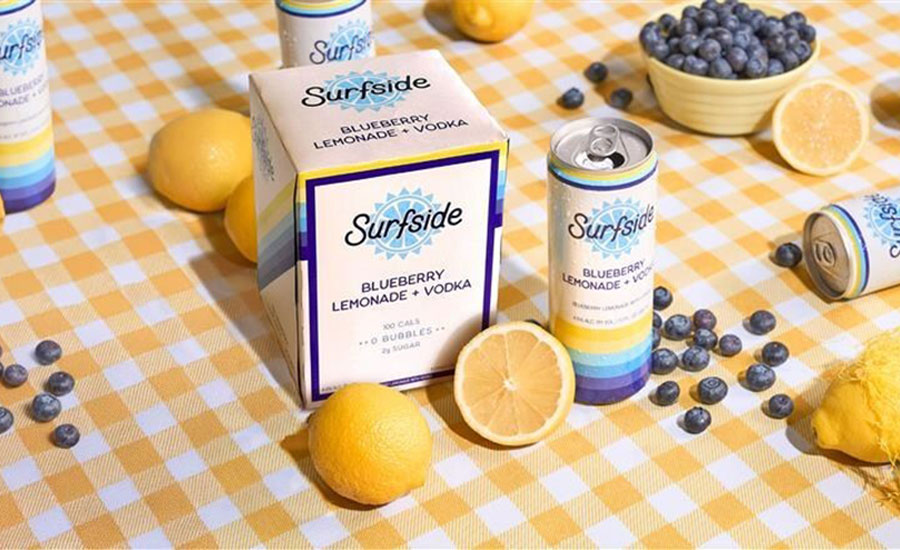 Surfside recently unveiled four new flavors, further expanding its canned cocktail lineup with the launch of Surfside Blueberry Lemonade and Half & Half Variety Pack.
Image courtesy of Surfside
“The interest in mixed drink and cocktail culture fuels an interest in flavored vodka, tequila, and rum,” the report continues. “Flavored innovations make at-home drinks easier and away-from-home drinks more reliable. New flavored launches need to launch with education on how to use the flavor in a drink.”
Further, tequila and mezcal continue to grow sales, according to the report, but hardly enough to offset declines in vodka and smaller segments of rum and gin.
“At the same time, ready-to-drink cocktails (RTDs) are stealing share from white spirits, offering a consistency and convenience that handmade drinks cannot guarantee,” it states.
NIQ’s Theriault notes that spirits-based RTDs are up 25.7% and NA spirits grew 62.2%, even as total spirits softened.
“Tougher spots included several traditional segments like vodka and American whiskey, both down year-over-year,” she says.
S&D Insights’ Sudano notes, as mentioned earlier, that RTD spirits is what’s driving market performance.
“Other categories all declined with the best performing segment, tequila/mezcal, continuing to be the best performing traditional segment, which was flat to down slightly,” he says.
Challenges ahead
As the spirits market continues to face headwinds, experts highlight what could potentially impact the category, as well as what’s anticipated in the coming year.
“Tariffs on imported spirits may add pressure on the market, especially on categories like tequila, Canadian whisky, and European liqueurs that rely heavily on global supply chains,” Keychain’s Madoff says. “When a tariff is added, importers and distributors suddenly face higher costs to bring products into the U.S. From there, retailers and bars have to decide to either absorb the extra cost, swap in different brands, cut back on promotions, or raise prices.”
NIQ’s Theriault echoes similar sentiments in regard to tariffs.
“Tariffs are a watch-out because they can raise costs on imported inputs and finished goods, potentially pushing shelf prices higher and pressuring already value-conscious shoppers,” she says. “NIQ flags ‘tariffs’ as a key driver to watch across beverage alcohol.”
S&D Insights’ Sudano notes that imported spirits declined dramatically in 2025, especially hitting European imports to include Scotch and vodka.
“Between inventory adjustments and reduced imports due to tariffs, imports declined near 25-30%,” he explains.
Looking ahead, Sudano anticipates that the market will decline again in 2026 but at a more modest rate as the shock from tariffs and economic uncertainty begins to moderate.
“Other factors that have hurt consumption such as GLP-1, neo prohibition campaigns, and THC hemp surge in 2025 moderates,” he says. “As a result, we expect spirits to decline a more modest 2-3% without RTDs and to grow between 1-2% with RTDs included. Separately, RTD growth is expected to moderate slightly to around 12-17% growth by volume.”
NIQ’s Theriault expects the category to experience continued volume pressure in the next year, with less ability to lean on price increases, noting that growth will depend more on winning with occasions, relevance, innovation, and the right formats.
“Overall, core spirits (excluding RTDs) will continue to struggle this year, but the back half may fare better as consumers push for holiday gifting,” she says. “Spirits RTDs and non-alcoholic options will continue to become more mainstream as part of moderation behavior.”
Keychain’s Madoff also anticipates that market growth in the coming year is not expected.
“Based on what we’re seeing from shifting consumer behavior and data on Keychain, performance will likely remain flat and uneven,” he says. “There might be gains in selective pockets, like within the ready-to-drink formats I’ve mentioned, but broadly speaking, I don’t think a huge expansion is on the horizon.
“But ultimately, the brands that see success in this category will be the ones who truly embrace and lean into consumer trends, meeting them at their health and wellness goals and engaging with them on social platforms,” Madoff concludes.
Looking for a reprint of this article?
From high-res PDFs to custom plaques, order your copy today!