Beverage-makers have increasing options in terms of color concepts
Flavor, functionality among attributes communicated by color
Need to Know
- Government regulations and consumer perception have shifted the traditional color concepts market.
- Consumers are increasingly knowledgeable about synthetic color in beverage formulations.
- Color brands must work with beverage-makers in finding the correct concepts.
Visual appeal plays a role in consumers’ beverage choices. However, government regulations are impacting the colors market.
Kelly Newsome, global director of product marketing for colors at ADM, Chicago, says that regulatory activity and consumer preferences have made color reformulation a greater priority for beverage-makers.
“As beverage manufacturers evaluate alternatives to FD&C color additives, reformulation can provide a path to better align established products with changing expectations around recognizable ingredients, better-for-you positioning and the overall sensory experience,” she explains. “Growing interest in ingredients derived from nature is translating into new opportunities for beverage developers to rethink color alongside the complete product experience.”
Alice Lee, technical marketing manager at Dallas, N.C.-based GNT USA, notes that there already were more beverage launches using natural coloring solutions than artificial colors in the United States, but the difference was modest until recently.
“Although reformulating recipes takes time, the FDA’s push to phase out petroleum-based dyes is already having a clear impact on new product development,” she says. “In 2025, the launch data shows there were 14% more beverage launches containing natural coloring solutions than synthetic dyes. In the first three quarters of 2026, the gap widened to 68%, and that’s a trend that’s only likely to continue in the years ahead.”
Brittany Jones, director of marketing at Sensient, St. Louis, shares that, in North America, the driving factor behind the mass conversion from synthetic dyes to natural colors is “undeniably consumer demand.”
“Consumers’ concerns around synthetic colors have been rising for years, and recent legislation efforts and activity at both the state and federal level have only cemented this shift,” she says. “Most of the legislation we have seen falls into three main categories: bans targeting synthetic dyes in school meals, bans targeting synthetic dyes in a state, and new warning label requirements. This legislation has arisen in direct response to consumer concerns and movements like Make America Healthy Again (MAHA).”
ADM’s Newsome says that consumer trends are reinforcing the shift to natural and organic color choices.
“Notably, new ADM research finds U.S. survey respondents were more likely to prefer and expressed willingness to pay more for carbonated soft drinks (CSDs) and sports drinks featuring colors derived from natural sources,” she shares. “This should encourage brands to explore how naturally derived colors can support familiar beverage experiences and new product innovation, while prioritizing the visual cues consumers expect.”
This evolving environment intersects with the broader movement toward cleaner, more recognizable formulations, Newsome adds.
“Beverage developers must therefore consider shade matching, stability, cost-in-use, application compatibility and supply consistency alongside consumer and regulatory expectations to deliver an enjoyable sensory experience,” she says.
“Beverage developers must therefore consider shade matching, stability, cost-in-use, application compatibility and supply consistency alongside consumer and regulatory expectations to deliver an enjoyable sensory experience.”
– Kelly Newsome, global director of product marketing for colors at ADM
GNT’s Lee shares that the MAHA initiative means many natural color projects right now are direct color replacements.
GNT’s EXBERRY colors are created from more than 30 different types of non-GMO fruits, vegetables and plants. The company offers an organic range as well.
“FD&C Red No. 40 and FD&C Blue No. 1 have consistently been among the most widely used colorants in U.S. soft and alcoholic beverages,” Lee says. “There are various plant-based raw materials that can provide an excellent replacement for Red 40 in acidic beverages, including black and purple carrot, purple and red sweet potatoes, hibiscus and blueberries. These are all anthocyanin-based colors, which can deliver very vibrant, stable shades in low-pH environments.”
Blue has historically been much more challenging, she notes.
“Spirulina extract is the most established natural blue color and can provide a very close color match for Blue No. 1, but it was only recently that it became a viable option for U.S. manufacturers,” Lee explains. “In 2022, GNT secured FDA approval for its use in beverage applications, and we also developed our patented EXBERRY Blue for Beverages technology.”
FD&C Yellow No. 5 is another widely used synthetic dye that Lee lists.
“Carotenoid-based natural yellow colors such as carrot and pumpkin concentrates have many technical advantages, but they do add turbidity to beverages,” she says. “Turmeric concentrates can provide an alternative, but they’re sensitive to light and generally require opaque packaging.”
Sensient’s Jones notes that the movement to natural and organic products is driving developers away from synthetic dyes.
“However, consumer expectations for visual cues aren’t dropping, so developers are tasked with finding natural and organic color solutions that emulate the performance of synthetic dyes,” she says. “Fortunately, the color industry has been closing the gap between natural and synthetic dyes for years with technological and botanical source advancements, so a broad rainbow is available.”
Unlike synthetic dyes, which are largely stable across a wide range of processing conditions, many natural colors are subject to performance differences depending on a product’s pH, water content, packaging or heat stability, Jones describes.
“This makes it more important than ever before that developers lean on color experts to simplify formulation and recommend colors that will perform their best in a particular application,” she adds.
Ashlee Martin, senior application scientist at Oterra, Mount Pleasant, Wis., shares that for some beverages, the best natural color solution could require a concession on shelf life, shade or another performance characteristics.
“Customers are now more willing to consider those trade-offs,” she notes. “… Greater acceptance of those practical limits has been a major change for us.”
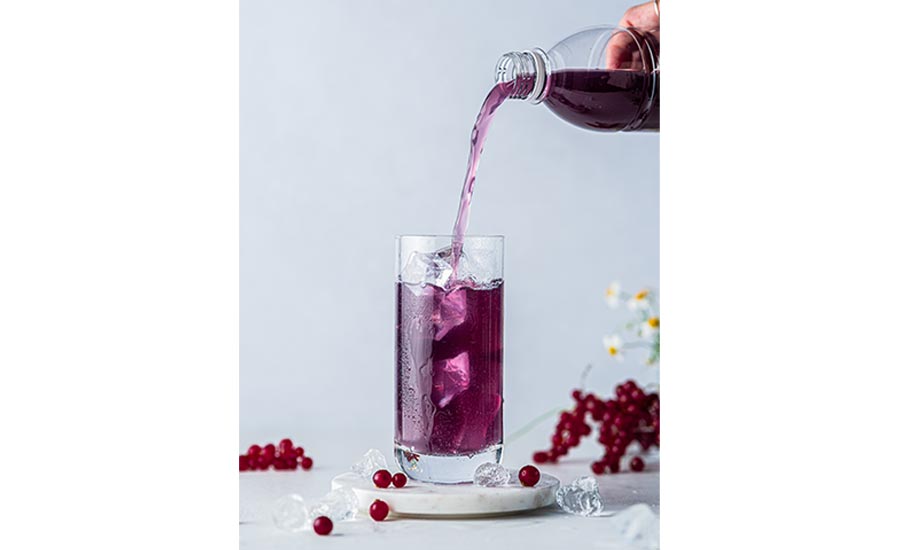
Image courtesy of GNT USA
Martin says there has been an overall shift toward natural colors in beverages, especially in new product development, while some established brands might be hesitant to change their core brands.
“Almost all new product development now uses natural colors, a trend we see across industries, including beverages,” she adds.
Other trends are influencing color solutions as well.
“Better-for-you innovation is progressively overlapping with sensory expectations, particularly across specialized nutrition powders, RTD specialized protein beverages, energy drinks and other functional beverage formats,” ADM’s Newsome shares. “Consumers may seek protein, fiber, vitamins, botanicals and other nutritional benefits, but they still expect appealing taste, texture and appearance. Beverage developers must consider how each ingredient interacts with the broader formulation.”
GNT’s Lee says that beverage innovation is becoming increasingly multisensory and extends beyond flavor to texture and visual experience.
“That can include additions such as boba pearls as well as eye-catching and sometimes unconventional colors,” she notes. “Color-changing drinks, activated by temperature, pH or mixing can create surprising, highly sharable moments, while hues such as blue, purple and black can help products stand out.”
Visual appeal also is playing an increasingly important role in beverage trends, Lee states.
“Matcha-strawberry is a great example: the flavors work well together, but the striking contrast between matcha green and strawberry pink has been vital to the combination becoming a viral sensation,” she explains.
Sensient’s Jones also points to functional claims.
“With added benefits or complex flavor profiles, color can be used to emphasize features or flavors,” she says. “Color can be especially important when functional ingredients impact the taste profile of a product. Sensient’s consumer research found that optimized color can improve flavor perception by 15%, which could be the key to overcoming or mitigating unwanted flavor notes.”
Brands that want to emphasize or imply juice content might choose to add color with or without cloud to their product, Jones shares.
“Shoppers may associate a cloud with wellness or naturalness compared to a cloudless beverage,” she says. “Consumers taste what they can see, and a colorless, cloudy beverage may be perceived as flavorless.”
Oterra’s Martin describes the trend of limited-time beverage offerings in restaurants and fast-food outlets.
“Limited time offers create fun opportunities for bold, highly visual, Instagrammable color concepts because the products generally have a shorter shelf life,” she says. “These concepts may use multiple syrups that combine in the finished beverage to create a color change. Limited time offers often feature unusual flavors and shades.”
Because the color might be held in a syrup and the pH conditions can be less demanding, Martin notes that spirulina might be suitable for a vivid blue.
“This gives us a broad toolbox for playful beverage concepts,” she shares. “The main benefits is meeting consumer demand. Consumers who value natural sources can recognize it on the label.”
For brands, Martin says that offering a more natural product can strengthen appeal and potentially support sales among those consumers.”
A rainbow of benefits
Experts share the benefits of using natural colors in beverages.
Colors derived from natural sources can help beverage manufacturers respond to evolving formulation and labeling priorities, while maintaining the visual appeal consumers expect, ADM’s Newsome states.
“However, successful implementation requires application-specific expertise,” she notes. “Factors such as pH, heat, light, oxygen exposure, processing conditions, packaging and shelf life can all influence pigment performance. Different pigment source may also respond differently during formulation.”
Beet-derived reds, for example, can be particularly heat sensitive, Newsome notes.
“Oxidation can also degrade pigments, making it important to select and stabilize colors according to the needs of the complete beverage formulation,” she says. “ADM’s Colors from Nature portfolio offers a full spectrum of color solutions made from fruits, vegetables and botanicals, supported by application expertise and advanced technologies. Instead of viewing colors derived from natural sources as direct substitutes for synthetic colors, beverage developers can match each pigment to the specific formulation and processing conditions to achieve the desired shade and stability.”
GNT’s Lee shares that natural colors enable beverage-makers to create visually striking beverages while maintaining natural ingredient lists.
“Some natural colors allow for completely clean and clear label declarations,” she says. “The majority of our EXBERRY colors are produced using physical processing methods and water, so they’re actually edible concentrates of fruits, vegetables and plants. They can be described in simple ways such as ‘fruit and vegetable juice for color’ or ‘spirulina extract (color).’”
At a time when petroleum-based dyes have frequently been in the U.S. news cycle, that instant clarity is more important than ever, Lee notes.
“Consumers want to see clean ingredients in their beverages,” Sensient’s Jones states. “This year, Sensient’s consumer research found that over 81% of consumers express varying levels of concern regarding synthetic colors in food and beverages, a significant increase from years past. Over half of consumers indicate a higher likelihood of purchasing from brands that replace artificial colors with natural ones.”
There is real opportunity for brands that are first-to-shelf with naturally colored new or converted products, she says.
Stephen Lauro, president at colorMaker Inc., Anaheim, Calif., shares several observations regarding beverage colors. He notes that beverage companies have often sourced butterfly pea flower extract believing it is a low pH stable natural color.
“Butterfly pea flower extract is stable at low pH, but it is not very blue,” he says. “When we suggest gardenia blue instead, beverage companies balk at the ‘may contain soy’ ingredient declaration. When we suggest spirulina blue, beverage companies complain that the colorant itself smells of dead fish.
“We have never had so many options for natural blue colors,” Lauro continues.
He notes that beverage-makers are replacing cocoa powder with natural colors due to high lead levels, only to discover that some natural colors are no better than cocoa powder regarding lead levels. Lauro also shares that companies are demanding the cleanest, simplest ingredient declaration while at the same time presenting the consumer with a vividly colored drink.
“Despite all the regulatory changes, we still encounter stark difference between fresh foods and beverages versus processed foods and beverages,” he says. “Our educational efforts never end.”
Looking for a reprint of this article?
From high-res PDFs to custom plaques, order your copy today!