Cambio Roasters unleashes recyclable aluminum K-Cup pods
Coffee company’s third bottom line aims to make world a better place
Although credible evidence shows that cultivation and coffee drinking began in Yemen by the 15th century, in the coffee world, there’s a tale that remains an iconic origin story for the world's beloved beverage.
Legend has it that Kaldi, a goat-herder from Ethiopia in the 9th century, went out to search for some of his missing goats only to find them energetically dancing and eating the berries of a small tree, which he had never seen before. Proceeding to try the berries himself, Kaldi felt a rush of vitality come to him after eating the berries. After this experience, he became determined to show this discovery to the world.
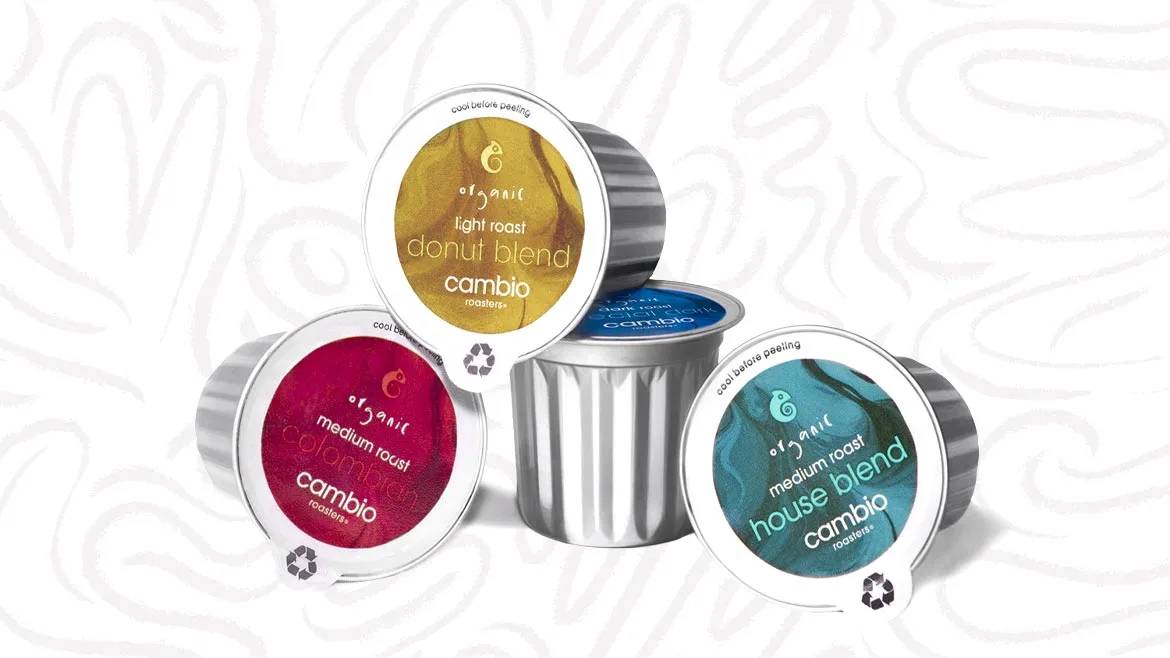
Akin to the legend of Kaldi, Kevin Hartley, founder and CEO of Cambio Roasters, Isle of Palms, S.C., set out with vision and determination to share a new, great discovery — jolting the coffee world with recyclable aluminum K-Cup pods.
As a former chief innovation and strategy officer for Keurig Green Mountain Coffee, Hartley leads a team of former Keurig executives who have rebuilt the iconic pod.
“I started working with a little coffee company you may have heard of called Green Mountain Coffee Roasters,” Hartley says. “It’s a multi-billion-dollar brand. Green Mountain Coffee was started by this amazing entrepreneur, Bob Stiller, and his right-hand man Steve Sable was who engaged me to do some work.”
During his time at Green Mountain, Hartley recalls the company finalized its purchase of the coffee brewer Keurig in 2006, noting that K-Cup sales at the time remained niche.
However, that’s no longer the case, Hartley explains, estimating approximately 20 billion K-Cups will be consumed this year.
“About 54 million per day,” he says. “And there's now 60 different brands and over 800 SKUs.”
Given this proliferation, Hartley notes that alongside Ann Hutson, co-founder of Cambio Roasters, the two came up with the idea to assemble a dream team — basically ex-senior people at Keurig — to reimagine the K-Cup for the next 25 years.
“[W]ith that lens, the 25-year lens, we had to solve K-Cups as single-use plastics, and we had to solve two sticky issues with that,” he says.
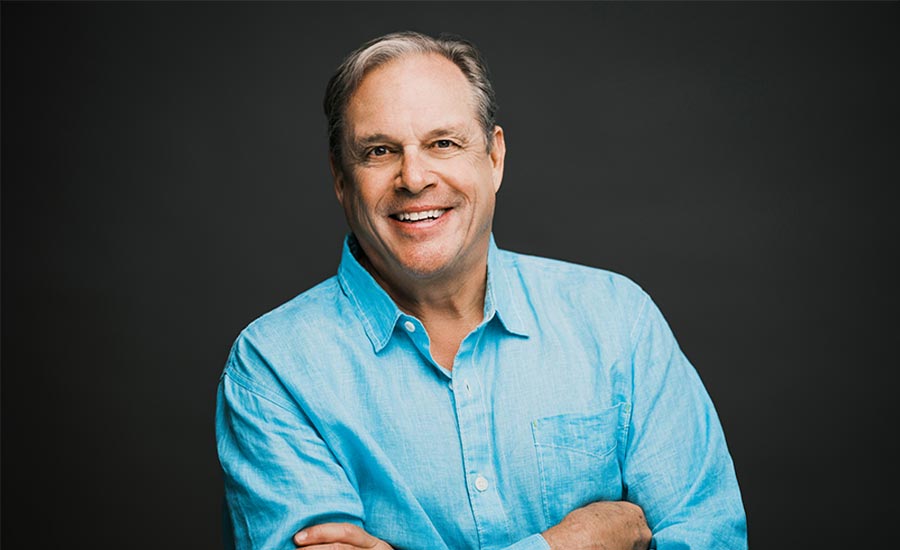
Cambio Roasters’ Kevin Hartley notes that embarking on a multi-year, multi-million-dollar innovation project wasn’t a sole effort, as it took thousands of amazing people to bring the brand vision to fruition.
(Image courtesy of Cambio Roasters)
Addressing the first “sticky issue” with single-use plastics, Hartley explains that “the coffee doesn't actually love it.”
“It lets in too much oxygen to keep the magic that the roast master intended for as long as you need to in North American supply chains,” he says. “It’s called the oxygen transfer rate (OTR). The OTR is high enough that the coffee loses its magic over time. That’s problem number one.
“Problem number two, and this is sad, is that in America, when we put plastics in curbside recycling, any plastic packaging, less than 3% of the time it turns into another product,” he continues. “So, 54 million K-Cups a day on average take another garbage truck ride to a landfill. And that’s sad.”
As founder and CEO of Cambio Roasters, Hartley says he’s “super” proud of what the company has built.
“It’s amazing. It certainly wasn’t just me. It was thousands of amazing people,” he explains. “But those two problems — when we said reimagine the iconic K-Cup for the next 25 years — that’s what we set off to solve.
“We embarked on a multi-year, multi-million-dollar innovation project to help everyone who has recycling concerns and coffee freshness concerns, who has a Keurig,” Hartley continues. We set off on a remarkable innovation project led by the genius Rick Estabrook, our head of innovation. And Cambio now has the only aluminum coffee pod brand that you can use in a Keurig.”
For the love of coffee
With a passion for Cambio’s K-Cup, Hartley delves into aluminum’s attributes, giving several reasons as to why it’s dubbed the “magic metal.”
“The first is that coffee loves it,” he says. “The oxygen transfer rate is effectively zero. The coffee keeps the magnificence of the most amazing beans in the world roasted by the most amazing roast masters on the planet. It keeps it until the moment you brew it, so, the ability to keep the coffee fresh is just magical.
“The second thing that’s really interesting … unlike plastics, nearly 100%, call it 97% of aluminum that goes in the recycling bin, turns into another product. A Diet Coke can, a Bud Light can, an Airstream trailer, a golf club head, you name it, because the aluminum molecule is eerily stable,” Hartley continues. “You can remelt it thousands of times, and the molecule retains its integrity and is just as good as virgin.”
Yet, the Cambio story isn’t just about the aluminum K-Cup pod.
“Cambio is, of course, Spanish for change. Our dream is to change the K-Cup industry, one delicious cup at a time kind of thing,” Hartley says. “And then I would also like to share that we have an amazing woman, Lindsay Bolger, who managed all of Green Mountain Keurig's multi-billion-dollar coffee activities, [and] now leads Cambio’s coffee work. She sources only 100% organic, small farm source, small batch roasted coffees that are truly amazing. She selects from only the Top 1% of the beans grown on this planet and then does her curation magic.
“So not only does the aluminum love the coffee, but the coffee that Cambio puts in there is truly amazing,” he continues. “It’s the best coffee you can make with a Keurig.”
Hartley further calls attention to where Cambio coffee is sourced — small coffee-farms located in the finest coffee-growing regions across the coffee belt.
“The coffee-growing region is between the Tropic of Cancer and the Tropic of Capricorn, around the equator,” he says. “… [D]epending on which beautiful roast, single-source roast or blend we're doing, the coffee is sourced appropriately.”
Yet, Cambio isn’t just focused on where the coffee is grown, Hartley explains, as the company also helps coffee-farming families end hunger by helping tackle seasonal food insecurity.
“Coffee-farming families struggle economically quite badly,” he says. “They live on between $1 and $3 dollars per day, which is why Cambio gives 20% of profits back to 10,000 coffee-farming families. This means if we hit our target, 60,000 less people a year will struggle, which is really important to me personally and as a brand.”
As far as which roast profiles are most popular, Hartley says Cambio’s Medium Roast Columbian is definitely the bestseller.
“[W]hen people say coffee in America, we all actually mean a different thing from each other,” he explains. “So, the roast profiles, to have a successful coffee brand nationally, you have to have big bomber Pacific Northwest super dark roast that’s removed from the roaster right after the second crack, right before the moment the whole thing bursts into flames, all the way to these lovely, nuanced, light New England roasts.
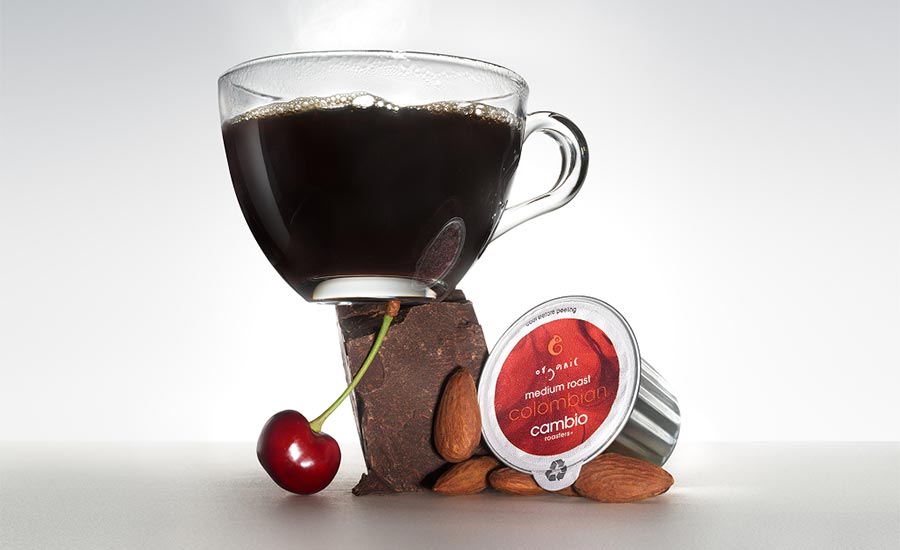 As far as which roast profiles are most popular, Hartley says “Cambio’s Medium Roast Columbian is definitely the bestseller.”
Image courtesy of Cambio Roasters
“So, Cambio has a range from our Donut Blend to our French Roast, and then we also have some beautiful origin roasts, which means they’re 100% from a particular country, and we have Colombian and Sumatran, which are amazing,” he continues.
As for top-selling roasts on Amazon, Hartley notes that’s where Cambio’s Decaf shines.
“And our Decaf is amazing,” he says. “It’s Swiss water processed, which is a non-chemical process. And in the very near future, we’ll be surrounding our Organic Medium Roast Decaf with a lovely Organic Dark Roast Decaf and an Organic Half-Caf to support this growing demand. ”
Living the dream
Aside from its vision to reimagine the K-Cup industry, Cambio celebrates consumers who love to make coffee.
“If coffee drinkers prefer French press and pour-overs, we love that,” Hartley says. “We just love the beverage. Our vision is if you have a Keurig and you care about coffee freshness, premium coffee taste, and our small spinning planet, boy, do we have a brand for you.”
Like many companies, Cambio has a target consumer and an avatar that the brand was built around.
“For Cambio, ours is HOPE. And she’s a really interesting person. She represents about 25% of all Keurig households,” Hartley says. “She’s on the trend of looking to align her purchases with her values. You can picture; she’s buying Method detergents and Kind bars and shopping at Whole Foods and Trader Joe’s.
“However, HOPE is very pragmatic,” he continues. “She’s not looking to spend crazy amounts more for her products. What she gets excited about is when she can move one of her purchases to the ‘better-for-you’ category. And that gives her a dopamine hit — without sacrificing taste or price. We basically precision-crafted Cambio to be her dream K-Cup brand.”
What’s even more interesting about HOPE is that retailers are paying attention to this shopper, Hartley adds. Most of them refer to her as the ‘purpose driven consumer’ and she actively seeks brands she might love, he says.
However, it is not just retailers that are paying attention. Recently, Cambio Roasters was named to Fast Company's prestigious list of the “World’s Most Innovative Companies of 2026.”
“I’ve been reading the magazine Fast Company for more than two decades,” Hartley says. “And my innovations throughout my career have gotten a lot of good press. Fortune, Forbes, Wall Street Journal Inc. ― all kinds of places in different iterations of my companies. But this for us, it was amazing to be up with Fortune 500 behemoths to be considered one of the topmost innovative companies.”
Despite all the recognition, Hartley explains that at the center of Cambio’s vision is to leave the world in a better place, a concept he first heard of in 1994.
“We call it the triple-bottom line, and I’ve been obsessed with it ever since,” he says. “And what that is, is you run your brands, your companies, your businesses with not just an eye toward the bottom line of money, but also a bottom line for people and a bottom line for the planet.
“And when you can bring that dream to life, to the world, powerful things happen,” Hartley continues. “You attract amazing consumers who care, and you attract amazing employees who like to work for purposes just bigger than money or bigger than themselves. And again, that’s not everybody, but it does create a fun community of change. And I love this idea that with running our businesses and our companies, we can leave the world better than we found it.”
Reaching for the stars
As Cambio remains laser-focused on reimaging the K-Cup industry for the next 25 years, for Hartley innovation means something different than the normal or typical definition, he says.
“Innovation means you actually have to commercialize the idea and bring it to the world,” he explains. “And that’s what I’ve done my whole life, which I’m obsessed with.”
Moreover, Hartley emphasizes that what’s most important to him is working with the amazing people that have helped bring his vision to fruition. Among those is Mike Cunningham, Cambio’s chief operations officer (COO) and one of Hartley’s best friends, who has a rich history of being the chief technology and chief innovation officer with Fortune 500 companies.
“He’s not only a genius, but he’s a super nice, big-hearted person,” he says. “We like to say, in and around Cambio, ‘no difficult people.’ We’re all at the stage in our lives where we prefer to be listened to and valued. ”
As far as Cambio Roasters’ U.S. footprint, Hartley notes that distribution is growing rapidly, and says he is proud of that.
“We’re available nationally at Kroger and all of its brands, so more than 2,000 doors,” he says. “We’re in all the top Target stores. We’re also soon going to be available in the Southeast in Publix.”
As for future distribution plans, Hartley says the dream is to be available wherever consumers are buying K-Cups.
And as far as other dreams within Cambio’s 25-year vision, he adds, “we’re just going to continue to build the Cambio brand.”
“One of our dreams is that a decade from now, there aren’t any single-use plastic K-Cups. Of course, all the other brands and Keurig, etc., would have to adopt it,” Hartley says. “But that’s sort of our long-term dream. That would be awesome.”
Looking for a reprint of this article?
From high-res PDFs to custom plaques, order your copy today!