Non-alcohol, alcohol brands blur lines between segments
Consumers welcome the nostalgia, familiarity of non-alcohol brands entering alcohol space

Many duos within the food and beverage industry are simply iconic ― milk and cookies, peanut butter and jelly, coffee and doughnuts. Other notable duos, like Jack Daniels and Coca-Cola, now come in the form of their own ready-to-drink (RTD) cocktail.
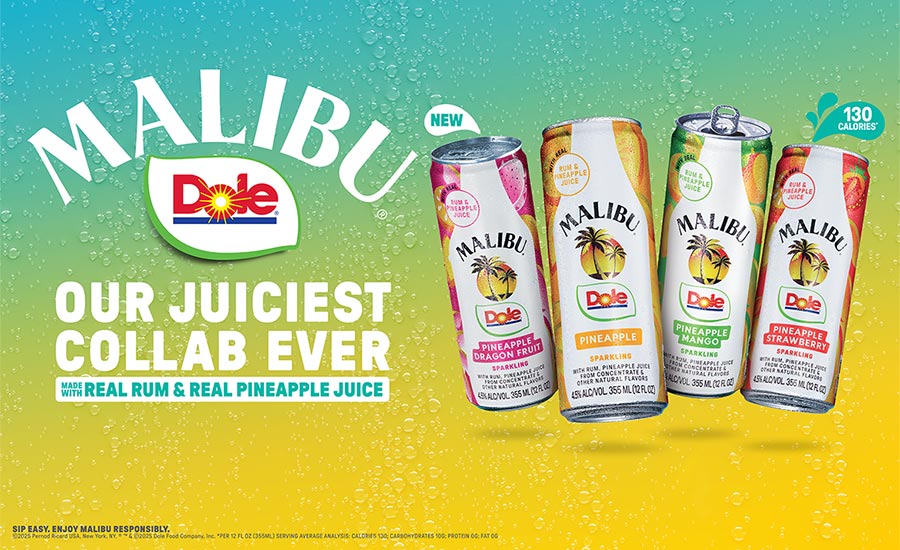
More recently, Malibu partnered with Dole to introduce Malibu & Dole RTD Cocktails. The cocktails, which are inspired by the popular pairing of Malibu and Dole pineapple juice, are set to launch early 2026 and another example of an iconic beverage duo in an RTD format.
The new line will include a variety eight-pack of 12-ounce cans with four flavors: Pineapple, Pineapple Mango, Pineapple Strawberry, and Pineapple Dragon Fruit. Large format single 19.2-ounce cans will be available in Pineapple and Pineapple Mango.
“Malibu & Dole have had a long-standing relationship and have been enjoyed together by our consumers in bars and homes across the country for many years,” said Natalie Accari, division vice president and general manager of RTD and convenience at Pernod Ricard USA, in a statement. “This innovation takes our consumers favorite serve and makes it even more accessible in a convenient format.”
In a statement, Elisabeth Morris, director of brand licensing at Dole Food Co., said the brand is thrilled to embark on the new collaboration with Malibu.
“Both brands are leaders in their category and bringing them together in a highly desirable and convenient format will only enhance the consumer experience year-round,” Morris said.
Prior to Malibu and Dole’s news, the beverage market has seen brand licenses cross lines with non-alcohol products venturing into alcohol. Consumer trends have lent themselves to this movement.
Sydney Riebe, U.S. food and beverage analyst at Mintel, Chicago, shares her thoughts on the topic.
“Consumers increasingly value convenience, and with many of these innovations showing up as ready-to-drink options, this is certainly a driver of this movement,” she says. “Flavor and texture innovation is also prevalent among these launches, reflecting younger consumers’ interest in more novel, global flavors.”
Additionally, Riebe notes that social media is a strong driver for discovery, brand recognition and the ability for beverage trends to find virality, especially with limited-time and collaborative products.
Brian Sudano, CEO of S&D Insights, LLC, Norwalk, Conn., states that consumers are increasingly drinking less.
“Non-alcoholic brands bring with them with credentials as being lower in or no alcohol,” he says. “This allows for them to be marketed as great tasting adult beverages as a point of entry for younger consumers. In addition, consumers entering legal drinking age are receptive to try these trusted brands in an alcohol format as they enter the adult beverage landscape.”
As successful non-alcohol brands already have strong followings, Sudano says gaining access to retail shelves quickly with scale is much easier than for an unproven new brand.
Mitch Madoff, head of retail partnerships at Keychain, New York, says a big part of the shift in crossing lines comes down to nostalgia.
“People love seeing their everyday brands in new formats, and in today’s environment, that sense of comfort is more appealing than ever,” he shares. “Recognizing this, brands are tapping into childhood favorites and creating adult experiences. Take Minute Maid and Sunny D for example — consumers who grew up drinking these household staples are now reaching for their adult twists, like Minute Maid Spiked Vodka Punch or Sunny D Vodka Seltzer.”
Like Mintel’s Riebe, Madoff says social media has played a role in such innovations as well.
“Influencers in the beverage space often post reviews as soon as new drinks hit the market, sparking buzz and making consumers eager to try them,” he adds.
Sabrina Godfrey, director of marketing communications at Clearwater, Fla.-based Monin Inc., says consumer trends that emphasize familiarity, discovery and experience are driving the crossover of non-alcohol brands into the alcohol space.
“Today’s consumers are eager to explore new flavors while still seeking pints of recognition, which makes the entry of soft drink and candy brands into alcohol especially effective,” she states. “By combining novel formats with nostalgic, comforting tastes, these products reduce the risk of disappointment and encourage trial since people already trust the brand. Nostalgia plays a powerful role here as well, because iconic food and beverage brands don’t just deliver flavor, they evoke memories.”
When these brands reappear in alcohol forms, Godfrey explains that they spark emotional connections for adults who grew up with them, creating experiences that are both fun and shareable.
“This shareability is amplified by social media, where visually striking, story-driven beverages thrive,” she notes. “As highlighted in Monin’s 2025 ‘Reel World’ trend, consumers increasingly view beverages as content, and licensed crossovers provide instant viral appeal by merging the recognizable with the novel.”
At the same time, Godfrey says that the booming RTD category is fueling growth, as licensed formats offer a blend of convenience and trust — perfect for consumers who may not mix cocktails at home, but are drawn to cans featuring two familiar brand names, she adds.
“Finally, younger generations such as Gen Z and millennials are driving demand for approachable, flavor-forward drinks over bitter or high-proof options,” Godfrey describes. “Licensed products from soda, candy or juice categories directly align with these preferences, making alcohol more accessible and appealing to newer legal-age drinkers.
Further, experts share how consumers have reacted to the blurring of beverage lines.
“In general, there has been positive consumer sentiment for the alcoholic products that non-alcoholic brands have released or collaborated on,” Mintel’s Riebe says. “However, nearly half of consumers agree that there are too many types of RTD alcoholic beverages, the category that NA brands have been most likely to enter, indicating high category saturation and competition.”
S&D’s Sudano states that generally, trial is strong, but sustainability of volume is more difficult.
“The non-alcoholic version establishes expectations, which are hard to deliver against,” he adds.
Consumers are responding positively to this trend, Keychain’s Madoff says, because it hits a “sweet spot” between familiarity and novelty.
“People enjoy seeing their go-to non-alcoholic drink brands enter the alcohol space because it feels approachable and fun,” he describes. “The Keychain platform supports this, with Arizona Hard Iced Teas showing strong growth, reflecting the excitement around these crossover products.”
Madoff also has observed that these launches drive social media buzz and word-of-mouth, which fuels trial and keeps the momentum going.
Potential conflicts
Because so many non-alcohol names are entering the alcohol space, concerns might arise, experts note.
Mintel’s Riebe says there is a potential concern for confusion on packaging and brand recognition, in which consumers make assumptions about the category. Mintel does not have any consumer data that backs this up, she adds.
“From a strategic standpoint, a major concern would be that consumers are generally drinking less alcohol, and while brands continue to invest in blurring, it’s possible that more brands will follow Spindrift and exit the RTD alcohol category, which has become increasingly crowded in recent years,” Riebe explains.
S&D’s Sudano lists two major concerns, the first being the potential for brands to attract under-aged drinkers, which could damage a brand’s image and potentially expose it to potential regulatory backlash.
“The second concern is, does it complement the brand’s relationship with consumers and provide a halo back to the parent brand, or does it create brand confusion that can have an impact on the parent brand relationship with consumers,” he says.
Keychain’s Madoff notes that it is not surprising that traditionally non-alcohol brands face some backlash when moving into the alcohol space, especially around packaging and marketing.
“Some products have faced pushback for looking too similar to their non-alcoholic versions, raising concerns that younger consumers could confuse the two,” he says. “That said, many of these concerns are already being addressed by both brands and regulators. Companies are updating their packaging to make the difference clear.”
Madoff points to Monster Energy as an example of this. The brand didn’t just release a spiked version of its energy drink, he describes, it launched a separate product line called The Beast Unleashed to avoid confusion with the original.
“These challenges are real, but they’re being managed in a way that lets the category grow responsibly,” Madoff notes.
Certain non-alcohol categories are most commonly lending their licensing to alcohol categories.
“Juice brands are leading the charge into the alcoholic beverage industry, with products like Simply Spiked or Sunny D Vodka Seltzer gaining popularity,” Madoff says. “The Keychain platform also shows that soda brands are following behind closely — legacy names like Coca-Cola and Mountain Dew are pairing with spirits companies to develop RTDs and flavored malt beverages.”
Energy drinks are another category entering the scene, he adds, leveraging their younger fan base and ties to social occasions with products like Monster’s Nasty Beast Hard Tea.
Mintel’s Riebe says that carbonated soft drink (CSD) brands are most commonly entering into the alcohol category, likely due to strong brand recognition and loyalty, and the ability to expand their portfolios in collaboration with alcohol brands. She notes that, in such cases, alcohol brands “can do the heavy lifting” on the production side and increase recognition even further.
S&D’s Sudano echoes similar sentiments, saying that the most common category licensing to alcoholic categories are CSDs.
“This makes sense, as carbonated soft drinks are based on flavor experiences, and the brands are licensed for products in either flavored malt beverages or spirit RTDs, which are also based on flavor,” he says.
Keychain’s Madoff says the company is seeing the greatest uptick in hard seltzers and RTD beverages.
“These categories are the most welcoming spaces for non-alcohol brands tapping into the alcohol sector because they rely on novelty and brand equity to stand out,” he shares. “Drinks like Topo Chico Hard Seltzer show how a familiar name can cut through the noise and get people to try something new in an already crowded market. RTD cocktails are also a natural fit, with products like Jack Daniel’s & Coca-Cola meeting consumer demand for convenience and trusted flavors.”
Embracing a blurred future
With so many traditionally non-alcohol beverage brands crossing into the alcohol space, it seems as though the trend is here to stay.
S&D’s Sudano notes Coca-Cola as an indicator of this.
“Coca-Cola has publicly stated they are looking at the alcoholic beverage industry as a sustainable source of additional revenue and venue to increasing exposure to its trademarks,” he says. “As a result, they will likely continue to market new flavors and license brands into the beverage alcohol marketplace. You never know when the right brand and product will hit a sweet spot with consumers.”
Mintel’s Riebe expects the blurring of beverage lines to continue, but not necessarily on the non-alcohol to alcoholic trajectory.
“Continued consumer interest in moderation and beverages with benefits like advanced hydration, energy, and functionality will likely drive blurring between non-alcoholic categories,” she states. “Younger consumers in particular are engaged with non-traditional beverages, and the future of innovation will certainly take this group into consideration.”
Keychain’s Madoff feels similarly.
“Consumer preferences keep shifting, and that’s what’s driving non-alcoholic brands to tap into the space,” he says. “As people continue to seek out new experiences and brands look for fresh ways to stay relevant, we’ll likely see the category move into more intentional partnerships that have staying power.”
Madoff expects that the next wave will be about aligning with consumer values. He suspects to see products developed with better-for-you ingredients and functional benefits, especially as more people test out sober-curious lifestyle and cut back on traditional alcoholic beverages.
Looking for a reprint of this article?
From high-res PDFs to custom plaques, order your copy today!