Packaging Equipment: Coding Technology
Beverage packaging providers utilize latest technology
Both print and laser systems aim to innovate, meet sustainability goals

Image courtesy of Videojet Technologies
Taylor Swift’s fandom, called the Swifties, often try to find “Easter Eggs” for future projects or releases in anything and everything the pop star does. From social media posts to album art, it seems the Swifties are always finding things to decode the singer’s latest message.
Meanwhile, in the beverage industry, experts share what packaging trends are dominating and note where coding technology — not decoding — is important.
In the beverage market, sustainability and environmentally responsible practices are having a greater influence on packaging operations, explains Max Owen, product manager at Wood Dale, Ill.-based Videojet Technologies.
“Beverage companies are increasingly adopting sustainable packaging and labeling practices in response to consumer preferences for environmentally responsible options,” he says. “This trend is influencing the selection of packaging materials, as well as the printing and marking equipment necessary for production. Companies are prioritizing materials that are recyclable and meet consumer expectations for sustainability.”
As environmental concerns continue to grow, especially surrounding plastic waste, Owen notes that beverage producers are transitioning to alternative packaging options like aluminum cans, rPET and plant-based bottles.
“There is clear consumer demand for products with packaging that is not only minimalistic, but also readily recyclable, prompting companies to seek transparent solutions that align with these interests,” Owens explains. “I’ve also noticed a trend in the expansion of can sizes, with 24-ounce cans becoming increasingly favored by consumers seeking greater value.”
Aljona Barberio, marketing manager and team leader of marketing at LEIBINGER, Tuttlingen, Germany, shares that customers have reported that the culture surrounding beverages is being reshaped by consumer trends.
“Consumers are showing increased interest in a wide variety of beverage tastes … new trendy drinks and special, fancy packaging, along with a much greater emphasis on sustainability,” she says.
Barberio notes that recycling remains a crucial aspect of the industry and is becoming increasingly important, as evidenced by new regulations requiring caps to be attached to plastic bottles.
“At the same time, high production quality, efficient and very fast bottling, and a highly reliable marking system all remain essential to the success of beverage companies,” she states. “In the production environment, the high hygienic regulations, high humidity and wet conditions present challenges. These, combined with very high filling speeds, are essential factors in choosing a reliable and effective marking device.”
Additionally, Barberio says that the ability to remove markings from bottles for recycling and refilling is a significant consideration. Because of the humid production environment, she notes that the IP65 standard is indispensable for the marking systems used, which ensures fault-free function and durability.
Videojet’s Owen notes how sustainability trends have prompted the use of laser marking.
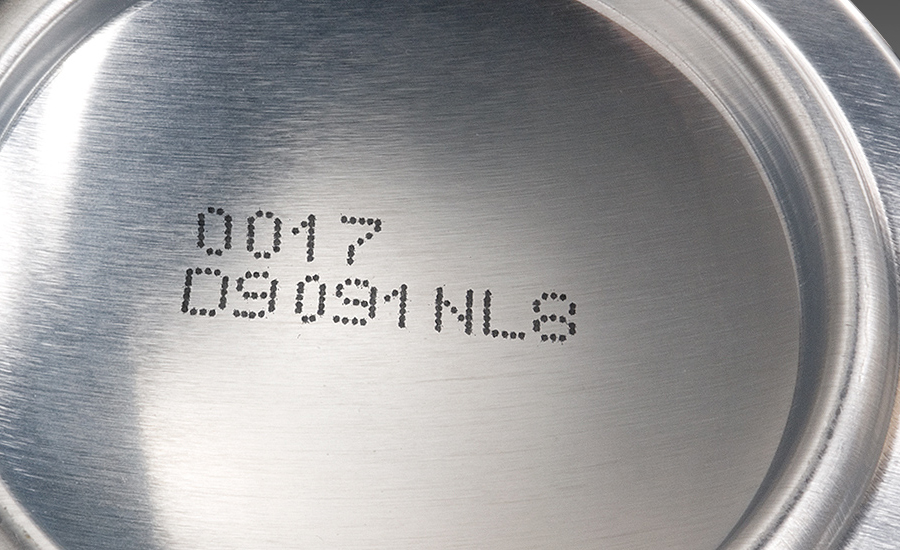
“Due to its precision and compatibility, laser marking is frequently chosen for producing codes on rPET and plant-based bottles,” he explains. “Lasers’ specific wavelengths are selected based on the nature of the packaging material, its shape and the production requirements. They create clear and permanent marks without affecting the package integrity or the product inside.”
Owen says that continuous inkjet (CIJ) printing is another method used for rPET and plant-based packaging materials. CIJ inks are formulated to adhere well to such substrates and are available in MEK-free, low odor and low-toxicity formulas, he adds, which comply with certain food and beverage packaging standards.
“As the growth of aluminum cans continues, manufacturers continue to adjust their coding and marking operations,” Owen states. “Ideal for high-speed beverage lines, CIJ printers and laser marking systems apply legible codes to aluminum surfaces at fast production speeds and on curved areas like the bottom of cans.”
Both methods are widely used in the aluminum packaging industry due to their efficiency and precision, he adds.
“At Videojet, our in-depth analysis of beverage packaging trends inspires continuous innovation,” Owen says. “For example, the Videojet 3350 CO2 laser’s Smart Focus technology uses auto-adjustable focal distances and a pilot beam focus finder to mark on different bottle sizes and shapes with minimal operator intervention.”
LEIBINGER’s Barberio says that filling companies must be able to rely on their marking systems.
“Any errors in this area can result in significant time and material losses, as well as increased waste,” she notes. “This is confirmed by our customer Gary Fogg from the Four Peaks Brewery in Arizona, [who] states, ‘At the end of the day, our job is to brew great beer and get it out there to thirsty customers. And coding should be such a simple task. If it’s legible and repeatable and we don’t have downtime, that’s all we need. And that’s what we’ve had for years now with LEIBINGER.’”
Barberio adds that the reliability and consistently high quality marking have always been and remain crucial factors in the beverage industry, as well as the ability to quickly integrate and connect marking systems into manufacturing processes.
“Easy-to-install and user-friendly printers, following the ‘Plug & Print’ approach, like the LEIBINGER printers do, are highly valued by our customers,” she says. “These features simplify their daily production processes, making operations smoother and more efficient.”
Moving toward automation
Automation and speed of operation also are affecting coding and printing equipment, experts note.
“Most coding and printing equipment is designed for versatile integration, easily fitting into automated production lines and capable of operating in high-condensation environments,” Videojet’s Owen explains. “Both CIJ and laser technologies deliver high and ultra-high-speed solutions that can keep pace with production line speeds.”
LEIBINGER’s Barberio simply says that speed is crucial.
“Coding machines must reliably keep pace to support productivity,” she expresses. “The printing must be fast, produce easily readable results, adhere maximally and comply with all legal requirements — this is a must.”
For the extreme speeds in beverage production, LEIBINGER offers specially designed Rapid Printers that can maintain speeds as fast as 1,000 meters a minute and ensure maximum adhesion even in very wet production environments.
“We continuously tailor the printer technology and ink (super-fast-drying and highly adhesive) to each customer’s needs,” Barberio explains. “Since we manufacture and develop our inks, we can guarantee the high reliability and quality of the prints. The perfect alignment between technology and consumables is one of the key factors ensuring exceptional performance.”
She says that the same applies to automation.
“Printers must support processes with minimal effort required from operators,” Barberio notes. “The interfaces of the printers must also be compatible with modern automated production environment and settings.”
At LEIBINGER, she says that the Rapid Printer models offer USB, Ethernet, I/O signals (9/8) and serial interface RS232. The new printer IQJET further includes OPC UA protocol, Barberio adds, and Cloud connection via LAN or LTE.
“Marking experts must keep pace with future developments in both areas: speed and automation,” she says.
Upping the demand
Lasers are growing in demand in the beverage market, Videojet’s Owen says, because they are essentially a hands-off process for entire production runs. He adds that, in an age of higher operator turnover, this means less worry about training or mistakes.
“Lasers’ use is also increasing because they meet a wide range of packaging challenges,” Owen explains. “In addition to aluminum, lasers can mark a variety of beverage packaging materials, including lightweight plastics, mono-materials, cartons and pouches.”
He notes that it is essential to conduct application testing with a qualified coding and marking partner to ensure optimal results.
The benefits that laser coders offer include reduced downtime, no need for consumables aside from a filter — which benefits both costs and the environment — code permanence, even in high-condensation environments, Owen lists, as well as lower preventive maintenance and associated costs compared to ink-based partners.
“They can product distinctive marks, including color changes from chemical reactions or surface ablations, varying with the packaging material and laser intensity,” Owen adds.
He also gives insight regarding demand for inkjet coders in the beverage market.
“With a growing selection of inks featuring special properties and printers that meet elevated line speeds without compromising print quality, CIJ demand continues to grow,” he says.
LEIBINGER’s Barberio notes that there are a host of good reasons to use inkjet coders, which she says is the most used around the world.
“It is relatively inexpensive, suitable for universal use,” she notes. “It is flexible and can deliver the high printing speeds required on filling systems. CIJ printers are suitable for almost all surfaces, shapes and materials. Coding is contactless.”
Barberio explains that integration is simple, operation is safe for people and the environment and that no protective devices are necessary.
“The inks are extremely fast-drying and are suitable for almost all production environments and applications,” she says. “Furthermore, CIJ inks provide strong adhesion, while also allowing for easy removal during the recycling phase. The importance of recycling, especially in today’s context, and the advantages it brings to businesses are unquestionable.”
Barberio also considers CIJ printers to be flexible.
“Their flexibility is particularly notable as they can print on glass bottles, plastic bottles and cans,” she says. “… For small- and medium-sized filling companies … The flexibility of CIJ printers is also advantageous because the print can be easily and quickly moved from one line to another. … Also, in terms of changes in packaging design — whether it’s the bottle material or the design itself — the CIJ printer is very easy to adapt and does not generate additional costs for complex adjustments.”
Valuing sustainability
To meet sustainability needs, Videojet’s Owens shares that the company’s inkjet inks are continuously developed with key properties, such as low-toxicity and low volatile organic compounds (VOCs), to help beverage-makers comply with regulations and meet sustainability objectives.
“Inks are also designed to provide excellent adhesion on recyclable and reusable substrates, including mono-materials, recycled plastics and returnable bottles,” he says. “Both printer and ink innovations allow these MEK-free ad lower VOC inks to run more efficiently in the printer, reducing waste and helping users to achieve their short and long-term sustainability goals.”
LEIBINGER’s Barberio says that, as marking experts, the company continually develops and optimizes its printers, placing an increasing emphasis on sustainability. An example of this is its IQJET.
“This new printer uses substantially less ink, solvent and power than conventional CIJ technologies,” she explains. “The scale of improvement can be illustrated effectively by taking a look at its use of solvent. During breaks in printing, the IQJET consumes no solvent at all and it is the automatic nozzle sealing system which makes this possible … Solvents vaporized during the printing process are recovered and returned to the system.”
She notes that this results in lower emissions and a reduction of up to half in solvent consumption. Another sustainable aspect in all LEIBINGER printers is the company’s commitment to the longevity of its products.
“We do not replace entire core modules,” Barberio says. “We strive to keep the maintenance of our devices minimal, and when maintenance is necessary, we only replace the necessary wear parts, not complete modules. … Our approach significantly reduces not only follow-up costs for our customers, but also conserves resources and prevents unnecessary waste.”
LEIBINGER’s ink system is designed to ensure that every last drop is used, she adds.
Looking ahead
With all the buzz around artificial intelligence (AI), there is a possibility it will play a role in coding and printing equipment.
LEIBINGER’s Barberio expresses that AI, in all areas of life, will bring significant changes to production processes.
“It’s difficult to specify the exact impacts solely for the beverage market, but areas such as quality control, supply chain optimization and marketing will certainly be affected,” she shares. “I am sure that predicting trends, optimizing processes and improving traceability will all become more efficient with AI.”
Barberio also suggests that the coding and marking sector will benefit from such advancements with AI.
“For us, it clearly means staying up-to-date, recognizing and leveraging new opportunities promptly, and supporting our customers in their processes reliably and efficiently,” she says.
Videojet’s Owen says that the biggest opportunity he sees is within production monitoring.
“Some beverage manufacturers and bottlers might not realize how data-rich product coding/serialization is,” he explains. “When coding equipment is highly integrated into a production environment with the appropriate product sensors, encoders and vision inspection, all those data points can map out the very heartbeat of production. AI can turn a cacophony of data into a symphony of predictive monitoring.”
By learning the unique trends of production, Owen suggests that AI can pinpoint when would be the ideal time for preventive maintenances or when production speeds have changed. He says AI also can help operators determine the causes of slowdowns.
“Scaled across a large organization with multiple facilities, it can be a powerful tool for optimization,” Owen concludes.
Looking for a reprint of this article?
From high-res PDFs to custom plaques, order your copy today!