Beverage Industry logo
search
cart
facebook twitter linkedin youtube
  • Sign In
  • Create Account
  • Sign Out
  • My Account
Beverage Industry logo
  • NEWS
    • R&D News
    • Supplier News
  • PRODUCTS
    • New Products
    • Reader's Choice Poll
  • CATEGORIES
    • Alternative Drinks
    • Beer
    • Bottled Water
    • Cannabis Beverages
    • Carbonated Soft Drinks
    • Energy Drinks & Shots
    • Juice & Juice Drinks
    • Plant-Based Beverages
    • Sports Drinks
    • Tea and Coffee
    • Wine & Spirits
  • R&D
    • Beverage R&D Features
    • Ingredient Spotlight
  • PACKAGING
    • New Packages
    • Packaging Equipment
    • Packaging Material
  • OPERATIONS
    • Distribution
    • Plant Focus
  • TOP LISTS
    • Beer Market Report
    • Executive of the Year
    • State of the Beverage Industry
    • Top 100 Beverage Companies
    • Truck Report
    • Wholesaler of the Year
  • MEDIA
    • eBooks
    • Podcast
    • Polls
    • Videos
    • Webinars
  • DIRECTORIES
    • Annual Manual
    • Contract Packaging Guide
    • Take a Tour
  • MORE
    • Classifieds
    • Channel Strategies
    • Newsletters
    • Events
      • Membrane Technology Forum
    • Interactive Product Spotlights
    • Market Insights
    • Sponsor Insights
    • Store
    • White Papers
  • EMAG
    • eMagazine
    • Archived Issues
    • Advertise
  • SIGN UP!
Distribution

The 2013 State of the Beverage Fleet Industry

Results reflect shift to end-load trailers

By Tom Kelley
February 14, 2014

Beverage Industry recently surveyed a sample of its readers to gain insight into the size and makeup of current delivery fleets, future vehicle purchase plans, as well as operational concerns and strategies. Among the key findings were a smaller than usual average fleet size, a more hands-on group of executives, an extension of replacement cycles, and in some cases, a mismatch between concerns and strategies.

Long-term shifts in vehicle types and config-urations held consistently, while the split between some types was uniquely reflective of our readers’ operations.

Vehicular variables

The split between light-duty vehicles (passenger cars, SUVs, pickups and vans) and medium- and heavy-duty vehicles showcases respondents’ entrepreneurial operations. Among survey-takers, nearly as many light-duty vehicles are in use as medium- and  heavy-duty vehicles. Future purchase plans also reflect this near-even split between light-duty and medium- and heavy-duty vehicles.

The continuing industry shift from side-load to end-load equipment and from straight-trucks to tractor-trailers also is reflected in survey responses. Although individual side-load vehicle types slightly outnumber individual end-load types in current fleets, the overall split between side-load and end-load favors the end-load equipment. For future purchases, the split widens tremendously, with an overwhelming preference in favor of end-load equipment. Similarly, tractor-trailer configurations in current fleets and future purchase plans outnumber the straight-trucks.

For future purchase plans, roughly two-thirds of planned purchases represent replacement of existing vehicles, with the balance reflecting expansion of current fleets, according to survey respondents. These reported replacements were based on a two-year period, which translates to a replacement cycle of roughly 12 years. This is quite a bit longer than the long-term industry average of seven to 10 years, based on interviews that I have compiled in the approximately 20 years of reporting on fleet operations.

When it comes to ownership versus leasing, slightly more than two-thirds of companies own their vehicles. Twelve percent use full-service leases, and 5 percent use finance-only leases, according to survey results.

Maintenance and downtime

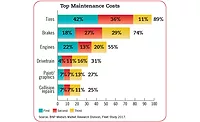
Tires and brakes rank as the Top 2 maintenance costs for the majority of respondents. Engine maintenance follows closely behind in third place, which could be because of longer replacement cycles that many fleets have employed in reaction to the economic conditions experienced during the last five years.

Engine and drivetrain failures rank as the Top 2 causes of downtime and unplanned repairs, which likely is another symptom of longer replacement cycles, while collision repairs rank third on the downtime scale. This potentially points to the smaller fleets being less able to compete for the most experienced drivers.

Operational concerns

In spite of relatively stable fuel prices during the last 12 months, fuel price volatility ranks as the top operational concern of respondents by a large margin with
66 percent citing it as a top concern. This is especially curious given that, among the available fuel cost reduction strategies, those that address price volatility rank comparatively low on the scale, according to the survey. Insurance and vehicle lifecycle costs follow in second and third place for operational concerns. This heightened cost sensitivity points to the smaller company size of many of the survey’s respondents.

Fuel cost strategies

By a four-to-one margin compared with the next highest option, route optimization is the most popular fuel cost reduction strategy among respondents. Although replacing older trucks — a distant second-place fuel-saving option — is far more costly than route optimization, driver training and coaching — the third-place option — is not a costly choice. Considering that a driver can impact fuel economy by as much as 30 percent, employing driver training and coaching deserves much more consideration as a fuel-saving strategy.


Beverage Industry’s Fleet Study was conducted by BNP Media’s Market Research Division. The online survey was conducted between Nov. 7 and 21, 2013, and included a systematic random sample of the domestic circulation of Beverage Industry.Geographically, respondents were well-distributed across the United States, with a slightly stronger showing in the Northeast and Southern regions. Half of the respondents were distributors or wholesalers, and roughly one-third indicated they were producers or bottlers, with the remainder composed of retailers and other industry participants.

When it comes to operation size, more than half of the respondents reported sales of less than $5 million, and more than three-quarters had sales less than $15 million. The average fleet size among the respon-dents is just fewer than 25 vehicles. Many respondents said they are either extremely involved or very involved in logistics; however, many identified themselves as senior corporate executives rather than dedicated fleet managers. More than 60 percent of those completing the survey had 10 or more years of industry experience. Nearly 90 percent of those providing survey responses have authority to specify, recommend or approve purchases of fleet products and services. 

KEYWORDS: beverage fleet beverage fleet survey Tires trucks

Share This Story

Looking for a reprint of this article?
From high-res PDFs to custom plaques, order your copy today!

Recommended Content

JOIN TODAY
to unlock your recommendations.

Already have an account? Sign In

  • top 100 beverage companies

    Top 100 Beverage Companies of 2024

    For the global beverage market, mergers and acquisitions...
    Sports Drinks
  • Chocolate, Strawberry, Vanilla shakes

    Classic flavors provide reliable, consistent results for beverage-makers

    Classic flavors of chocolate, vanilla and strawberry...
    Ingredient Spotlight
    By: Chloe Alverson
  • Free Spirits Instant Bar Bundle

    Lifestyle trends drive growth for non-alcohol category

    As lifestyle trends continue to drive growth for the...
    Wine & Spirits
    By: Lauren Sabetta
Manage My Account
  • Newsletters
  • Online Registration
  • Subscription Customer Service
  • eMagazine Subscription
  • Manage My Preferences

More Videos

Sponsored Content

Sponsored Content is a special paid section where industry companies provide high quality, objective, non-commercial content around topics of interest to the Beverage Industry audience. All Sponsored Content is supplied by the advertising company and any opinions expressed in this article are those of the author and not necessarily reflect the views of Beverage Industry or its parent company, BNP Media. Interested in participating in our Sponsored Content section? Contact your local rep!

close
  • Woman in Coat
    Sponsored byApplied Food Sciences

    Opportunity for Hormone Support in Functional Beverages

Popular Stories

Pepsi Prebiotic Cola

Pepsi offers limited online release of Prebiotic Cola

Airheads Soda

AIRHEADS enter beverage market

Buffalo Trace Distillery

Buffalo Trace Distillery pays homage to its region’s heritage and history

making connections webinar

Events

April 16, 2025

2025 State of the Industry Series: Alcoholic Beverages

On Demand In Beverage Industry’s annual State of the Industry: The Alcohol Beverage Market, analysts at S&D Insights LLC delve into these trends and how they’re shaping the industry.

View All Submit An Event

Poll

Retail Coffee Segment

What retail coffee segments will fare well into the next year?
View Results Poll Archive

Products

Milk and Dairy Foods Nutrition, Processing and Healthy Aging

Milk and Dairy Foods Nutrition, Processing and Healthy Aging

See More Products

Related Articles

  • Owned/leased vehicles chart

    The 2016 State of the Beverage Fleet Industry

    See More
  • The 2015 State of the Beverage Fleet Industry

    See More
  • Top Maintenance Costs Chart Fleet Study 2017

    The 2017 State of the Beverage Fleet Industry

    See More

Related Directories

  • DMW&H

    DMW&H stands out as a premier provider of integrated material handling and automation solutions with a heritage dating back to 1964. Specializing in the design, implementation, and support of sophisticated warehouse and distribution systems across diverse industries, DMW&H has cultivated particular expertise in serving the Wine and Spirits sector for over 30 years. Their solutions encompass conveyor systems, sortation technologies, robotic automation, and comprehensive indaGO Warehouse Execution Systems (WES), all aimed at enhancing efficiency, productivity, and accuracy in logistics and distribution operations.
  • ORTEC

    For more than 40 years ORTEC has supported beverage manufacturers and distributors worldwide. Our Beverage Suite of Loading and Routing solutions allow our customers to continuously improve their business results by enabling them to predict, prepare, plan, execute, monitor, and improve their operation.
  • Magline Inc.

    Magline, Inc. is the world’s leading manufacturer of Magliner route distribution solutions and much more. We are a committed partner in helping to grow your business. By listening to your challenges first, our team can work with you to develop the right solutions that fit your unique distribution needs.
×

Elevate your expertise in the beverage marketplace with unparalleled insights and connections.

Join thousands of beverage professionals today. Shouldn’t you know what they know?

JOIN NOW!
  • RESOURCES
    • Advertise
    • Contact Us
    • Directories
    • Store
    • Want More
  • SIGN UP TODAY
    • Create Account
    • eMagazine
    • Newsletters
    • Customer Service
    • Manage Preferences
  • SERVICES
    • Marketing Services
    • Reprints
    • Market Research
    • List Rental
    • Survey/Respondent Access
  • STAY CONNECTED
    • LinkedIn
    • Facebook
    • YouTube
    • X (Twitter)
  • PRIVACY
    • PRIVACY POLICY
    • TERMS & CONDITIONS
    • DO NOT SELL MY PERSONAL INFORMATION
    • PRIVACY REQUEST
    • ACCESSIBILITY

Copyright ©2025. All Rights Reserved BNP Media.

Design, CMS, Hosting & Web Development :: ePublishing