Combining technologies
Voice-picking adapts to warehouse automation
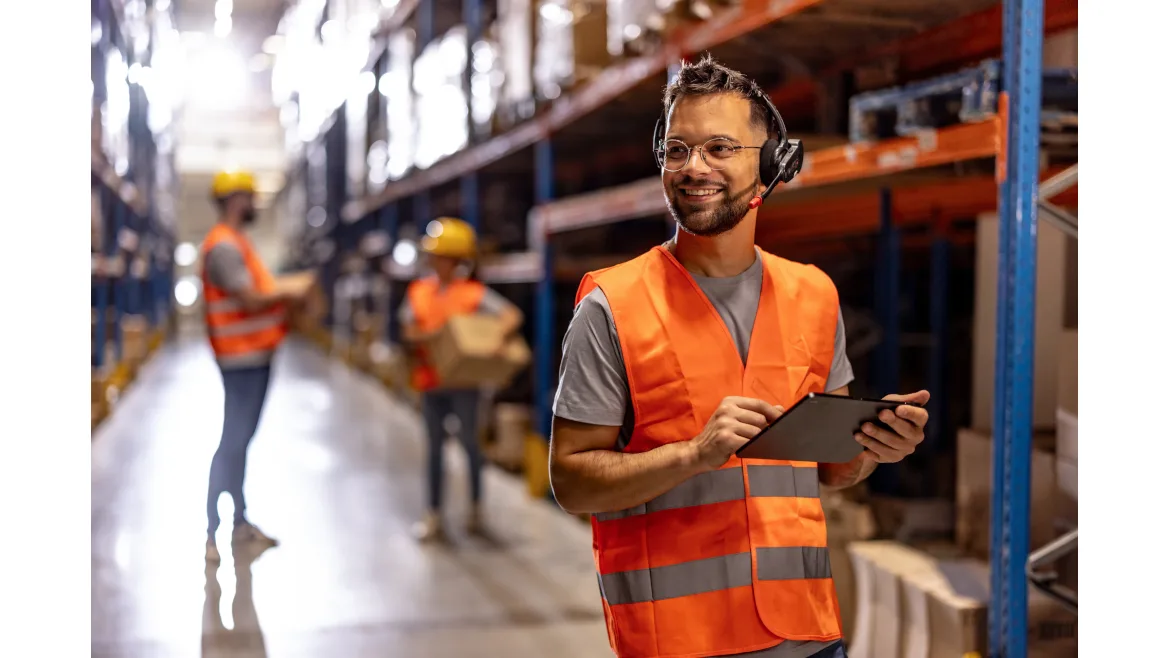
Interest in voice-picking is growing as beverage operations seek ways to improve productivity while addressing labor challenges and the physical demands of warehouse work.
Alyssa Keeney, solution consultant at Dematic, Atlanta, explains that interest in this technology is strong as voice-picking addresses several challenges beverage distributors are facing.
“Operations are managing more SKUs, greater order complexity, and continued pressure to improve productivity with the labor they have available,” Keeney says. “Voice provides a way to make manual picking more efficient while maintaining the flexibility.
“There is also growing interest in the visibility that comes with a software-directed picking process,” she continues. “Beyond simply telling an operator where to go and what to pick, voice-directed systems can give better insight into picking activity and inventory movement. That combination of productivity, flexibility and visibility continues to make voice relevant as beverage warehouses adopt higher levels of automation.”
Alongside increased SKUs, Keeney points to labor availability, space constraints, and increasingly complex order profiles as all influencing beverage warehouses.
“Distributors are being asked to manage more products and changing volumes without necessarily having more space or labor available,” she explains. “Those pressures are pushing beverage distributors to look for solutions that improve the productivity of their existing workforce while giving them room to scale.
“Rather than viewing manual and automated picking as an either/or decision, we’re increasingly seeing the value of combining technologies based on the needs of a particular operation,” Keeney continues. “Voice can play an important role within that broader automation strategy.”
Tatiana Munoz, director of business development at Hardis Supply Chain, New York, notes that beverage warehouses are being influenced by many of the same trends affecting logistics more broadly — labor shortages, increasing order volumes, pressure for faster fulfillment, and the need to control operating costs.
“There is also growing pressure to make better use of warehouse space and improve working conditions for employees,” Munoz says. “The physical characteristics of beverage products add another consideration. Cases, containers and pallets can be heavy, and repetitive lifting and movement can place significant demands on operators.
“Technologies that reduce unnecessary travel and make picking more efficient can therefore contribute to both productivity and operator comfort,” she continues. “At the same time, automation is becoming more prevalent in warehouses. The important consideration is not simply whether to automate, but which processes should be automated and to what degree. Voice-picking can be an effective solution for operations where full robotic automation may not be practical or economically justified.”
Munoz adds that voice-picking systems have evolved beyond simply providing spoken instructions.
“Today’s solutions can be more customizable, connected and multimodal, allowing voice to work alongside other warehouse technologies rather than operating as an isolated system,” she explains. “For example, Hardis Supply Chain’s solution is compatible with Android devices and market-leading Bluetooth headsets. It can be customized to accommodate specific warehouse procedures and updated as those processes change. Multilingual functionality also makes the technology more accessible to diverse workforces.”
Moreover, integration with the WMS is particularly important, Munoz says.
“The WMS serves as the central system coordinating inventory, orders, storage locations and picking activities,” she explains. “By connecting voice picking to the WMS, operators can receive real-time instructions based on current orders and inventory information. This helps ensure that the technology supports the broader warehouse workflow rather than simply automating one task.”
Dematic’s Keeney notes that voice technology has become more sophisticated in both the operator experience and the software behind it.
“Improvements in speech recognition, noise management and device usability have made voice systems easier to deploy across diverse workforces and challenging warehouse environments,” she says.
“The bigger evolution, however, is how voice fits into the connected warehouse,” Keeney continues. “Today’s picking processes can be integrated with WMS so that voice is one component of a broader, software-directed workflow. That allows operations to synchronize picking with replenishment, inventory and other fulfillment activities while gaining real-time visibility into performance.”
Looking for a reprint of this article?
From high-res PDFs to custom plaques, order your copy today!