Beverage operations prioritize long-lasting facility builds
Sustainability, automation among factors considered in new facilities
In the song “First Date,” Blink-182 sings about wanting to make a budding relationship last forever as they sing in the chorus, “Let’s make this last forever / Forever and ever.”
Although not romantic prose, beverage operations are looking to make their facilities last longer, especially due to rising costs and shifting beverage trends.
J.D. Boone, vice president of A M King, Charlotte, N.C., notes the biggest drivers of new beverage facility builds are growth, product diversification and supply chain control.
“Beverage companies are expanding SKUs faster than ever, whether that’s functional drinks, private label or regional variations — and many existing facilities simply weren’t designed for that level of flexibility,” Boone says. “There’s also a strong push toward reshoring and regionalization. Companies want to be closer to their end markets to reduce freight costs and improve responsiveness.”
When combined with aging infrastructure across the industry, he explains that it often becomes more practical to build new rather than continue retrofitting facilities that weren’t designed for today’s production demands.
“At a certain point, you’re not upgrading the operation, you’re working around the building,” Boone states. “That’s usually when a new facility starts to make more sense.”
Patrick Holleran, senior principal at HDA Architects, St. Louis, echoes similar sentiments. He points to SKU proliferation and portfolio diversification as influences, as wholesalers experience rising SKU counts.
“This drives the need for larger pick areas, deeper storage and more flexible racking and automation,” Holleran says.
The age of facilities is another factor.
“Many beverage warehouses were built between 1980-2005,” he notes. “They lack clear heights, dock counts and systems needed for modern operations.”
Labor shortages, market growth and territory consolidation are other influences Holleran lists.
Ari Opsahl, CEO of Tivoli Brewing Co. and Outlaw Light, La Junta, Colo., shares his thoughts on the topic.
“Access to a strong labor talent pool is critical, particularly as beverage operations become more technical and automated,” he says. “Water availability, water quality and wastewater treatment capabilities also play a major role, especially in regions where water resources are limited or highly regulated.”
Inbound and outbound logistics are another major consideration, Opsahl notes.
“A facility needs to be positioned to efficiently receive raw materials, packaging and ingredients, while also supporting cost-effective distribution to key markets,” he explains. “Finally, companies must evaluate geographic demand trends and forecast where future volume growth is likely to occur. Building in the right location can help reduce freight costs, improve service levels and support long-term scalability.”
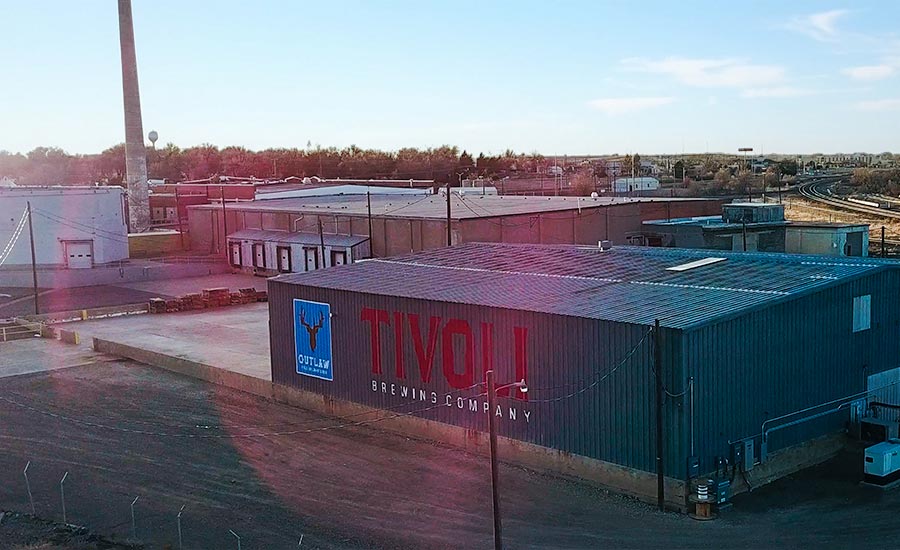
Image courtesy of Tivoli Brewing Co./Outlaw Light
A M King’s Boone explains that a number of factors go into deciding whether to execute a new build versus an expansion.
“It usually comes down to three things: site constraints, operational disruption and long-term scalability,” he states. “If an existing site limits flow, whether that’s truck circulation, raw material storage or production line expansion, you can quickly reach a point where adding on creates more inefficiencies than it solves.”
At the same time, Boone says that many beverage operations run 24/7, so expanding in place can introduce significant disruption risk.
“We often walk clients through a side-by-side analysis: what it costs to expand versus what it costs to build new, but more importantly, how each option impacts operations over the next 10-20 years,” he notes. “We spend a lot of time helping clients understand the cost of disruption, not just the cost of construction. In many cases, a new build offers better lifecycle value, even if the upfront cost is higher.”
Outlaw’s Opsahl shares that expansions are often more efficient, faster to execute and less costly if the existing brewery or production site has the available space, utilities and infrastructure to support growth.
“However, a new build can offer greater long-term flexibility and efficiency, especially when logistics, freight costs and geographic demand are considered,” he says. “A new facility allows a company to design around current and future operational needs rather than adapting to existing constraints.”
Ultimately, Opsahl notes that the decision comes down to capacity requirements, capital cost, speed to market, infrastructure limitations and long-term business strategy.
“The best choice is the one that supports both current production needs and future growth,” he adds.
HDA’s Holleran further details the factors that beverage operations should take into account:
- Site constraints: When a current site lacks acreage for building expansion, a new build is the only viable option.
- Operational disruption: Because expansions can disrupt picking, receiving and routing operations, high-volume wholesalers will opt for new builds to avoid service interruptions.
- Future growth: When 10-year growth projections exceed the site’s capacity, new builds are favorable.
- Infrastructure limitations: Older buildings often lack 32-36-foot clear heights, sufficient power for automation, dock capacity and costs for structural upgrades related to automation and racking.
Holleran explains that costs will continue to come into play, noting that historically an expansion will be approximately 20-35% less per square foot compared with new builds. However, when balancing the needs of today’s facilities, wholesalers are seeing the benefits of new builds.
For example, Clark Beverage Group/Distributing Co. determined that the ever-changing industry prompted their need to either expand or build new facilities, Holleran notes. After analysis, he says that the need was to replace an older building with inadequacies and inefficiencies.
“A thoughtfully designed new facility will meet current and future needs for years to come with the ability to expand,” he states. “The office and support areas are designed with flexibility and multiple uses to meet the changing demands. The warehouse will include a minimum of 34-foot clear, allowing for the installation of automation to autonomously store, pick, replenish and build orders.”
Additionally, the replacement facility will feature added floor and rack storage, completing the warehouse operations. Thirty-six dock position will allow for efficient loading and unloading. In addition to increased productivity, Holleran shares that this project is accelerating depreciation through cost segregation and is eligible to participate in the One, Big, Beautiful Bill Act.
Recurrent requests
When planning facility builds, beverage operations are requesting certain items for their facilities, experts note.
A M King’s Boone says that flexibility is at the top of the list.
“Operations want facilities that can adapt quickly to new products, packaging formats and production volumes without major work,” he shares.
“Operational flexibility, efficient changeovers, strong quality controls and scalable infrastructure are all essential features in a modern beverage facility.”
– Ari Opsahl, CEO at Tivoli Brewing Co. and Outlaw Light Beer
Boone has observed increased demand for the following:
- High-efficiency material flow.
- Expanded cold and dry storage integration.
- Improved employee environments.
- Infrastructure that supports automation.
“Flexibility today is less about extra space and more about how the facility is set up to change,” he says. “Ultimately, clients are asking for facilities that don’t just meet today’s needs but can evolve with the business.”
HDA’s Holleran further details top requests:
- Clear-height warehouses ranging from 32 to 40 feet to accommodate racking and automation.
- Increase of dock doors to support additional routes increase, as well as more positions to support efficiency.
- Large pick areas with optimized travel paths.
- A fleet-focused site design to accommodate trailer parking, fuel islands as well as electric vehicle (EV)-ready infrastructure.
- Automation-ready floors.
Outlaw’s Opsahl says that, for the company’s operation, flexibility is one of the highest priorities. Beverage facilities need to be designed to handle multiple products, packaging formats and production runs without creating downtime or complexity, he notes.
“On the packaging side, that means having a canned line and supporting systems that can efficiently manage different SKUs, pack sizes and product types,” Opsahl shares. “As consumer preferences continue to evolve, facilities need to be able to respond quickly to changing demand. Operational flexibility, efficient changeovers, strong quality controls and scalable infrastructure are all essential features in a modern beverage facility.”
The rise of automation and artificial intelligence (AI) has affected warehouse builds and expansions as well. Opsahl considers automation to be having a “significant impact” on beverage warehouse builds.
“Facilities are increasingly being built with improved material flow, better inventory visibility and more efficient movement of finished goods in mind,” he says. “Automated palletizing, conveyor systems, warehouse management systems and advanced scanning technologies can all help reduce labor constraints, improve accuracy and increase throughput.”
AI and data-driven tools also are beginning to influence planning and operations, Opsahl notes.
“These technologies can help forecast demand, optimize inventory, improve scheduling and identify bottlenecks before they become larger issues,” he explains. “As a result, warehouse design needs to account not only for physical storage capacity, but also for digital infrastructure, data collection and future automation opportunities.”
A M King’s Boone expresses that automation no longer is a future consideration but is now a baseline expectation in warehouse builds.
“Even if a client is implementing full automation on day one, they want facilities designed to support it when the time is right,” he says. “Automation influences everything from clear heights and column spacing to slab design, power distribution and data infrastructure. We’re also seeing more interest in robotics, automated storage and retrieval systems (ASRS), and smarter inventory management tools.”
Even if automation isn’t installed on day one, the building must be ready for it, or clients are paying for it twice, Boone adds.
“AI is starting to play more of a role on the operational side — forecasting demand, optimizing inventory and improving throughput, but it still drives physical design decisions,” he says. “Facilities need to support higher data volumes, tighter process control and more integrated systems than ever before.”
Sustainable mindset
The experts share how sustainability-focused aspects are impacting beverage facility designs.
“Sustainability is becoming less about checklists and more about operational efficiency,” Boone notes. “Clients are focused on reducing energy and water consumption because it directly impacts their bottom line.”
He has observed an increased use of high-efficiency HVAC and refrigeration systems, water reuse and treatment strategies, building envelope improvements to reduce energy load and onsite energy generation in some cases.
“The most effective sustainability strategy is usually the one that also improve operations,” Boone says. “There’s also a growing emphasis on designing facilities that last longer and adapt over time, which is one of the most practical forms of sustainability.”
HDA’s Holleran shares the following sustainability-focused features:
- LED lighting with smart controls, motion sensors
- Solar-ready or solar-installed roofs to offset energy use
- High-efficiency HVAC, especially for temperature-controlled storage
- EV charging infrastructure for fleet and employee vehicles
- Low-water landscaping and stormwater management, bioswales, permeable pavement, detention basins
- Insulated wall panels to improve thermal performance and reduce costs
- Waste-stream optimization, cardboard, shrink wrap, pallets and aluminum recycling programs
Outlaw’s Opsahl shares similar factors, noting that water stewardship is a major focus for the company, especially because it is located in La Junta, where water from the Arkansas River is limited and needs to be managed responsibly.
“Beverage facilities are increasingly incorporating closed-loop water systems, onsite wastewater treatment and clean-water versus grey-water reuse strategies to support more sustainable operations,” he says. “Beyond water, energy efficiency is also a major priority. Heat recovery systems, efficient boilers and chillers, CO2 recapture, improved insulation, LED lighting and data-driven monitoring systems can all contribute to reducing a facility’s environmental impact.”
Sustainability in beverage facility design is really about using resources more efficiently while building an operation that can remain resilient for the long term, Opsahl states.
Aside from sustainability, security and digital protections play a role in considering new design builds.
Opsahl notes that these protections are becoming increasingly important.
“Physical security remains essential, including controlled access points, camera systems, secure storage areas and clear separation between public, employee and production spaces,” he says. “At the same time, digital security is now just as critical. Modern beverage facilities rely on connected equipment, automation, warehouse systems, production data and quality-control platforms. That creates a need for strong cybersecurity protections, secure networks, access controls and backup systems.”
A well-designed facility needs to protect not only the physical product and people, but also the operational data and digital systems that keep production running, Opsahl states.
HDA’s Holleran shares similar security factors, both physical and digital. For physical security, he notes controlled access points, fenced yards, secure fleet parking, license plate recognition for inbound and outbound trucks, and camera footage for docks, point-of-sale (POS) rooms and high-value storage.
In terms of digital security, Holleran suggests segmented networks for automation systems, redundant fiber and protected server rooms, cybersecurity compliance for supplier integrations, and AI-based monitoring of inventory anomalies.
A M King’s Boone notes that security now goes beyond physical access; “it’s tightly connected to operations,” he explains.
“From a physical standpoint, we’re designing with controlled access points, clear separation of public and operational zones, and enhanced site visibility,” he says. “On the digital side, the increase is connected equipment and automated systems means cybersecurity has become a real consideration in facility planning.”
As facilities become more connected, the risk isn’t just intrusion, it is interruption, he states.
“Clients are thinking about how to protect production data, prevent disruptions and ensure resilient,” Boone concludes. “That requires coordination between IT, operations and the design-build team earlier in the process than ever before.”
Looking for a reprint of this article?
From high-res PDFs to custom plaques, order your copy today!