Reusable packaging systems offer beverage operations array of benefits
Automation, sustainability affects reusable packaging systems
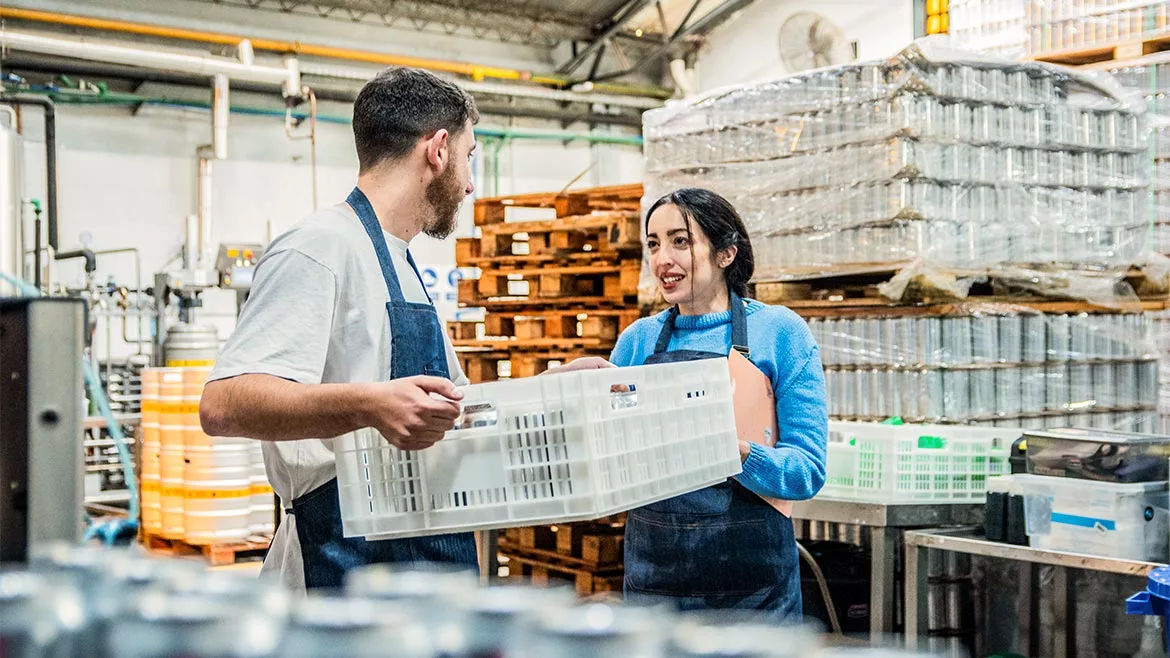
In grade school, many students learn the “Reduce, Reuse, Recycle” song as part of curriculum surrounding Earth Day. In the beverage industry, sustainability and reuse remain important factors, especially in regards to packaging and packaging systems.
Joanna Vanderhoef, product manager for pallets, and Alison Zitzke, market manager for pallets at ORBIS Corp., Oconomowoc, Wis., explain how automation is impacting the reusable packaging systems market.
“Automation is changing the game for reusable packaging systems,” they say. “As a result, it is pushing the companies that have not converted to reusables to adopt reusable solutions such as pallet systems, bulk containers and trays. Automation also gives beverage companies the flexibility to handle more product variations to meet evolving consumer preferences, which can add complexity that is solved with the use of consistent, reusable packaging.”
Vanderhoef and Zitzke also note that the dimensional consistency and tight tolerances found in reusable packaging products make them ideal for automation, which boosts efficiency.
Andrew Resler, vice president of sales for supply chain solutions at Monterey Park, Calif.-based Rehrig Pacific Co., says that beverage companies have continued to invest in warehouse automation and autonomous mobile robots (AMR) or automatically guided vehicles (AGV).
“With these investments, consistency of pallet quality and performance matters, and beverage companies continue to invest in plastic pallets to achieve this level of consistency,” Resler states. “We are also seeing an increase of automated storage and retrieval (ASRS) and high-capacity warehouse. Again, these high-performance systems require a high-performance pallet to operate smoothly.”
Plastic pallets provide beverage manufacturers and integrators with consistent dimensions, weight, flatness and cleanliness that these systems demand, he adds.
The same level of consistency and cleanliness is required by beverage companies for inbound deliveries for materials such as cans, bottles, caps and preforms, Resler notes.
“As beverage companies continue to automate their infeed system, the consistency of packaging/reusable packing will become more critical,” he says. “Beverage companies and their suppliers have already made significant investments in reusable bulk packaging to ensure these systems operate efficiently and do not introduce any contamination into their bottling operations.”
As most companies automate, Resler says some level of work refinement and investing will be needed.
“When manual labor positions are reduced, companies may have to invest in automated depalletizing systems, vision systems and may need to shift where manual work takes place,” he states. “What once took place at the bottling facility, may need to take place at the distribution center or another off-line operation that is possibly managed by a third party. We have seen this type of shift with major retail customers who invest heavily in automation and rely on third-party services to manage their reusable assets, with tremendous results.”
Going green
Reusable packaging systems can help operations address sustainability initiatives.
ORBIS’ Vanderhoef and Zitzke say such systems play “a big role” in the area of sustainability.
“They support the circular economy by traveling hundreds of trips over their lifetime, and when they reach end-of-life, they can be recovered and reprocessed into new products using recycled resin,” they note. “And with more companies asking for packaging made from post-consumer recycled (PCR) content, reusable systems meet that need.”
Rehrig Pacific’s Resler states that the beverage industry has been a “pioneer” in circular plastics economy for decades with the continual reuse of plastic beverage crates, pallets, top frames and bulk bins.
“The beverage industry’s consistent production and distribution systems create an environment where these plastic packages can be filled, shipped emptied and then collected and brought back to start that process over and over again until they reach their end-of-life,” Resler explains. “That can easily be 10-plus years of reuse.”
But it gets better, he adds.
“At the end-of-life, these plastic packages are recycled and made into brand new reusable packages that can start the circularity journey again,” Resler says. “Many beverage companies have sustainability initiatives aimed at reuse and improving the circular plastics economy and simply need to continue to invest and refine what is already in place. Using a tool known as a life cycle analysis (LCA), beverage companies can capture sustainability data from their reusable packaging systems, compare this to one-way packaging data and report on the sustainability savings.”
Reusable packaging presents an opportunity for beverage brands to decrease their use of virgin plastics and increase their use of recycled material, Resler notes. Most reusable plastic packaging allows for a large percentage of recycled material content, which he says can vary based on performance requirements.
“The recycled material can be from packaging that has reached end-of-life, as noted above, or from other post-industrial and post-consumer sources,” he explains. “Beverage companies can capture and quantify the use of recycled materials in their reusable packaging to support their sustainability metrics.”
Through innovation and redesign, Resler says that packaging manufacturers and beverage-makers are able to collaborate on new packages that can further improve sustainability metrics.
“Redesigning a package may allow for weight reduction, where less plastic can be used to produce each reusable package,” he notes. “Innovation may also allow for improved trailer use or cubing, where the beverage company can get more crates, pallets or bins on each trailer. Weight reduction and cubing will directly and positively influence the LCA data of a reusable packaging system, that will also improve the beverage company’s sustainability metrics.”
Shaping the system
Sustainability is just one of many beverage market trends affecting reusable packaging systems, especially with SKU proliferation and varying pack sizes impacting the industry, experts note.
ORBIS’ Vanderhoef and Zitzke weigh in.
“SKU proliferation is pushing packaging suppliers to innovate with new footprints and customize solutions,” they share. “At the same time, beverage companies are marketing products in new ways through co-packing and multichannel selling, which demands more operational flexibility — which can be supported with reusable packaging.”
With asset management becoming critical, Vanderhoef and Zitzke say that reusable packaging management services help companies monitor and optimize their fleets of reusable pallets, divider sheets, top frames, trays and bulk containers to manage costs more effectively.
Rehrig Pacific’s Resler observes that there is no shortage of beverage SKUs on shelves.
“It remains an extremely competitive and innovative space that brings new products online at a rapid pace,” he says. “There are a few trends that we are seeing, or continue to see, related to SKU proliferation and package sizes.”
Resler points to fewer production locations and longer distribution channels for beverages outside of core brands. These factors can make it difficult for reusable packaging to make its way back to the bottling facility with the same consistency and frequency as they do with bigger brands, he notes.
“With that, we tend to see more one-way packaging being used for those brands,” Resler states.
As for nationwide distribution, where one-way packaging often displaces reusable crates, he has observed an increased use of pooled (rented) pallet, wood and plastic. Moreover, Resler says that multipacks have repositioned the use of reusable plastic crates.
“We have seen great success with flavored water companies using reusable plastic packaging for internal use to store full cases of singular flavors that are then introduced to a repacking line that creates multipacks of mixed flavors,” he explains.
He notes that most of these companies have nationwide distribution and resort to one-way packaging for their finished product. Where they cannot use reusables for distribution, Resler says these companies might value using reusable plastic crates for production and work-in-progress (WIP) inventory.
Experts note that innovations are being implemented to protect products and offer accurate traceability.
“Reusable pallets can eliminate damage associated with nails and broken boards, and they are designed with optional features like grommets and frictional elements to prevent slippage, molded-in stretch wrap corners and heavy-duty banding channel on top frames for added stability,” ORBIS’ Vanderhoef and Zitzke share. “On the traceability side, pallets can be equipped with barcodes, RFID tags and GPS monitoring, making it easier to track and manage assets throughout the supply chain.”
Rehrig Pacific’s Resler lists several technologies that can be either added to or coupled with reusable packaging to capture critical data:
- RFID and bar coding
- GPS tracking
- Temperature, humidity and impact tracking
- Vision, artificial intelligence (AI) and machine learning
“As assets move through your system, vision technology can also be used to capture images of the assets,” he explains, regarding his last point. “These images can be used to count moving inventory and to identify non-compliant or damaged packaging that needs to be removed. As you capture data tied to your reusable packing technologies like AI and machine learning can be used to derive trends, strengthen vision platforms, create predictive analytics, automate inventory management and develop AI-driven reporting.”
Looking ahead
As for what’s next for reusable packaging systems, ORBIS’ Vanderhoef and Zitzke consider them to no longer be simple cost-saving measures. These systems are becoming a strategic necessity, they say.
“Automation, sustainability goals, SKU complexity and regulatory pressures are all converging to drive innovation in durability, traceability and design,” Vanderhoef and Zitzke note.
On the horizon, they predict several major regulatory developments will significantly influence reusable packaging systems globally. One expectation is that the Packaging and Packaging Waste Regulation (PPWR) in the European market will spread to other markets and geographies as global companies ship between their own plants and to customers in different countries.
Vanderhoef and Zitzke also note the Food Safety Modernization Act (FSMA) and the Food Traceability Rule.
“Under FSMA 204, the Food Traceability Rule, companies will be required to develop a traceability plan and recordkeeping protocol for items found on the Food Traceability List,” they say. “The ability for a business to efficiently track totes and pallets will support compliance to this rule. Companies that invest now in reusable solutions will not only improve efficiency and reduce waste, but also position themselves to meet evolving customer expectation and global compliance requirements.”
Rehrig Pacific’s Resler anticipates seeing continued automation and warehouse projects taking place. He suspects that technology will become more embedded as a default option for reusable packaging.
“With these highly automated and high-performance systems, we anticipate the need for highly engineered and system-specific packaging,” he notes.
Resler also urges suppliers and retailers to evolve and work more collaboratively to solve the issues of labor challenges at all levels of the supply chain.
“We can expect more automation to extend to the store level and for the way in which products are merchandised to radically change and where packaging will be part of a system solution versus a product solution,” he explains.
Service-related work tied to reusable asset management will see increased demand, Resler notes, due to automation and the reduction or repositioning of employees.
“Sorting, storing, cleaning and validating reusable assets will be required, and companies may turn to third-party service providers for this work,” he concludes. “We have been involved in reusable packaging for 111 years and we are optimistic that it only continues to grow as we see the need for increased automation and supply chain efficiencies.”
Looking for a reprint of this article?
From high-res PDFs to custom plaques, order your copy today!