Beverage operations turn to customized conveyor systems to meet evolving trends
Packaging formats, SKU proliferation, and sustainability prompt equipment innovation
In the 2004 comedy film “13 Going on 30,” Jenna Rink experiences a magical transformation, waking up as a 30-year-old editor at a top fashion magazine. As such, Jenna’s glamorous Manhattan apartment features a high-end automated rotating clothing rack — similar to a dry-cleaner’s conveyor belt — that allows her to browse her vast wardrobe at the push of a button.
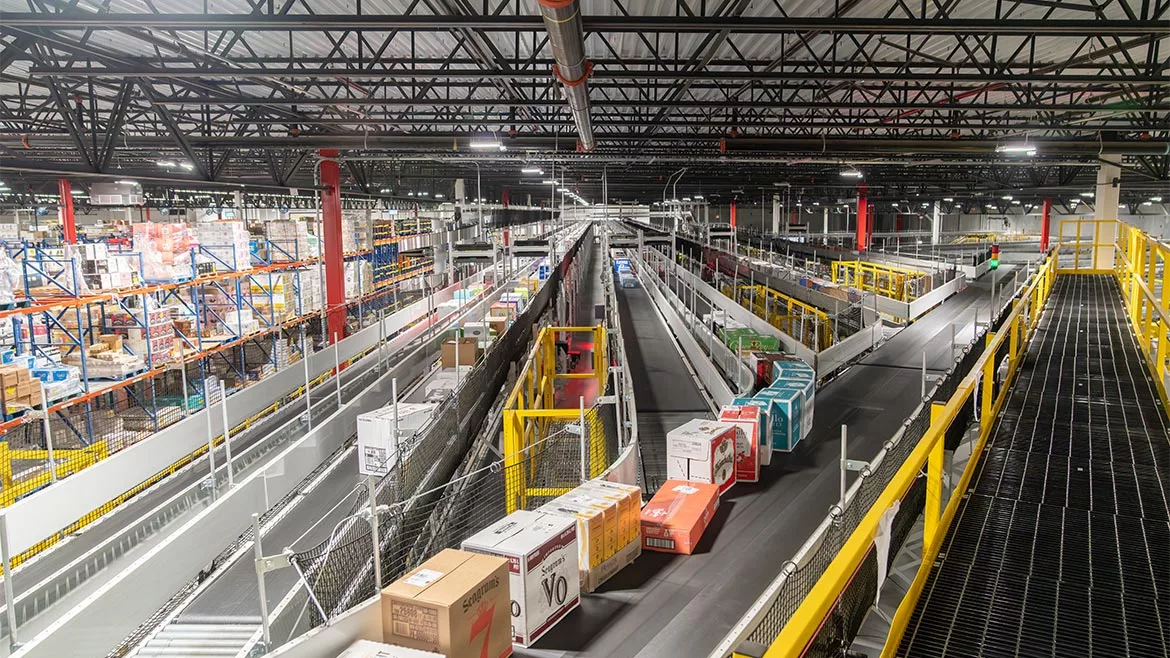
When it comes to the use of conveyor systems in beverage operations — although not quite as glamorous as Jenna’s closet — experts note that these conveyor systems are evolving with beverage producers pushing harder than ever for automation, efficiency, and sustainability.
“We’re seeing a clear shift toward systems that can flex with changing formats, faster line speeds and more frequent changeovers,” says Stacy Bashline, director of product line management Americas at AMMEGA, Atlanta. “In short, customization isn’t optional anymore, it’s the expectation. Modern conveyor solutions are being designed not just to transport product, but to help producers run smarter, cleaner, and more adaptable operations.”
Alyssa Keeney, solution consultant at Atlanta-based Dematic, also notes that the conveyor market is evolving as operations look for solutions that are more integrated and responsive to changing product flow and fulfillment demands.
“When operations require the ability to navigate obstacles, adapt to changing flow requirements, or account for future uncertainty, mixed solutions are becoming more common," she says.
“However, this does not mean we no longer use conveyors; in fact, considering conveyors to be obsolete is a common misconception,” Keeney continues. “They are inflexible once installed, so they should be used for high-volume fixed paths and often are used within flexible automation solutions as well, making the handoff points between the conveyor and AMRs (autonomous mobile robots) a very important handshake.”
Keeney adds that in applications where AMRs are not the right fit and high volume and reliability are required, tighter roller spacings or belted conveyors are selected to combat the decreasing pack sizes.
“Processing more volume out of the same building creates a space constraint, making the investment in spirals more appealing,” she explains.
Max Rocca, sales director at Atlanta-based Swisslog Logistics, says that automated conveyor systems stand at the core of contemporary warehouse automation, providing reliable, consistent, and cost-effective throughput.
“Well-suited for medium to high-volume operations in stable environments, conveyor systems are particularly effective for streamlined operations,” he explains. “Their modular design allows for some customization, and they integrate effectively with warehouse control systems. Through automated conveyors, goods are moved smoothly in both manufacturing and warehousing environments, enabling efficient sorting, packing, and shipping processes.
“This not only increases throughput and minimizes manual intervention, but also ensures careful handling of heavy items and secure product handling throughout the process,” Rocca continues. “The technology continues to evolve, expanding beyond simple product transport and becoming an integrated part of larger automated solutions that can directly impact efficiency, throughput, and profitability.”
Adapting systems
With the proliferation of beverage packaging formats, experts highlight how conveyors systems are adjusting to meet operational needs.
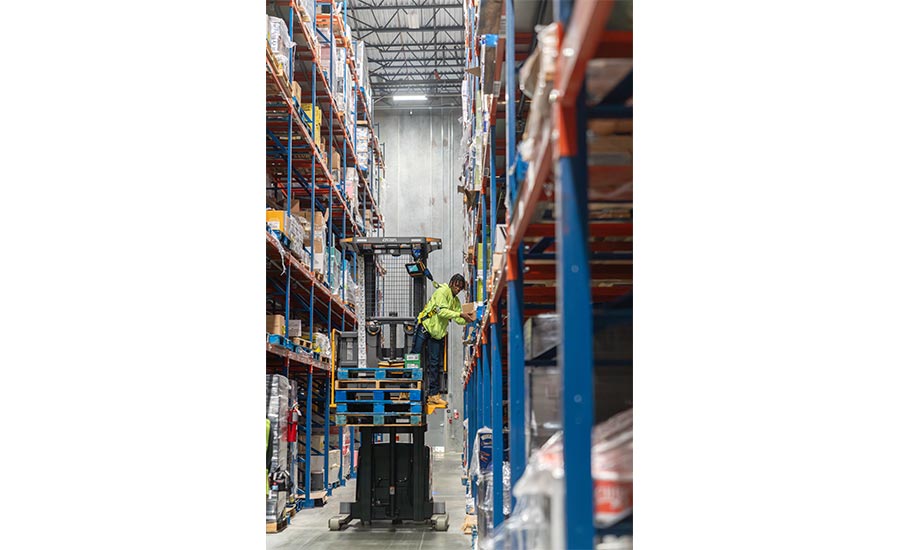
With operations having to adapt quickly, flexibility in conveyors allows beverage manufacturers to pivot as needed, while maximizing existing space, Dematic’s Keeney notes.
Image courtesy of Dematic
“The explosion of new beverage packaging formats, from smaller single-serve sizes to flexible pouches, is reshaping conveyor design in a significant way,” AMMEGA’s Bashline says. “All of it ladders back to shifting consumer behavior. In categories like bottled water, younger consumers are gravitating toward reusable and more sustainable options, which pressures producers to reduce costs and diversify packaging.
“For conveyor suppliers, this means designing systems that can handle lighter, more delicate, and more variable products at higher speeds,” she continues. “We’re seeing increased demand for belting designs that offer greater stability. As line speeds rise, friction must fall, which is why new low-friction materials are becoming essential. Packaging diversity is pushing conveyor technology toward faster, cleaner, and more precise product handling.”
Karli Sage, vice president of supply chain management and technology and engineering at Southern Glazer’s Wine & Spirits, Miramar, Fla., says the increase in packaging variety is one of today’s biggest challenges.
“You’re dealing with mixed formats, smaller packs, and new materials that behave differently on a line,” she says. “That creates more variability in flow and more opportunity for disruption if the system isn’t designed for it. From both an operational and technical standpoint, it’s driving the need for more adaptable conveyor designs and better upstream and downstream coordination.”
Dematic’s Keeney explains that in distribution settings, small pack sizes mean that for the same amount of product, more moves are required for less-than-full pallet picks.
“This means the rate requirement for the system increases, as well as requiring tighter roller spacings or switching over to belted conveyors to handle the smaller case sizes,” she says.
Keeney also notes that flexible pouch products generally are only picked in full-case quantities to maintain optimal density as well as a functional handling unit.
“Because these cases are lighter, they should be stacked on top of heavier cases,” she says. “These pouches are generally stored between 40 and 85 degrees, and first-in, first-out (FIFO) should be followed carefully. When properly utilized, they can achieve slightly faster full-case pick rates with less physical strain and more stability during mixed stacking than with glass products.”
Swisslog’s Rocca notes that beyond the proliferation of packaging formats, there are several additional trends shaping the conveyor market.
“These include shorter production runs that increase the need for flexibility and changeovers, labor availability and volatility that drives the need for automation, food safety expectations that is fueling efforts to minimize manual intervention, and sustainability concerns that are highlighting energy efficiency gains,” he says.
Rocca adds that these trends are reinforcing the need for conveyor systems to evolve from a piece of equipment to an integrated part of robotic and automation solutions, digitally connected and adaptive to the overall lifecycle of the system.
“The explosion of new beverage packaging formats, from smaller single-serve sizes to flexible pouches, is reshaping conveyor design in a significant way. All of it ladders back to shifting consumer behavior.”
– Stacy Bashline, director of product line management Americas at AMMEGA
What’s requested
As various beverage trends continue to impact the conveyor market in tandem, experts highlight some of the most common requests received from beverage operations.
“Competition in the beverage industry is intense, and manufacturers are laser focused on optimizing their production lines,” AMMEGA’s Bashline says. “Lean principles are driving many of the requests we see, from redesigning conveyors to improve speed and cleanliness to reducing water usage and overall operating costs.”
Bashline adds that ESG considerations are also becoming central to conveyor selection.
“Customers are asking for solutions that require less lubrication, use auto lubricating materials, or reduce water consumption,” she says.
Another major priority, Bashline notes, is cleanliness. “We often recommend magnetic tracks for fast-running lines, allowing operators to lift slat top chains for easier cleaning,” she says.
Dematic’s Keeney says that beverage distributors constantly seek advice in the handling of their slow-moving products.
“These products are generally picked one or two cases at a time, which drastically degrades warehouse efficiency,” she explains.
“Customers are also looking for ways to handle products that aren’t consistent sizes,” Keeney continues. “In these situations, conveyors with tighter roller spacing and belted conveyors are used to support varying pack sizes and minimize damage to customer-facing cases.”
Swisslog’s Rocca says modern logistics has become a strategic game of chess, noting every move, every workflow, and every design decision is part of a larger masterplan.
“As a result, many of our customers are looking for assurance that their automation investment delivers value now, stays resilient under change, and can adapt for tomorrow,” he says.
Rocca adds that when it comes to conveyor systems, there are four main things that customers request:
- Consistent, dependable performance under demanding conditions.
- Flexibility to handle varying case sizes, packaging types and SKUs.
- Seamless integration with automation and robotic technologies.
- Scalability that allows systems to grow and change based on volume changes.
Looking toward the future
As the conveyor market continues to evolve, experts note that artificial intelligence could have a great impact on conveyor equipment.
“AI has the potential to shift the industry from reactive maintenance to predictive and preventive strategies,” AMMEGA’s Bashline says. “Instead of waiting for a failure, conveyors will increasingly be able to self-diagnose issues and predict when maintenance is needed.”
Dematic’s Keeney explains that artificial intelligence is starting to utilize supervisory control and data acquisition (SCADA) data to drive preventive maintenance.
“When it comes to conveyor solutions, beverage manufacturers and distributors are seeking high rates and reliability,” she says. “Fortunately, predictive maintenance supports the reliability of a conveyor solution.”
Swisslog’s Rocca says, overall, artificial intelligence is making the warehouse of the future more dynamic, agile and responsive.
“When it comes to conveyor systems, it is increasingly influencing how the equipment is managed, monitored and optimized,” he says.
Rocca also notes that AI is playing an increasing role as conveyor equipment is integrated with other automation technologies to create automation solutions.
“AI-assisted orchestration platforms, capable of controlling all components of an automation solution, as well as manual processes, can synchronize processes and dynamically balance workflows and resources to eliminate bottlenecks and keep materials moving during demand peaks,” he explains.
Further, Rocca notes that these platforms go beyond traditional automation software.
“They enable real-time orchestration of warehouse operations, dynamically responding to demand shifts, labor constraints and inventory fluctuations,” he says. “By reducing complexity and connecting automation, processes and people in one synchronized intelligence layer, they empower businesses to optimize logistics with confidence.”
As for what the future holds for conveyor systems, Rocca notes that technology will continue to evolve to deliver reliability in high-speed environments, adapt to diverse product requirements, integrate seamlessly with advanced automation and robotics, and easily scale to align with business growth and volume changes.
Southern Glazer’s Sage expects the future to be more connected and adaptable.
“From a user’s perspective, conveyors will need to integrate more tightly with new flexible automation, and their control systems must be able to communicate with other providers,” she explains. “Ultimately, this will create a more balanced approach; using conveyors where they make sense and combining them with more flexible solutions in areas with high variability.”
Dematic’s Keeney notes that integration points will be critical in future solutions.
“Flexibility is more important than ever to protect solutions against changing business needs,” she says. “As consumer demands force operations to adapt quickly, flexibility will allow beverage manufacturers to pivot as needed.”
“Maximizing existing space will also be critical moving forward,” Keeney continues. “Spiral conveyors will be increasingly used to decrease the footprint of solutions. Conveyor systems are also expected to have tighter roller spacing or switch to belted conveyors altogether.”
AMMEGA’s Bashline notes the future holds, speed to market, speed to service, and speed on the production line itself.
“But increasing speed brings new challenges, reducing noise, improving sustainability, and maintaining reliability at higher throughputs,” she says.
Additionally, Bashline says the company expects to see belting products become greener, with better recycling pathways.
“Belts will run faster yet quieter. Customer service will need to become even more responsive,” she says. “And AI will push the industry toward greater efficiency, requiring suppliers to develop products that not only meet but lead the next generation of performance standards.
Looking for a reprint of this article?
From high-res PDFs to custom plaques, order your copy today!