Lift truck solutions help beverage operations navigate distribution challenges
SKU proliferation, worker safety prompts innovation
Created to test speed, agility, and endurance, obstacle courses have a series of challenging physical barriers — such as walls, nets, ropes and mud pits — where individuals or teams navigate the terrain, often while timed. In a similar vein, lift truck operators are faced with navigating beverage operations with speed and agility, all while helping distribution run more efficiently.
“Beverage delivery drivers have a very different job than lift truck operators who work in carefully planned and laid out warehouses,” says Kevin McWilliams, director of major accounts at Yale Lift Truck Technologies, Greenville, N.C. “Every day, they navigate rocky, uneven parking lots designed for automotive use and store aisles designed for foot traffic rather than material handling equipment that has to keep beverages stable.”
As such, McWilliams notes that Yale set out to design a new direct-store-delivery (DSD) solution that can handle any environment between truck and store shelf, all while improving efficiency as more SKUs take up more time throughout a shift.
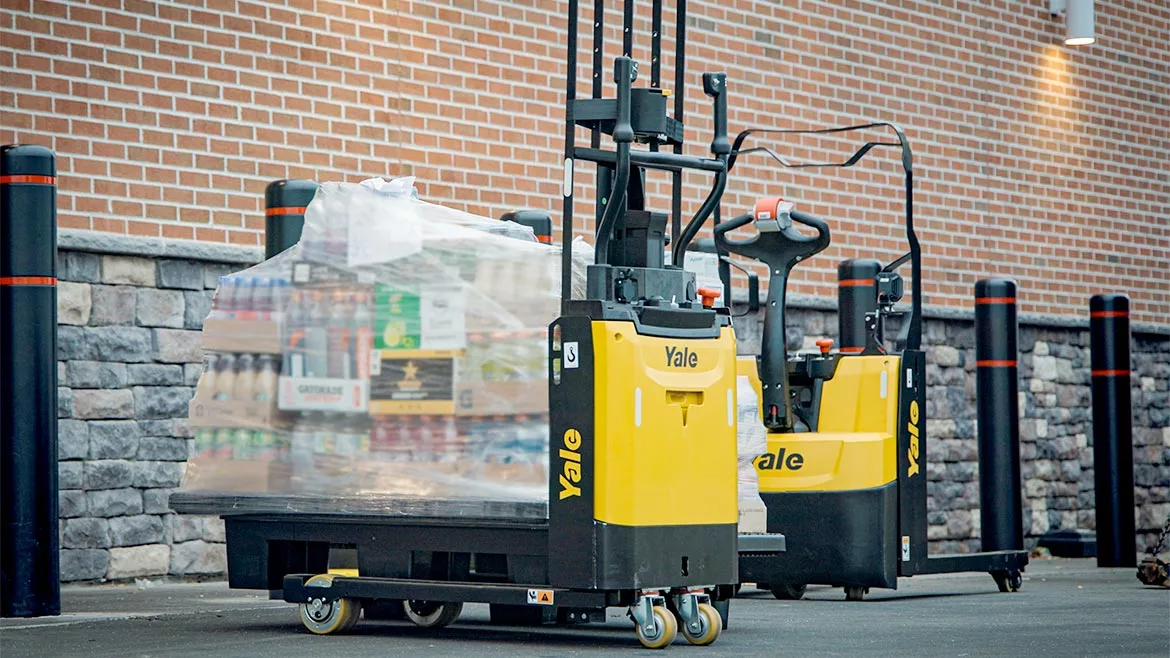
“Such a specific use case inspired us to create an innovative solution that provides the versatility to excel in dynamic delivery applications,” he says. “That solution is Yale Route Runner, a two-in-one solution that consists of a motorized sled and a standard pallet jack that nest together to handle the task of bringing product from truck to store, then unnest to take advantage of the small footprint of the sled within store aisles. The detachable sled is designed to work with industry standard pallet designs, and custom pallets are available to further maximize the space efficiency of the sled.”
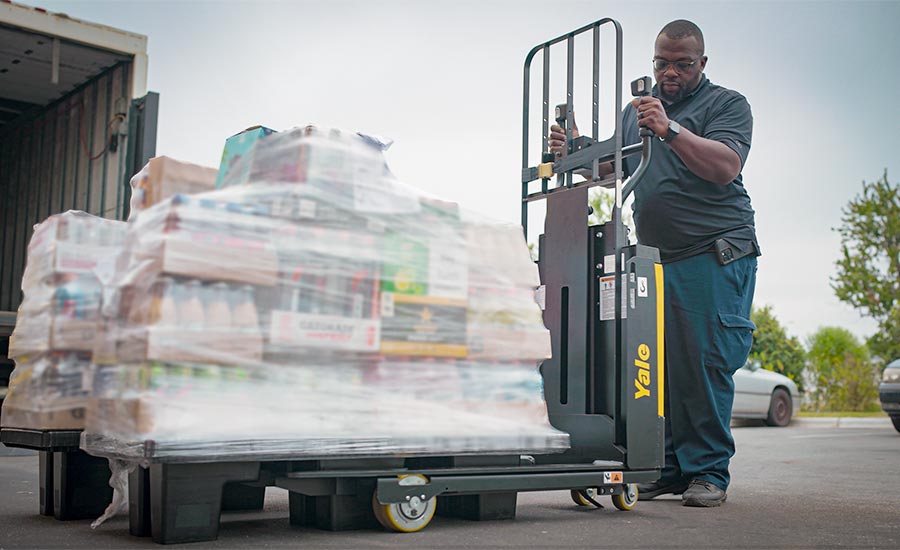 Yale’s Route Runner, a two-in-one solution that consists of a motorized sled and a standard pallet jack nest together to handle the task of bringing product from truck to store, Yale’s Kevin McWilliams notes.
Image courtesy of Yale Lift Truck Technologies
McWilliams adds that, during the course of a standard nine-stop shift, the solution allows drivers to lift 27,000 fewer pounds, take nearly 2,000 fewer steps, and shorten their route by 63 minutes — possibly enabling drivers to make an additional stop.
“This is possible because drivers no longer have to bring loads from trailer to store with a pallet jack, walk back to the trailer to bring a smaller piece of equipment for use indoors, and then manually transfer cases from the pallet truck to that smaller hand truck or sled,” he explains. “Instead, they can simply haul the full solution to the store with inventory loaded, detach the sled and walk into the store — only one trip needed and no manually transferring cases from one piece of equipment to another.”
Lightening the load
Alongside a challenging distribution landscape, McWilliams notes that lift truck solutions also are helping to meet beverage market trends impacting operations.
McWilliams explains that with SKU proliferation and greater beverage selection, delivery drivers have to make more frequent deliveries for smaller-format retail outlets to keep a wide variety of SKUs in stock.
“That also means more repetitive motions — transferring product from pallet truck to sled, then stocking on shelves — that can lead to operator fatigue,” he says. “Yale Route Runner helps to solve this challenge by removing the need to transfer product between equipment and by offering an ergonomic lift to the nested sled.
“When activated, the sled’s forks will rise so the operator doesn’t have to bend as far to pick up trays or cases, which helps reduce the degree of bending and lifting as operators unload and replenish stock at each stop,” he continues. “That added productivity and reduced repetitive motion can enable operators to work more efficiently, which can allow them to make an extra stop along their route, further helping to address the need for more frequent delivers driven by SKU proliferation.”
Additionally, McWilliams notes that warehouses are facing more pressure to get product out faster as labor costs and rents for logistics space continue to rise.
“For the latter, costs went up about 1.5% in 2025,” he says. “To make best use of this space and pricey, hard-to-find warehouse labor, operations are pushing out more frequent, smaller deliveries. With Yale Route Runner’s productivity benefits, adding one more stop to each route can make a big difference in getting inventory on store shelves, rather than leaving inventory sitting in the warehouse.”
Moreover, McWilliams points to DSD as impacting ground delivery personnel who must navigate a variety of environments and terrain, from distribution facilities and parking lots to convenience stores and receiving docks.
“They face a landscape that can resemble an obstacle course during almost every shift, with narrow lift gates, uneven surfaces, congested store entrances, storerooms, coolers and more,” he says. “And with a severe, ongoing driver shortage, every strain, fall and pulled muscle can add up to lost productivity.”
Further, with delivery personnel facing the challenge of constant repetitive movements and difficult environments, McWilliams suggests that finding even small ways to improve the work experience is vital.
“Beverage operations should look for pallet trucks that can actually make operators’ lives easier,” he says. “For example, ergonomic enhancements to the control handle can enable easier maneuverability in stores and on lift gates. One-hand throttle activation allows the operator to stand beside the truck as they move through tight spaces. Other features like a load retention strap can also help with stability when moving loads over rough and poorly maintained parking lots.”
In the case of an electric pallet truck, McWilliams adds that lithium-ion battery power can offer longer runtimes with the ability to charge in between delivery stops to help power through longer delivery routes.
“Beverage operations should look for pallet trucks that can actually make operators’ lives easier.”
– Kevin McWilliams, director of major accounts at Yale Lift Truck Technologies
“Compared to lead-acid battery alternatives, lithium-ion batteries can be charged in the trailer between deliveries, eliminating the need to head back to base for a battery replacement,” he says. “And as previously mentioned, removing some of those repetitive motions and easing the physical burden of making those motions is also pivotal to improving that experience.
“Lifting the load to an ergonomic height when restocking, can help greatly by reducing the severity of each bend to pick up or move equipment,” McWilliams continues. “The detachable sled of Yale Route Runner not only includes this feature, but it also removes the need to transfer inventory from one piece of equipment to another. This removes an entire move from a drivers’ schedule — they only need to place inventory on the full solution and then remove it manually when stocking inside the store.”
Meeting the moment
Given labor scarcity and turnover challenges, McWilliams highlights how innovative lift truck solutions are helping to ensure beverage operations run smoothly, safely and efficiently.
“[I]nexperienced operators are commonplace, and they’re often maneuvering in challenging spaces, navigating in and out of trailers, on the back of lift gates, around tight store corners and in close proximity to pedestrians,” McWilliams explains. “Working in these limited spaces can slow down productivity and lead to other issues.
“Another challenge of direct-store delivery is using industrial equipment in retail environments that may not be designed for the wear and tear of lifting equipment,” he continues. “To prevent floor tile damage at stores, operators have typically had to haul two different pieces of equipment from truck to store — a pallet truck for the parking lot and a sled for inside the store.”
To address these issues, McWilliams points to the Yale Route Runner that allows drivers to haul just one piece of equipment up to the store, then detach the sled to move inventory into the store.
“This sled is designed to prevent damage to store flooring, allowing for smooth operation that doesn’t harm either operation’s bottom line,” he says.
As for improvements or future innovations in the industry, McWilliams says that Yale expects to see more solutions that are focused specifically on the challenges users of the equipment face on a daily basis.
“A strong design process requires getting to know customers, from the operator who uses it every day to the maintenance technician required to service it, and developing a deep understanding of the challenges they face and what makes their operations tick,” he explains. “Many times, the customer may not recognize their challenges, or they may recognize them but just work around them not knowing they can be solved.”
Looking for a reprint of this article?
From high-res PDFs to custom plaques, order your copy today!