Health needs, technology advancements support maturing plant protein market
High-protein drinks, meal replacements among beverage segments embracing plant proteins

When Chappell Roan hit the concert scene in 2024, the rising star experienced the variables that came as her music now became mainstream. To cope with her newfound fame, she adjusted her performance schedule and exposure to what suited her needs.
As consumers continue their love affair with protein, plant-based solutions have moved from being a niche option to a go-to ingredient to meet protein needs in beverage development.
“Over the past decade, the U.S. plant‑protein beverage market has grown from a small niche into a mainstream category,” says Heidi Geisenhoff, senior product strategy manager in the Dairy Nutrition division at Glanbia, Chicago. “It was previously limited to specialty health stores and centered on soy or rice proteins, but options have expanded and these are widely available in supermarkets, club stores, pharmacies and cafés. In recent years, the high‑protein category has accelerated, and companies have rapidly broadened their portfolios in response. This has made plant‑protein beverages a regular part of many consumers’ routines.”
Emily Berg, marketing manager at Cargill, Minneapolis, also highlights how protein has become an important nutrient for today’s consumers.
“Protein is a central focus in many consumers’ diets, and beverages are one of the most convenient ways to deliver it,” she says. “They can start their morning with a protein-enhanced coffee, reach for a protein water during the day, substitute lunch with a ready-to-drink meal-replacement shake and recover from their workout with a sports beverage. Demand for protein in liquid formats continues to expand across dayparts and occasions.”
Glanbia’s Geisenhoff explains that among the attributes that consumers recognize for protein-fortified beverages include energy, muscle health, a boost daily nutrition and support weight management.
“Many beverages also include added vitamins, minerals, fiber or probiotics for extra functional benefits,” she says. “Growing interest in vegetarian, vegan and flexitarian diets has broadened the consumer base for plant‑protein beverages, and many choose it for sustainability and animal‑welfare reasons.”
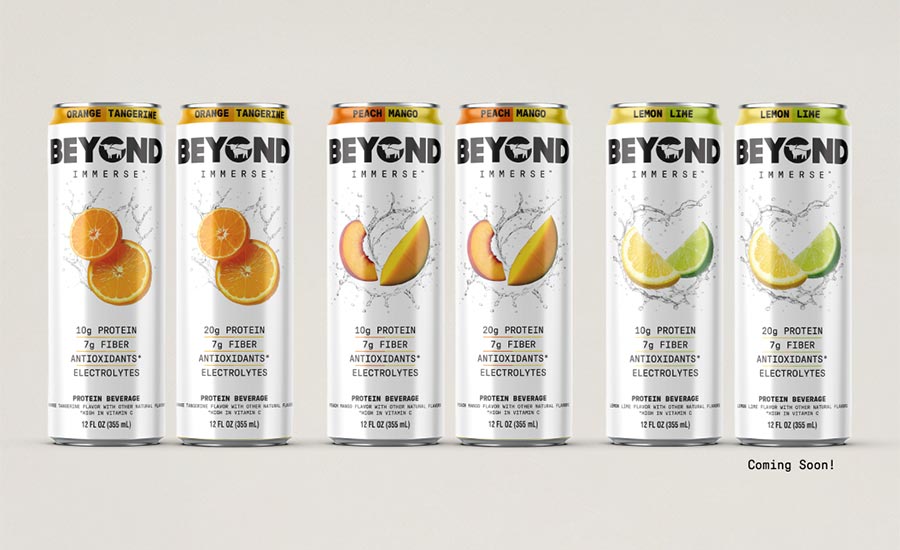 Beyond Meat Inc. announced Beyond Immerse, a plant protein, fiber, antioxidants, and electrolytes drinks available for a limited time exclusively on Beyond Test Kitchen.
 Image courtesy of Beyond Meat Inc.
Additionally, Cargill’s Berg notes that various consumer trends are prompting plant protein usage within beverages, particularly regarding active nutrition, weight management and overall wellness.
“Many GLP-1 users prioritize higher protein intake to support satiety and help maintain muscle mass, and beverages are particularly well positioned to meet those needs,” she says. “They’re convenient, portion-controlled and easy to consume, while modern formulations can deliver meaningful protein levels without compromising taste or texture.
“As a result, plant proteins are now being used across a wide range of beverage categories, including ready-to-drink shakes, protein waters, enhanced coffees, smoothies, meal-replacement beverages and more,” Berg continues. “What was once concentrated primarily in traditional sports nutrition has evolved into a mainstream opportunity spanning the broader beverage landscape.”
Glanbia’s Geisenhoff echoes similar sentiments regarding plant proteins growing appeal across the beverage market.
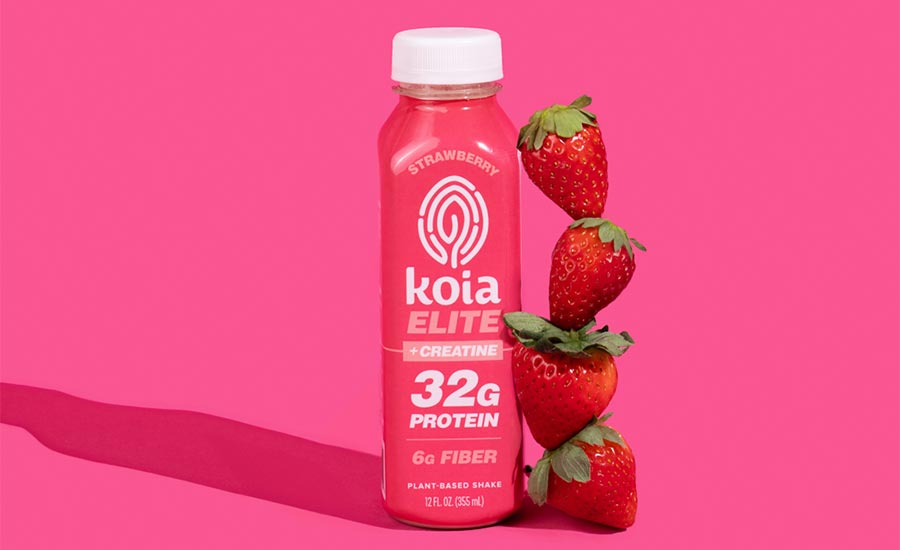 Each bottle of Koia Strawberry Elite +Creatine delivers 32 grams of complete plant protein and 1,000 mg of creatine, formulated to support muscle recovery, strength and sustained energy, the company says.
Image courtesy of Koia
“Convenient high-protein drinks are a core category for plant proteins,” she says. “These on-the-go beverages often use a variety of plant protein sources and cater to busy lifestyles and post-workout needs. Many new meal replacement drinks also use plant proteins to provide balanced nutrition in a bottle. This format offers dairy‑free nutrition for athletes, professionals, seniors and dieters seeking convenient, calorie‑controlled options.
“Meal replacement beverages often contain fiber for satiety along with protein to keep consumers fuller longer and support muscle maintenance,” Geisenhoff continues. “Caffeinated or flavored functional hybrid beverages with added plant protein (ex. protein cold brews, matcha, smoothies) deliver both energy and nutrition, for a dual-purpose appeal.”
Developed for success
Although plant-based protein ingredients are hitting on important attributes for today’s consumers, experts note that this is thanks to advancements in the development of these proteins.
“Taste has also improved significantly,” Geisenhoff says. “Advances in protein isolates, flavor‑masking and sweeteners have eliminated much of the chalky texture and off‑flavors found in earlier formulations. As plant-based options increasingly resemble mouthfeel and flavor profiles of dairy‑based drinks, more mainstream consumers are adopting plant‑protein beverages.”
Andrew Zumbusch, senior research scientist at Cargill, also credits technology advancements for furthering the ingredient category.
“Significant improvements in plant protein technology — especially with pea protein — have reshaped what’s possible in beverages,” he says. “New levels of solubility, improved flavor profiles and greater clarity now allow pea proteins to perform across a broader range of formats, from ready-to-drink shakes and acidified beverages to protein waters.
“The PURIS portfolio exemplifies this well. PURIS 2.0 improved solubility and flavor for mainstream beverage applications,” Zumbusch continues. “PURIS Hi-Lo expanded opportunities in acidified systems. And more recently, PURIS ClearP offers the clarity needed for lighter-colored protein beverages, including protein waters. That’s a format that simply wasn’t feasible with earlier plant protein technologies.”
Kushal Chandak, vice president of research and development (R&D) at Minneapolis-based PURIS, a partner with Cargill, explains that taste and mouthfeel are a non-negotiable for today’s consumers.
“Today, ingredient innovation is allowing plant proteins to perform much closer to dairy, while also enabling new formats like clear, juice-like protein beverages that align with how consumers want to drink protein,” he says. “Clear plant proteins like PURIS ClearP are a good example of this evolution. These ingredients are designed to deliver protein with a lighter sensory profile and less mouth drying than whey, making them better suited for clear and refreshing beverages.”
This has helped the pea protein market close the innovation gap with whey protein, Chandak explains.
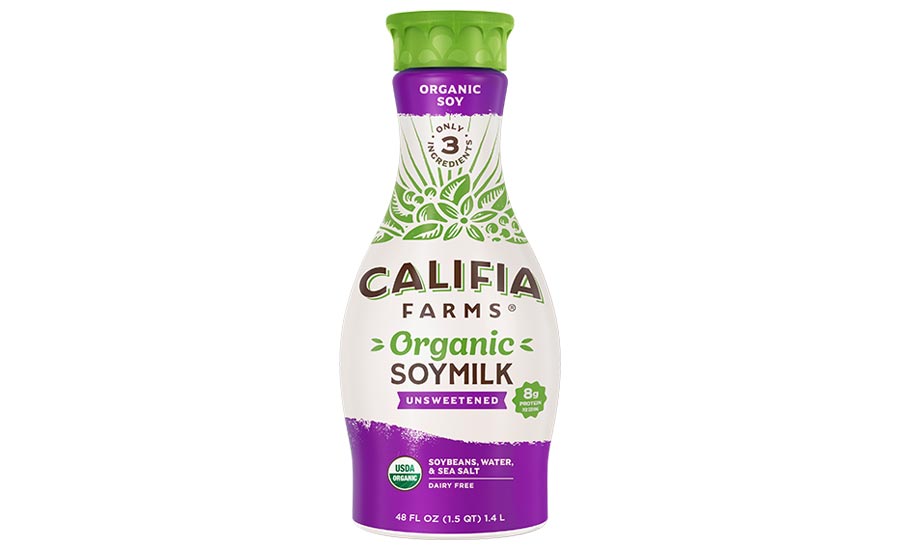 Califia’s new Simple & Organic Soymilk delivers 8 grams of plant protein in each serving, featuring just three ingredients: organic soybeans, water and sea salt, it notes.
Image courtesy of Califia Farms
“What was once a category defined by gritty textures and off-flavors is now a hotbed of innovation,” he says. “With breakthroughs such as Pea Protein 2.0 and ClearP, PURIS is redefining what’s possible in plant-based functionality, delivering clean-label, high-protein ingredients that perform across beverages, snacks, and sports nutrition. As consumer demand for protein fortified products accelerates, plant proteins are no longer playing catch-up, they’re setting the pace for the future of protein.”
When working with plant proteins, Glanbia’s Geisenhoff explains that these ingredients operate differently than dairy proteins. As such, beverage-makers can address this through their processing procedures.
“Plant proteins often have lower solubility than dairy proteins, leading to clumping, sedimentation or gritty texture,” she says. “Manufacturers may address this with high‑shear mixing, homogenization, stabilizers, emulsifiers, and pH adjustments or acid‑stable isolates to keep proteins suspended. Texturally, plant proteins can add chalkiness or thickness, so developers often use hydrocolloid systems to refine the particle‑size or use strategic blending (ex. adding flaxseed protein to pea protein) to achieve a creamier mouthfeel without thickness.
“Because many plant proteins carry earthy or beany notes, flavor masking with natural flavors, cocoa, vanilla, fruit or sweeteners is usually essential,” Geisenhoff continues. “Finally, shelf‑stable beverages require heat treatments like UHT or retort, which can stress plant proteins to curdle or sediment. Formulators must choose proteins and stabilizers that withstand processing to maintain a smooth, stable emulsion throughout shelf life.”
Cargill’s Zumbusch also pinpoints the importance of solubility when working with plant proteins in beverage applications.
“Protein solubility directly impacts texture,” he says. “Consumers expect beverages to be smooth and creamy, not gritty or chalky. Some plant proteins are difficult to disperse and keep in solution. Poor solubility can limit protein inclusion levels and may result in sedimentation or visible separation, which detracts from the drinking experience.”
Given this, Zumbusch explains that opting for plant proteins designed for beverages can aid the formulation process.
“For example, PURIS 2.0 pea protein was formulated specifically for beverages, offering superior solubility and improved taste compared to most other options,” he says. “This enhanced solubility allows for higher protein concentrations without compromising product quality. We’ve had customers aim for as much as 30 grams of protein/serving in a plant-based, sports nutrition beverage. Most plant proteins will struggle to hit those levels, but PURIS 2.0 lets us take protein levels much higher, thanks to its improved solubility and flavor profile.”
Zumbusch adds that protein stability is a vital consideration in acidic beverage, highlighting PURIS HiLo as a solution. He also notes processing considerations when developing ready-to-drink and high-protein beverages.
“Beverages with 20 or more grams of plant protein per serving may clog ultra-high temperature (UHT) machines,” Zumbusch says. “Additionally, some plant proteins may cause high-protein beverages to become more viscous over time, yielding a final product that’s more akin to pudding than a drink.
“High protein beverages also need the right stabilizer,” he continues. “Both animal and plant proteins tend to thicken and gel over shelf life, creating off-putting textures and mouthfeels. In these situations, adding hydrocolloids like carrageenan or gellan gum can help stabilize proteins and maintain viscosity.”
“As plant-based options increasingly resemble mouthfeel and flavor profiles of dairy‑based drinks, more mainstream consumers are adopting plant‑protein beverages.”
– Heidi Geisenhoff, senior product strategy manager in the Dairy Nutrition division at Glanbia
PURIS’s Chandak explains that because not all pea proteins are created equal, performance can vary widely. As such, he stresses the importance of communicating the format, functionality, and performance goals with supplier partners.
“It’s also critical to look at your formulation holistically, not just at the protein itself. Issues like heavy metals are a formulation and supply chain consideration; they are typically not a pea protein problem in isolation,” he says. “Beverage-makers should expect transparency and testing data from all ingredient suppliers, and work with partners who take responsibility for upstream sourcing to better understand their inputs.”
Continuing to advance
As demand for protein-fortified beverages doesn’t seem to be fading, experts anticipate that plant proteins will continue investing in ways to support the ingredient market’s growth.
“The future of plant proteins in beverages is centered on great taste paired with higher protein density,” Chandak says. “As ingredient technology continues to advance, the goal is to fit more protein into each serving without compromising flavor, texture, or drinkability, removing the tradeoffs that historically limited plant-based options. We’re already seeing innovation that moves plant proteins closer to that ideal, enabling beverages that deliver meaningful nutrition while still being enjoyable to drink.
“More broadly, the category is maturing beyond early experimentation toward products consumers can return to again and again,” he continues. “The goal has always been to create food that consumers can love forever. It’s an exciting evolution, and one that will continue to reshape how protein shows up across beverage occasions in the years ahead.”
Glanbia’s Geisenhoff anticipates that the plant protein market will benefit from emerging sources as well as hybrid beverage trends.
“The next wave of innovation will focus on expanding both protein sources and beverage formats,” she says. “While pea protein and soy protein remain widely used, emerging ‘next‑generation’ proteins are gaining traction and will diversify future formulations. We’ll also see more hybrid functional beverages, such as pairing plant protein with electrolytes, adaptogens, or caffeine to create sports waters, stress‑relief lattes, protein energy teas, and more. These multifunctional drinks will help plant‑protein beverages move further into the mainstream wellness and performance space.”
Given the advancements that already have taken place, Cargill’s Zumbusch explains that working with the right formulation systems will ensure it’s meeting the needs of today’s consumers.
“Today’s plant proteins are significantly ahead of those available a decade ago, delivering improvements in taste, color, and solubility,” he concludes. “When paired with advanced sweetening and texturizing systems, they give formulators the tools they need to create high-protein beverages that meet consumer expectations for taste, mouthfeel, and nutrition.”
Looking for a reprint of this article?
From high-res PDFs to custom plaques, order your copy today!