Labeling equipment adapts to growing beverage portfolios, customer needs
Consumer purchase patterns, digitalization influencing labeling machines
The proliferation of SKUs might be highly associated with space constraints on store shelves and warehouses, but today’s manufacturing and packaging equipment also is adjusting to these growing portfolios.
Justin Slarks, at Sleeve Seal, Little Rock, Ark., notes how labeling equipment has adjusted to the increase of SKUs.
“The need for labelers that can change formats easily has increased,” he says. “It seems that plants are producing more and more SKUs so the ability to pivot and change formats painlessly is more and more a part of the conversation.”
Mike Soloway, director of labeling technology at Krones Inc., Franklin, Wis., explains how this has made flexibility an important attribute of labeling equipment.
“Flexibility and modularity in labeling equipment are becoming more standardized,” he says. “Many older machines that were built for dedicated applications are being replaced with modular machines that allow a variety of labeling technologies to be used. The benefit of modular systems is that they allow multiple labeling applications to be run on a single machine as needed. They also have the flexibility to accommodate unknown future applications.”
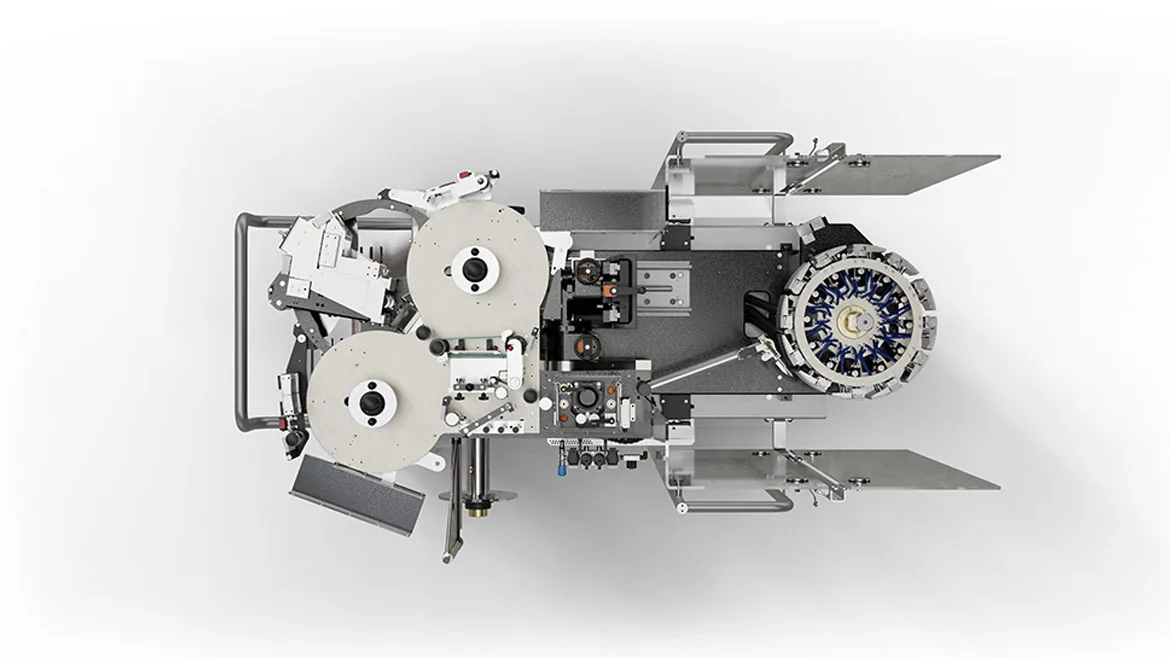
Soloway notes how the company’s Ergomodul is designed for this, while also offering an ease-of-use component.
“Each docking station contains an integrated lift which eliminates the need for leveling feet, as well as automatic internal connections for power, data, air, etc., so the operator doesn’t need to make any connections manually,” he says. “Labeling stations can easily be swapped in just a few minutes.”
Although flexibility and SKU proliferation have a strong impact on labeling equipment, original equipment manufacturers (OEMs) are taking into account a variety of trends when developing the next generation of solutions.
“Digitalization is another trend in beverage lines that is helping our customers maximize line efficiency and up time,” Soloway says. “By utilizing sensors, cameras and feedback from components such as servo drives, we can continually monitor every aspect of the line and proactively identify problems before they happen.”
Sleeve Seal’s Slarks also notes how consumer purchase patterns are impacting labeling equipment.
“Multipacks have been a hot topic recently,” he says. “With the big box stores offering savings on volume buying, manufactures are addressing this by packing their known SKUs in multipack form.”
Meanwhile, sustainability, which typically is more associated with packaging materials, is seeing OEMs taking consideration of label substrates and containers with equipment.
“The changes we are seeing in sustainability are changes to label substrates and containers,” Slarks says. “This doesn’t usually affect labeling efficiencies but is something we look at when engineering our labelers. We want to offer equipment that can easily adapt to changes in materials and formats without sacrificing efficiencies.”
“The benefit of modular systems is that they allow multiple labeling applications to be run on a single machine as needed.”
– Mike Soloway, director of labeling technology at Krones Inc.
Krones’ Soloway explains that a goal for many of its customers is to minimize their plastic use in packaging, so it has equipped its machines to support these goals.
“At Krones we have adapted our labeling and sleeving machines to efficiently utilize very thin label materials at very high speeds,” he says. “In addition, we are developing decoration technologies that remove the label substrates altogether. Two of these technologies, InkPression and DecoBeam, were showcased at drinktec in Munich in September of last year. InkPression applies a pre-printed image to a bottle without a label substrate, while DecoBeam uses laser technologies to etch product information on the bottles. Both of these technologies are built upon our proven Ergomodul labeling platform.”
With so many variables taken into account with beverage labeling equipment, OEMs are working to offer and develop solutions for these current and future trends.
“We work closely with our partners and are able to bundle products together as a multipack and label the bundle at high speeds with high efficiencies,” Sleeve Seal’s Slarks says. “It’s a team effort and we have a good team.”
Additionally, Krones’ Soloway points to Ingeniq, a line management solution the company highlighted last year at drinktec.
“It starts with the most advanced machinery available, but then extends to line management and life cycle service accountability,” he says. “With Ingeniq, Krones enters into an agreement with the customer to guarantee a certain efficiency for the line and then monitors the line to make sure that the guaranteed efficiency is being met. If the efficiencies dip below the guaranteed values, Krones proactively intervenes to get the line back to peak efficiency.”
To support the needs of beverage manufacturers, suppliers expect equipment innovation to keep up with the innovation throughout the beverage market.
“Technologies that help the recycling stream will continue to evolve,” Soloway says. “That could include labels and adhesives that detach cleanly in the recycling process. It could also include more technologies like InkPression and DecoBeam which eliminate the label substrate altogether.”
Sleeve Seal’s Slarks adds that high efficiency will continue to be a focus for the company going forward.
“We are continuing to develop machines that make the operator’s job as easy as possible to ensure high efficiencies,” he says. “This means that we work closely with our technology partners to incorporate the technologies that make operator friendly labelers a reality.”
Looking for a reprint of this article?
From high-res PDFs to custom plaques, order your copy today!