Robotics adapts to existing beverage warehouses
Improved ergonomics, efficiency accelerate usage of robotic technology
WALL-E, Johnny 5, R2-D2, and Gir are among some of the beloved robots of pop culture. In beverage warehouses, beloved forms of automation have traditionally been on the front end of production, but as operations have become more complex and labor challenges persist, end-of-line and outbound tasks are receiving love.
“The beverage market can be difficult to automate given the proliferation in size, weight, packaging standards, expiration dates, storage requirements, and more across vendors,” says Hayden Sykes, enterprise sales director at Corvus Robotics, Mountain View, Calif. “The production end is already highly automated, whether that’s filling bottles, packaging, or palletizing cases. Adoption is slower on the outbound side, because the higher variability has kept adaptable human labor more cost-effective. Old buildings and existing leases add to that. Large-scale automation is hard to justify against the upfront costs, the physical changes required, and a longer payback period.”
Sykes notes that robotics are helping to minimize physical challenges by adapting to environments.
“There’s also the product itself to think about,” he notes. “Expensive mechanical parts and sensitive electronics can be damaged by liquids, so any automation handling the product directly requires careful consideration.”
Thomas Houden, director of business development at OnRobot, Dallas, highlights how robotic technology adoption has been accelerating, notably among small and mid-size operations.
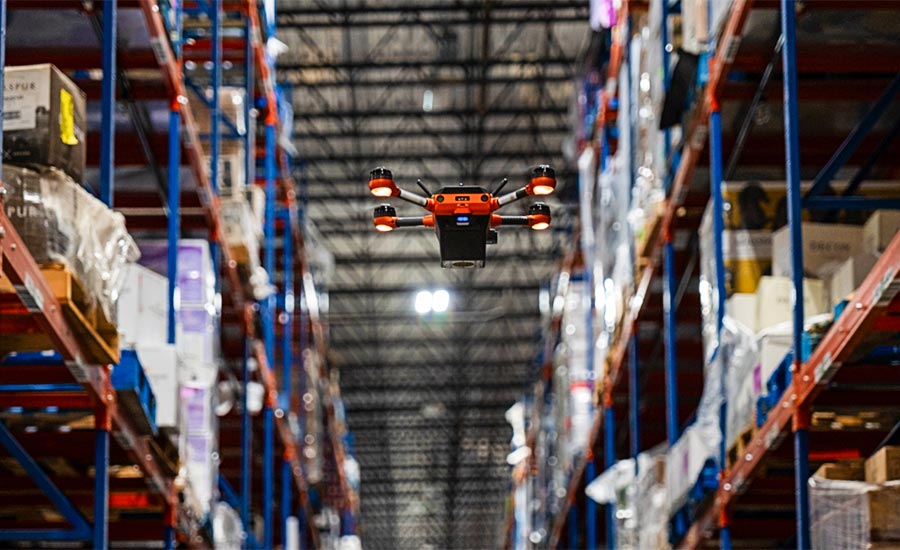 Image courtesy of Corvus Robotics/ Southern Glazer’s Wine & Spirits
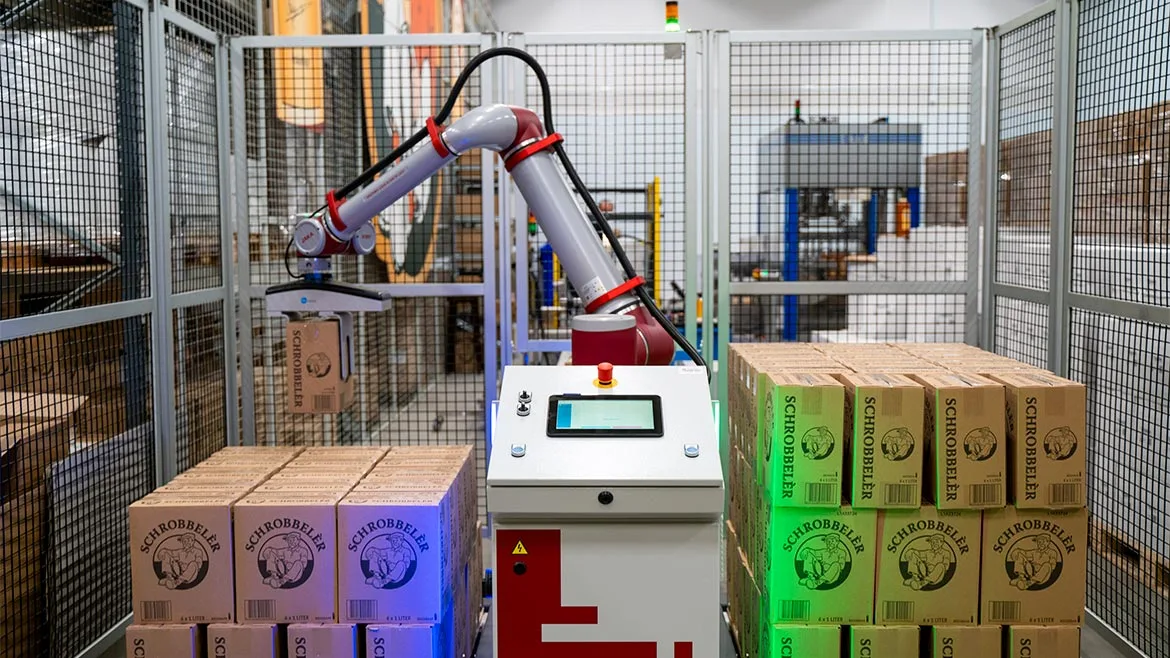
“We recently saw this play out directly with Schrobbelèr, a Dutch herbal liquor producer,” Houden says. “Palletizing their heavy bottle cases by hand was physically demanding and limiting their productivity, but they didn't have a technical team in-house to manage a complex robotics deployment.
“They installed an off-the-shelf palletizing solution powered by D:PLOY, and it was up and running in a single day, during active production, with no disruption,” he continues. “The team member managing the system day-to-day has no technical background, she runs changeovers herself whenever they switch bottle sizes. That’s the story of adoption right now: robotics is moving from something only specialists can operate to something any production team can own.”
Damaris Gruetter, chief marketing officer and managing director at Stoecklin Logistics, Marietta, Ga., notes that the acceleration of robotic technology usage comes as beverage operations face labor shortages, higher throughput requirements and pressure to improve efficiency.
“The market is not necessarily moving toward a single, fully automated model,” he explains. “Instead, beverage companies are looking at where robotics can provide the greatest operational value and integrating those technologies into broader intralogistics systems. Solutions such as palletizing and depalletizing robots, pick-and-place systems, automated guided vehicles, and automated storage and retrieval technologies can work together to create a scalable operation.”
When it comes to beverage distribution, Karli Sage, vice president of supply chain management for technology and engineering at Southern Glazer’s Wine & Spirits, Miami and Dallas, notes that operations have been highly automated for quite some time, it has been more fixed.
“With the volume we move and a next-day delivery model, you need speed and dependability, so conveyors, sortation, AS/RS and other traditional automation have served the industry really well,” she says. “What’s changing is the amount of variability we’re asking those systems to handle. More SKUs, different packaging, changing order profiles, smaller orders and customer-specific requirements all make the operation less predictable.”
Sage adds that robotics is starting to change that conversation, though
“We don’t have to choose between completely manual and completely fixed automation. Robotics gives us another option for parts of the operation that change more frequently or historically have been difficult to automate,” she says. “I still think beverage is relatively early in that transition, but it’s moving quickly. Five years ago, there were applications I wouldn’t have seriously considered for robotics. Today, we’re having very different conversations about what’s possible.”
Understanding the benefits
With robotics usage increasing within beverage operations, experts note the slew of benefits they can offer.
Recently, PMMI, The Association for Packaging and Processing Technologies, announced the release of its 2026 Packaging State of the Industry Report. Among the findings in the report was how robotic technology can improve operations.
“Robotic systems and cobots are providing manufacturers with a broader range of options to improve throughput, ergonomics and workforce utilization, although cost, speed, and integration requirements continue to determine which technologies are best suited to individual applications,” the association states in a release.
“The market is not necessarily moving toward a single, fully automated model. Instead, beverage companies are looking at where robotics can provide the greatest operational value and integrating those technologies into broader intralogistics systems.”
– Damaris Gruetter, chief marketing officer and managing director at Stoecklin Logistics
Stoecklin Logistics’ Gruetter notes that because of the physical impacts of moving beverage products, robotics can support a more ergonomic process.
“Robotics can deliver speed, precision, consistency and improved ergonomics,” he says. “Beverage products can be heavy, repetitive to handle, and challenging to move efficiently, particularly when creating mixed pallets for individual stores or customers. Robotic systems can automate these demanding tasks around the clock while maintaining consistent performance.”
Southern Glazer’s Sage notes that the obvious benefits are those that address repetitive work, heavy lifting, and ergonomics, which are important. She adds that there’s a big opportunity about what robotics can facilitate between people and traditional automation.
“Traditional automation is incredibly good when the process is repeatable, and you need a lot of throughput,” Sage says. “People are incredibly good at dealing with variability and exceptions. Robotics is starting to fill more of the space between those two.
“For beverage, that could mean picking, palletizing, depalletizing, unloading, replenishment, or other physical tasks where the product or conditions aren’t exactly the same every time,” she continues. “Using the right technology for the right work and allowing our people to spend less time on repetitive physical tasks and more time managing the operation and exceptions.”
Also recognizing the physical benefits, OnRobot’s Houden further details how platforms are offering more flexible options to implement.
“… [T]he core outcome we hear from customers is greater flexibility, higher output and improved ergonomics, without adding a layer of complexity that requires an outside integrator to manage,” he says. “Because OnRobot’s platform is compatible with a wide range of leading collaborative and light industrial robot arms, producers aren’t locked into one hardware vendor as their needs evolve. And electric end-of-arm tooling adds a further benefit on the operating side — lower energy and maintenance costs compared to pneumatic alternatives, eliminating the need for supplied air.”
Corvus Robotics’ Sykes also touts the adaptability benefits of today’s robotics systems.
“Solutions that fit into the existing building rather than requiring costly modifications are key,” he says. “Robotics can also scale capacity for peak season, so you aren’t building for the peak and only using that capacity a couple months of the year. For controlled products like alcohol, and anything carrying lot code requirements, you get continuous tracking and process enforcement. That confirms the right SKU, lot, and expiration ship to the customer, which avoids expired product and chargebacks from mis-shipments.”
These benefits suggest robotic usage will continue to accelerate.
Looking for a reprint of this article?
From high-res PDFs to custom plaques, order your copy today!