Packaging Equipment
Flexibility vital for can filling and seaming equipment
Quality control, safety important on filling lines

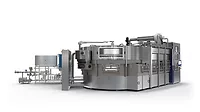
The compact Modulfill VFS-C can filler eliminates the need for a clean room cover and provides outputs from 50,000-95,000 cph, Krones’ Barry Fenske says.
Image courtesy of Krones Inc.
In Merriam Webster’s dictionary, “mettle” means tenacity, courage or doing one’s best to resist opposition. Today’s packaging equipment suppliers are “proving their mettle” with machinery that fosters the hygienic canning and seaming of a diverse range of premium products with flexibility and shortened changeover times.
Barry Fenske, technical sales for the filling division at Krones Inc., notes that the diversity of cans in the market — slim and sleek cans, 7.5-ounce mini cans for carbonated soft drinks (CSDs) and multi-pack variety packs — have not impacted its Franklin, Wis.-based operations, but he points out that fillers that run one SKU at a time provide the best efficiency.
However, one product line running on just one filler is a rarity in today’s market.
“The best line for any filler is one that runs one SKU. [It provides the] best efficiency, but who does that nowadays?,” he asks. “Our canners are capable of handling a variety of cans on the market with just some additional change parts. This makes our canners attractive to co-packers as well.
“You can have a can filler that targets one product type, or one that does multiple products,” he continues. “Our can fillers can do hot-fill, cold-fill, carbonated, non-carbonated, clear, some particulate, etc.”
Although the canning business hasn’t changed that much, automation has simplified operations, Fenske adds.
“We have pretty much gotten the filling and seaming aspects down to a science, with little operator involvement needed,” he notes. “Where we see continued focus is improving line efficiencies, changeover times and sustainability.”
Steve Davis, product line director at Industrial Physics, parent company of CMC-KUHNKE, Boston, concurs that while “things don’t change that quickly within metal packaging,” what has changed regardless of the shape of a beverage package, is the ability for aluminum cans to be manufactured at high speed and in great volume.
“There’s a lot of machinery that’s able to adapt to different can sizes as we move forward, but the thing to remember with this is that, if new instruments are going to be introduced to produce different sizes and shapes of cans, then the nature of introducing something new requires additional training,” he says.
“What’s more, there will need to be money spent on change processes, testing processes, and so much more,” he continues. “Cans of varying sizes will impact operations in a large way — so investing in the right quality control and testing equipment is critical.”
Packaging design, or the ability to shape or emboss cans with patterns or to add embossed finishes, considerably slows down line speeds, he adds.
“There’s a focus on continuous improvement on tweaks here and there rather than radical changes coming about i.e., different finishes and textures to the label and the lid,” Davis explains. “Having said that, one factor we have noticed a huge push on — and something that’s quite topical — is the de-risking of human impact, and this is largely due to the way that COVID is changing things.
“Obviously at the moment, if someone catches COVID or comes into contact with someone who has tested positive, there could be quarantining implications,” he continues. “And if somebody in a plant catches the virus, it could result in the entire floor having to take time off — this obviously has a hugely negative effect on a business.”
Thus, beverage manufacturers are searching for more automated solutions. Not only does the Auto-XTS offer a fully automated, more efficient approach to seam inspection, manufacturers can minimize the impact of losing critical skills in their production line, the company says.
The need for speed and sustainability
Although experts note that “the pace of change is gentle in the canning world” and that canning and seaming processes generally stays fixed, particularly within large beverage companies, there’s been an evolution in speed and efficiency due to advanced technology.
“That’s a key focus — how cans can be produced in a faster manner,” Industrial Physics’ Davis says.
To meet speed, hygienic and sustainability demands, suppliers have unveiled some innovative equipment.
For instance, Krones offers its Modulfill VFS-C, a compact clean room can filler that eliminates the need for a clean room cover on the filler’s top. The filler also facilitates clean-in-place/clean-out-of-place (CIP/COP) to occur concurrently.
In extolling the benefits of the compact Modulfill VFS-C, Fenske says: “An external foaming system is not needed, this process is done by the filler itself. This is our most hygienic can filler. It needs less HEPA air, has a smaller footprint and has outputs from 50,000-95,000 cph.”
When it comes to seaming inspection, more automated technologies like Industrial Physics’ Auto XTS have been introduced, which links back to the desire for more efficient ways of working, Davis says.
“This is one of the many reasons that we’ve noticed a lot of bigger beverage manufacturers looking at more automated solutions (such as our Auto-XTS, which offers a fully automated approach to seam inspection),” he says. “With automation, manufacturers can minimize the impact of losing critical skills in their production line. Alongside a whole host of additional benefits such as a more efficient process.”
Canning manufacturers are seeing more and more products packaged in shelf-stable cans — canned wines, canned waters, canned craft beers, canned cocktails and canned CBD beverages — due to the huge push for sustainability and eco-friendly options.
“We have pretty much gotten the filling and seaming aspects down to a science. Where we see continued focus is improving line efficiencies, changeover times and sustainability.”
--Barry Fenske, technical sales for the filling division at Krones Inc.
“This is driven both from legislation and consumer demand. As metal is 100% recyclable ― and also endlessly recyclable ― it’s unsurprising that we’re seeing a huge rise in this packaging option,” Industrial Physics’ Davis explains. “We actually mention this in our report, ‘A Thirst for Perfection’, where we explore the different trends facing beverage packaging manufacturers today.”
Given the required investment, many beverage manufactures are turning to co-packers because they don’t have the time, resources or budget to fill and seam cans at the pace the market is demanding, according to Krones’ Fenske.
As a result, several can fillers were sold to new co-packers in 2020-2021, an indicator of the demand. “There are those that can buy their own equipment, maybe starting out with a semi-automatic line to begin with and with the hopes of upgrading down the road,” he says.
When selecting the right can fillers, Fenske advises that manufacturers look for can fillers with a proven track record for machine and support, low thermoplastic (TPO) pick-up guarantees and, of course, excellent fill accuracy.
“Electro-pneumatically controlled filling valves are flexible at the touch of a button ― mechanical valves are not,” he says. “A must for a wide range of SKUs.”
As filling and seaming equipment adapts to different can sizes, Industrial Physics’ Davis notes the importance of training warehouse employees.
“If new instruments are going to be introduced to produce different sizes and shapes of cans, then the nature of introducing something new requires additional training,” he explains. “What’s more, there will need to be money spent on change processes, testing processes, and so much more. Cans of varying sizes will impact operations in a large way ― so investing in the right quality control and testing equipment is critical.”
Looking for a reprint of this article?
From high-res PDFs to custom plaques, order your copy today!