Reusable packaging systems improve consumables’ footprint
Brands work to maximize return-on-investments
As the U.S. POPULATION grows, IT STANDS TO REASON THAT the amount of pollution produced grows with it. Research and policies regarding waste have been prevalent for many years now and the consumables market is doing its part to lessen the environmental burden. Determination for creating a greener earth is driving beverage suppliers and consumers to reduce, reuse and definitely, recycle.
For instance, the Florence, Ky.-based National Association for PET Container Resources and the Washington, D.C.-based Association of Plastic Recyclers announced a recycling rate of 29.2 percent for PET plastic bottles in 2017. This percentage is slightly higher than the 2016 rate of 28.4 percent, reflecting a decrease in both total collection volumes and volume of PET bottles available for recycling in the United States, the associations reported.
However, primary packaging materials are not the only ways in which suppliers are furthering the sustainability movement. The requisite for consistent return-on-investment (ROI), accurate reverse logistics and standardized deliveries motivates beverage industry players to implement reusable packaging systems.
“The reusable packaging market is embracing growing conversations and awareness around environmental sustainability,” says Alison Zitzke, senior product manager for ORBIS Corp., Oconomowoc, Wis. “Manufacturers continue to produce innovations for new and evolving sustainability trends and industry needs. The more reusable solutions there are in the industry, the more sustainable options supply chains have to improve their environmental impact.”
Reusable packaging systems not only minimize a company’s carbon footprint, but can provide monetary benefits, experts note. In Linden, Va.-based Reusable Packaging Association’s (RPA) 2016 report titled “Think Outside the Box: Think Reusable,” the association outlines the monetary benefits of implementing reusable packaging systems:
- Improved ergonomics and worker safety: standardized package weights, sizes and materials reduce risk of injury
- Reduced inventory and just-in-time delivery: standardized packaging and ordering quantities improve tracking, reduce errors and the amount of time inventory is idle and nonproductive
- Quality improvements: durable, uniform containers stabilize loads and prevent product damage
- Packaging material cost reductions: longer useful life means less replacement materials
- Reduced waste management costs: less waste to manage and less labor required to prepare waste materials
- Environmental impacts: reduced greenhouse gas emissions and overall energy consumption
All-around assets
As beverage companies strive to improve their environmental impact, new trends and packaging materials are meeting consumer preferences for sustainability.
As a result, beverage companies are diversifying their product offerings to meet emerging consumer needs, according to ORBIS’ Zitzke. “More consumers want authentic craft beverages, so small-scale manufacturers and distributors are focused on delivering specialty products,” she explains. “Because specialty products are transported in fewer quantities, packaging — such as reusable handheld totes — that can accommodate smaller, more frequent shipments is required. Also, with the increase in mindful consumption, consumers are buying healthier alternatives. As a result, sleek 12-ounce cans are being used over traditional cans, which can impact the design of reusable packaging.”
Manufacturers also are introducing new ways to reduce labor needs and the number of touchpoints during delivery, Zitzke says. “One packaging solution is mobile merchandising,” she says. “Reusable packaging — such as pallets and totes that have a mobile mechanism — makes transporting product from the truck to the store aisle, or storage room, more seamless and less labor intensive.”
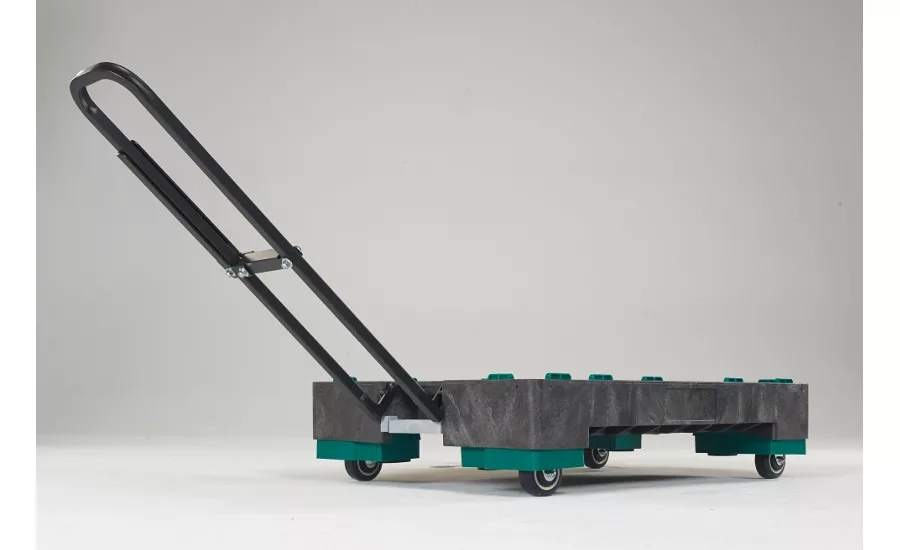
For example, the company manufacturers the ORBIS Pally, which is a combination of a pallet and a dolly. “It can switch from static to mobile mode with one press of its pedal,” Zitzke explains. “This saves time at delivery so more focus can be put toward customer service.
“Another solution is small-format packaging,” she continues. “Reusable packaging with smaller dimensions improves efficiencies during the delivery process. As more retailers decrease brick-and-mortar footprints, they will need small-format pallets and totes that can easily fit through tighter doorways and aisles.”
Zitzke also details how bulk loads and transportation demands are impacting the reusable packaging market. “Reusable bulk containers offer many transportation efficiencies for bulk loads,” she says. “Their durable, heavy-duty design allows maximum fill volume — such as the ORBIS MAXCUBE — and maximum storage and return ratios – such as the ORBIS OpteBulk.”
“For maximum truck packout, manufacturers are introducing right-sized bulk containers to fit more containers per truck and more pack designs than traditional bulk packaging,” she adds.
The ORBIS MAXCUBE, a 40-by-48 or 45-by-48-inch reusable bulk container, and the OpteBulk, are used for primary packaging components such as beverage preforms, caps and closures, Zitzke says.
The company also designs inbound beverage pallets, top frames and layer pads, typically used by can and bottle manufacturers.
Before beverage-makers and distributors invest in reusable packaging, several factors should considered, experts note.
“Beverage-makers and distributors should consider their supply chain loop,” Zitzke says. “Reusable packaging systems are best managed in a closed-loop supply chain. Because reusable packaging is meant to return to its original user, track and trace technology, such as barcodes and radio-frequency identification (RFID) or GPS, can help ensure packaging makes a complete loop successfully.
“This decreases packaging loss, regulates cleaning and maintenance, and further protects users’ investment to achieve their [return-on-investment] ROI targets,” she continues. “Packaging management services such as ORBIS’ Reusable Packaging Management, can help companies put a management system in place to track and maintain their reusable packaging fleet.”
The RPA also touts the feasibility of closed-loop systems. “Closed-loop systems are ideal for reusable transport packaging,” the report states. “Reusable containers and pallets flow through the system and return empty to their original starting point (reverse logistics) to begin the entire process again.”
When it comes to reusable packaging systems, the association also recognizes pallet and container pooling as an alternative option. “With pallet and container pooling, companies outsource the logistics of pallet and container management to a third-party pooling management service,” the report states. “The pallets are delivered to the companies; palletized products are shipped through the supply chain; then a pallet rental service picks up the empty pallets and returns them to service centers for inspection and repair. Pooling pallets are typically made of high-quality, durable wood, metal or plastic.”
Open-loop shipping systems also are an option, according to the RPA. Open-loop systems require the assistance of a third-party company, who sets up the pooling network to facilitate the return of empty reusable transport packaging (reserve logistics), it says. The pooling management company also might provide various services such as supply, collection, cleaning and repair of reusable transport packaging, it adds.
Putting it all together
Certain management systems like tracking systems, play an important role in the reusable packaging industry. “A few of the benefits include asset visibility, reduced manual shipment logging, uncovering loop inefficiencies, improved packaging utilization and reduced packaging loss,” ORBIS’ Zitzke says.
ORBIS offers a range of tracking solutions to help manage reusable packaging systems. “ORBIS Reusable Packaging Management services include the use of its proprietary ORBIS SmartTrak software, which integrates with customers’ systems and accepts data input from different technology solutions,” Zitzke says.
“With ORBIS SmartTrak, companies can monitor their packaging and have visibility of inventories, in-transit quantities and historic data.”
As experts have noted, companies that combine reusable packaging, like pallets, with management systems, can not only achieve a higher ROI, but can significantly reduce their environmental impact. For example, this past October, the RPA announced Anheuser-Busch InBev (AB InBev) as one of the two winners in the 2018 Excellence in Reusable Packaging award program.
“Anheuser-Busch InBev (AB InBev) won for their design and implementation of a comprehensive maintenance, reusable pallet, and logistics system that significantly reduced waste, increased reusable packaging lifespan, and reduced CO2 impact by 30 percent,” the association said in a statement at the time of the announcement.
Although the benefits of using a reusable packaging system likely outweigh the drawbacks, it does have its associated challenges, experts say. “When not managed properly, supply chains can skip crucial steps in the reusable packaging ownership process, such as repairing damages, tracking proper movement, and properly cleaning and sanitizing the packaging,” ORBIS’ Zitzke says.
“Improper management can create waste due to lack of visibility, leading to unplanned downtown, lower productivity and packaging loss,” she continues. “It also could hinder ROI measurement if the number of trips per year cannot be calculated due to unreturned packaging.
“However, with the right education and service provider, a management system can be implemented, so savings and efficiencies are quickly realized,” she says.
As consumers trend toward decreasing their environmental footprint, beverage-makers and distributors work to do the same. The proliferation of reusable packaging systems and materials likely will continue as sustainability stays top of mind.
“The beverage industry can expect to see more mobile packaging options and bulk delivery systems,” Zitzke says. “Because of the increase in aluminum can production — a 20 percent increase since 2011 — more bulk, lightweight solutions will be needed to ship more product per trip. This, paired with mobile distribution solutions, results in a more efficient retail supply chain, from warehouse to the aisle, in less time and with less hassle.”
As SKUs constantly grow, beverage supply chains strive to maximize their ROI, by realizing the environmental and all-around business benefits of implementing reusable packaging systems. BI
Looking for a reprint of this article?
From high-res PDFs to custom plaques, order your copy today!