Initiatives, policies support healthy food and beverage choices
ABA makes progress in initiative to reduce calorie consumption from beverages

PepsiCo launched Hello Goodness, a vending initiative that offers good- and better-for-you product choices from the company’s food and beverage portfolios. (Image courtesy of PepsiCo Inc.)
Whether it’s from their friends and family, doctors or TV personalities, Americans have numerous outlets from which to receive advice on how to live a healthy lifestyle. However, the U.S. Department of Health and Human Services (HHS) and the U.S. Department of Agriculture (USDA) are hoping to make it easier for American consumers to make smart food and beverage choices.
In January, the HHS and USDA released updated nutritional guidelines that encourage Americans to adopt a series of science-based recommendations to improve how they eat and drink in order to reduce obesity and prevent chronic diseases. The 2015-2020 Dietary Guidelines for Americans reflects advancements in scientific understanding about healthy eating choices and health outcomes across a lifetime, according to the departments. The newly released 8th edition recognizes the importance of focusing not on individual nutrients or foods in isolation, but on the variety of what people eat and drink — healthy eating patterns as a whole — to bring about lasting improvements in individual and population health, they add.
The specific recommendations fit into five overarching guidelines in the new edition:
- Follow a healthy eating pattern across the lifespan. Eating patterns are the combination of foods and drinks that a person eats over time.
- Focus on variety, nutrient-dense foods and amount.
- Limit calories from added sugars and saturated fats, and reduce sodium intake.
- Shift to healthier food and beverage choices.
- Support healthy eating patterns for all.
Under the Beverages section, the Dietary Guidelines note that some people might not always consider beverages when accounting for their overall food intake, but beverages remain an important part of eating patterns.
“In addition to water, the beverages that are most commonly consumed include sugar-sweetened beverages, milk and flavored milk, alcoholic beverages, fruit and vegetable juices, and coffee and tea,” the Guidelines state. “Beverages vary in their nutrient and calorie content. Some, like water, do not contain any calories. Some, like soft drinks, contain calories but little nutritional value. Finally, some, like milk and fruit and vegetable juices, contain important nutrients such as calcium, potassium, and vitamin D, in addition to calories.”
The following are some of the beverage consumption recommendations/information:
- Calorie-free beverages (especially water) and nutrient-filled drinks (fat-free or low-fat milk and 100 percent juices) should be the primary consumed beverages.
- Milk and 100 percent fruit juice should be consumed with recommended food groups and calorie limits.
- Sugar-sweetened beverages (i.e. carbonated soft drinks, sports drinks, juice drinks) should be within overall calorie limits and limits for calories from added sugars.
- High-intensity sweeteners found in diet beverages might reduce calorie intake in the short-term, yet questions remain about their effectiveness as a long-term weight management strategy.
- Moderate intake of alcohol drinks and overall calorie limits apply.
- Coffee, tea and flavored waters can be selected, but calories from cream, added sugars and other additions should be accounted for within the eating pattern.
Applauding the HHS and USDA, the American Beverage Association (ABA), Washington, D.C., stated: “We appreciate the extensive work in developing the 2015 U.S. Dietary Guidelines for Americans. We fully support the goal to help Americans achieve and maintain a healthy weight. America’s beverage companies are doing their part to help people manage their calorie and sugar intake by providing a wide range of beverage choices, a variety of package sizes and clear, easy-to-read calorie information — on package and at point-of-purchase — to help them make the choice that’s right for them. With our Balance Calories Initiative, we are working toward a common goal of reducing beverage calories in the American diet. This is a meaningful initiative that will have significant real-world impact in helping people reduce their consumption of calories and sugar from beverages.”
Working together
Although the latest edition of the Dietary Guidelines highlights that consumers should make balanced choices, the ABA, in partnership with the Alliance for a Healthier Generation, The Coca-Cola Co., PepsiCo Inc. and Dr Pepper Snapple Group, have been spearheading a similar effort.
As part of their initiative to help reduce the calories consumed from beverages by 20 percent a person by 2025, the partners have been laying the foundation this past year to help support implementation to reach the overall goal.
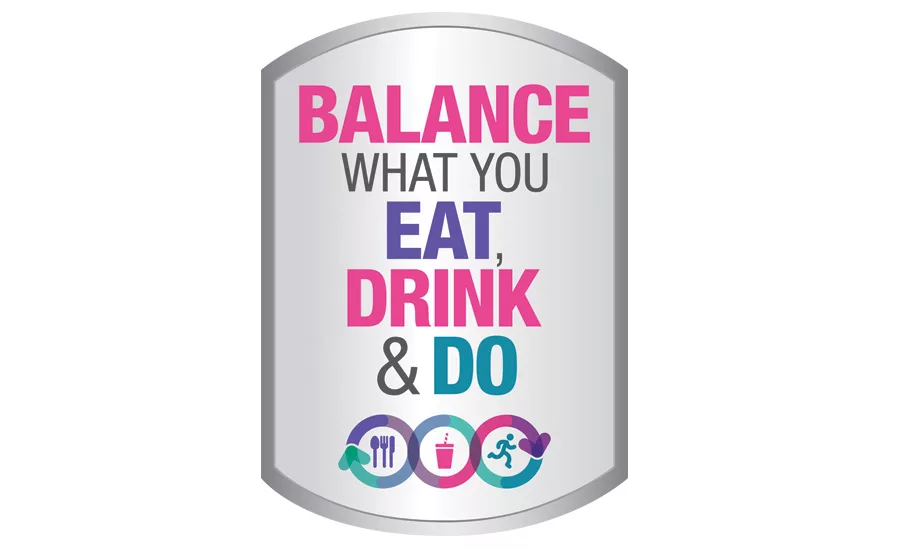
“Specifically, we’ve developed a unified program for labeling vending machines, coolers and fountain equipment,” says Susan Neely, ABA president and chief executive officer. “With both vending and fountain, that will include calorie information for the beverages. It also includes an awareness message to balance what you eat, drink and do. Cooler labels also will feature the awareness message.”
Neely notes that a style guide has been developed to ensure that the whole industry implements the labeling program in a uniform way to aid consumers by providing information that can help them decide which beverages are right for them.
“Perhaps they can enjoy more calories today, or they want a little less to balance out their day, either way they can see the calorie information very, very easily and are reminded with the awareness message to balance what you eat, drink,” she says. “This is a gentle reminder to get people thinking about the calorie information as they make their beverage choice.”
The implementation of labels for vending machines and coolers already has begun, and consumers can expect to see these in early 2016 while the fountain equipment labeling will begin later this year, Neely explains.
Also underway are test-and-learn community initiatives. The community initiative has beverage companies utilizing a range of marketplace activities in neighborhoods in an effort to help people reduce their calories. Communities within Los Angeles, New York City and Little Rock are the first in this effort.
Some of the efforts that consumers are seeing in these areas include more marketing of no- and lower-calorie options in stores, bodegas and restaurants, smaller portion sizes such as mini-cans, as well as the unified labeling program on vending machines, coolers and fountain equipment. They also will see companies utilize strategies such as product sampling programs, coupons and other incentives, and in-store displays featuring lower-calorie products, the ABA states.
Additionally, an important part of the test-and-learn program will be evaluating these new programs, Neely explains. Washington, D.C.-based Keybridge was selected, along with the Alliance for a Healthier Generation, as the independent evaluator. Keybridge will release a baseline progress report in the first quarter of this year with the first of annual reports coming later in the year.
“The progress report will include what the baseline is for calories consumed per person nationally, and in the test-and-learn markets, and some other information to establish what will be measured and then, later in 2016, actual data from the first full-year effort — which is 2015 — will be reported,” Neely explains.
She adds that the information will be presented in the aggregate and be completely transparent. “We anticipate that we will see patterns in these kinds of efforts in the test-and-learn markets that the companies will be able to recognize and replicate best practices. All of these efforts will work toward introducing consumers to the range of beverages and package options that are available to them to help them reduce their calories,” Neely says. “Hopefully, people will get excited about these choices and begin to enjoy them over time; that’s the goal.”
Beverage-makers also are employing their own proprietary efforts to support consumers’ health-and-wellness choices. Purchase, N.Y.-based PepsiCo launched a state-of-the-art food and beverage vending initiative called Hello Goodness.
The vending initiative offers good- and better-for-you product choices from the company’s food and beverage portfolio, it says.
This year, PepsiCo will place several thousand vending machines throughout the United States in a variety of locations, including select healthcare, recreational, transportation, governmental, workplace and educational facilities.
The Hello Goodness vending machine, which also will be available in a beverage-only version, features a carefully chosen selection of PepsiCo products such as Naked Juice, Smartfood Delight popcorn, Lay’s Oven Baked potato chips, Quaker Real Medleys bars, Pure Leaf iced tea, Propel Electrolyte Water, Tropicana Pure Premium and Sabra Ready-to-Eat Hummus cups, the company adds.
Modern twist
As public policymakers, associations and consumer packaged goods (CPGs) manufacturers look for ways to help consumers make healthy, balanced food and beverage choices, analysts note that the health-and-wellness trends of today will continue to evolve.
In its recently released “Eating Patterns in America” report, Chicago-based NPD Group notes that dieting among U.S. consumers has gone down over the years and suggests they are more interested in lifestyle changes.
Findings also suggest that fewer consumers are looking at calorie counts but more at sugar, fat and sodium content. Additionally, food purity is gaining traction as consumers are seeking items that are minimally processed and avoid product attributes that might be considered “unnatural” including artificial ingredients and GMOs, the market research firm notes.
“This may not come as the best news for the dieting industry, but consumers are looking for authenticity and simplicity as part of a healthy lifestyle, which, to them, has more ‘staying power’ than diets or fads,” said Darren Seifer, NPD food and beverage industry analyst, in a statement. “To ensure future growth, food marketers will need to make sure to promote the fresh or natural elements of products to reflect consumer need for authenticity.”
However, research from Bellevue, Wash.-based The Hartman Group notes that a segment of consumers and its health-and-wellness perceptions is helping to alter the culture of eating and drinking habits in the United States.
“We find that health and wellness, as defined by consumers, is increasingly reshaping food culture — this includes products bought, meals consumed and stores shopped,” says Laurie Demeritt, chief executive officer of The Hartman Group. “We find that progressive health-and-wellness consumers, while small in numbers, are increasingly influential in redefining food culture.”
Based on research in the market research firm’s “Health & Wellness 2015” report, Demeritt notes that progressive wellness consumers are sharing their enthusiasm and knowledge with mainstream consumers who are searching for guidance and direction.
“As shoppers, progressives are no longer thinking about condition management (lowering cholesterol or blood pressure) or dieting (low-fat, low-carb), but are focused on real quality food, positive nutrition, fresh, less-processed foods and beverages, and fun,” she explains. “From a purchase-and-use perspective, this means moving away from products that are fat-free, diet products and 100-calorie portion packs to kale, dark chocolate and quality fats, such as [those] found in nuts, avocados and butter. For all consumers, ‘wellness’ is everyday life. As we’ve seen in our research, we’re witnessing a profound cultural shift from ‘health’ to ‘quality of life’ and from reactive health to proactive wellness.
“While consumer segments may continue to vary in their level of knowledge, their degree of influence and their intensity of engagement in wellness institutions, they now largely share the idea that health and wellness is about a higher quality of life for longer,” Demeritt continues. “This broadened notion of wellness has become a tacit part of culture rather than a lifestyle choice or an alternative movement.”
Within the beverage market, The Hartman Group’s research found that consumer perceptions of balance support this proactive versus reactive notion of health and wellness.
“As consumers shifted away from this reactive notion of health and wellness, balance began to mean more than just a balanced diet, or balancing calorie intake with calorie burn,” Demeritt says. “The current, proactive vision of health and wellness is about knowing oneself and developing a balanced, healthy lifestyle focused on the long term and customized to each individual. Balance today not only encompasses eating, resting, energy and activity, but also social life, ‘me time,’ and mental and emotional wellness.
It is a flexible, livable idea that recognizes and incorporates the trade-offs of everyday life,” she continues. “Healthy eating can be balanced by the occasional treat, and social responsibilities with time for oneself. At a higher level, if any one area of life becomes over-prominent, it necessarily affects the others. Too many responsibilities, for instance, means time for rest or exercise is compromised, which can then affect emotional health, which can lead to poor eating. When consumers feel out of balance, they make trade-offs to realign their priorities and regain their sense of wellness.”
Beyond balance, research from The Hartman Group also found that energy plays a vital role so consumers can “live the life I want.”
“Energy is a broad topic and, much like the mindsets around health and wellness, it means diverse things to different people; there is no single consumer definition of energy,” Demeritt explains. “Yet consumers across all age groups feel the need for sustained, balanced energy. Suffice it to say, energy is much more than a beverage. Today, we hear consumers talk about energy as a problem that has developed into its own distinct health concern on par with issues like controlling weight and physical fitness. This is a departure from the past: energy management today is a balancing act that affects all other aspects of wellness. Consumers take this balance into account in their health-and-wellness habits and purchases, including foods and beverages.”
Looking for a reprint of this article?
From high-res PDFs to custom plaques, order your copy today!