Coca-Cola sees green
Company’s 2020 Vision prioritizes sustainability
|
One of the six pillars of The Coca-Cola Co.’s 2020 Vision is dedicated to sustainable goals organized under its Planet initiative. The company aims to attain global leadership in sustainable water use as well as industry leadership in packaging, energy and climate protection.
“We are making sure that we protect the environment in the communities that we operate in because, we, The Coca-Cola Co., is only as strong as the communities that we operate in,” says Rick Frazier, vice president of supply chain for The Coca-Cola Co.
As one of the world’s leading beverage companies, the scale of its global system presents opportunities for economic advantages, but also sets hurdles in the overall amount of energy, materials and costs in the supply chain, says John Farrell, vice president and chief strategy officer for the company.
“We sell 1.7 billion drinks per day,” Farrell says. “Now with that comes a huge responsibility to build out the supply chain that deals with sustainability and that deals with proper agricultural practices to support that type of system. But also with that size, we can direct and really create some policy that can help move different industries forward in a practical and professional manner.”
Muhtar Kent, chairman and chief executive officer of The Coca-Cola Co., sees an opportunity for a business with The Coca-Cola Co.’s global scale to lead the way in sustainability.
“It’s incumbent upon those progressive institutions that will find ways to convert waste to resource, to ensure that we use less and to ensure that we grow our business, but don’t grow our carbon,” Kent says. “Because at the end, not growing your carbon is better for business, not better because it’s on a page in your social responsibility report, but because it’s better.”
The company organized its Planet commitments around a program called Live Positively, which is organized around the platforms of: community, workplace, marketplace, which includes beverage benefits and active, healthy living; and environment that encompasses packaging, climate and water. To implement its sustainability programs, the company turned to global and local organizations, Frazier says.
“Without sustainability we would not be able to move forward for the next 125 years,” he says. “To do that, we have to be partners in our business, in our communities and the way we have framed sustainability within our company, within our system is through the Live Positively framework. We believe that in order to do sustainability, it cannot be done alone. It has to be done through a partnership with civil society, with government and with business. We call that our golden triangle. In order to make sustainability real, to make it a viable item within our business and within our strategy, we have to have a partnership.”
Message of the bottle
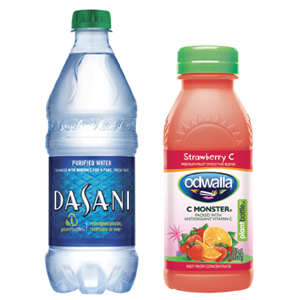
Packaging is integral within its environmental goals and the innovation team at The Coca-Cola Co. is working on projects across each of its primary packaging materials, including glass, aluminum and PET plastic. The company’s innovation priorities include lightweighting across all materials, stay-on tabs for aluminum cans, increasing recycling rates and ensuring that an end-market exists for the recycled materials, explains Scott Vitters, brand manager for the PlantBottle for The Coca-Cola Co.
In addition, the team also has worked on manufacturing packaging from renewable materials. As 60 percent of its volume is delivered in PET packaging, one focus was to research methods to manufacture PET from non-petroleum sources, explains Shell Huang, global packaging R&D for The Coca-Cola Co. Focusing on commercially viable solutions, the company searched for a method to create PET from renewable resources, Huang says.
“At that time, that question was really out of the box thinking because everybody was thinking about new material,” she says. “We were thinking, ‘How can we make an existing material that meets our recycle and functional requirements, but from a renewable resource?’”
The innovation team discovered an existing technology in India that created PET molecules from sugarcane. Through its own as well as external testing, the company found that the process was a viable one, which led to the release of the PlantBottle made from 30 percent renewable material. This year’s introduction of the PlantBottle is the preliminary rollout of this technology, Huang says.
“When we first announced the PlantBottle, we said our journey is to a 100 percent PlantBottle,” she says. “Today, this bottle is our first step. The bigger goal is to make the 30 percent PlantBottle from agricultural waste, such as corn stalks, fruit peels, tree leaves and tree bark. Those are truly long-term sustainable resource for us to use for packaging. We also have a robust research program underway, collaborating with multiple technology providers at universities to work on the other 70 percent molecule.”
Earlier this year, the company debuted the PlantBottle technology commercially.
“In under two years, we’ve moved from announcing the innovation to today having nearly 5 billion packages in the marketplace in 20 different countries around the world, moving toward an ultimate destination of all of our packaging containing PlantBottle material by 2020,” Vitters says.
Importantly, the PlantBottle moves The Coca-Cola Co. away from dependency on commodities, Kent says.
“As PET resin [cost] goes up, the cost of our PlantBottle goes down because it’s got ingredients in it now that up to 30 percent are actually waste-to-resource and that costs less than just using virgin over time,” he says. “Those are the kinds of things that more and more we need to ensure sustainability innovation is embedded into our business going forward.”
The Coca-Cola Co. also saw collaborative opportunities for this technology, Vitters says.
“As we got started, this really was a journey about how do we improve our own sustainability?” he says. “But we realized this program became a catalyst for something even bigger, that the potential of improving not only our own business, or even the PET plastics industry, but really across the all commodity plastics.”
The first step of that possibility was the partnership announced with Heinz to create a ketchup bottle using PlantBottle technology. This collaboration is the first of many that Vitters foresees.
“We’re going to build the supply chain and ultimately have more capacity than our own system can take because ultimately we see a vision where all PET plastic is made from PlantBottle packaging,” Vitters says. “So what’s important for us is that we bring great partners, like Heinz and others, along as we continue to roll this program out to improve our own performance, but also the performance for our environment.”
Environmental milestones
Alongside packaging, The Coca-Cola Co.’s commitment to sustainability includes goals around water and energy reduction, conservation and commitments. Water is a focus for the company because of its integral role in its products and production, explains Jeff Seabright, vice president of environment and water for The Coca-Cola Co.
“Water clearly is the most essential ingredient in our business,” Seabright says. “If we don’t have water, we simply don’t have a business. It’s also a resource that’s under growing stress in communities around the world.”
The company organized its water goals around three principles: reduce, recycle and replenish. Reduce and recycle are traditional focuses for the company as they encompass internal policies on efficient use of water in bottling plants, Seabright says. The company initially set a goal of 20 percent improvement of water efficiency by 2012, and is on track to accomplish the goal, Seabright says. It also is on track to recycle 100 percent of the process water used in the facilities to communities and nature in a safe manner, he says. Under the replenish banner, The Coca-Cola Co. aims to expand support of healthy watersheds and sustainable community water programs by 2020.
The company also has partnered to create nearly 320 community water programs in 86 countries that provide access to water and sanitation, education and awareness on water use, water for productive use and watershed protection and conservation.
In line with local issues, the company has established specific goals and programs in two geographies: India and Africa. In India, The Coca-Cola Co. has a goal of “net zero” water use that incorporates aims to increase rainwater harvesting, expand drip irrigation and other initiatives, and is helping to restore traditional water storage systems that local communities use.
In Africa, the company has a six-year $30 million commitment to provide access to safe drinking water throughout the continent. The initiatives aim to improve the lives of an estimated 50,000 schoolchildren and 250,000 women and girls, who frequently travel long distances to obtain water for their families.
In addition to sustainable water goals, The Coca-Cola Co. also set parameters to reduce its energy use.
“We believe that business must be a very critical part of the solution,” Seabright says. “We have the innovation, creativity and the reach to be able to really provide solutions that are going to be able to help address this challenge — and it’s a challenge that’s deeply linked to energy resource management. So we’re committed both to using the best mix of clean energy and renewable energy in our system, while at the same time reducing our energy use through efficiency in manufacturing and distribution.”
The largest component of the company’s overall carbon footprint is its worldwide network of cold drink equipment, Seabright says. The company has about 10 million pieces of equipment throughout the world, which contributes 15 million metric tons of carbon dioxide equivalent to the company’s total of 37 million metric tons, he says.
“One of the key things to selling these products is selling them cold,” Farrell says. “We place about a million coolers, whether they’re vending machines or refrigerated equipment, every year. And one of the things that you can do as a very, very large business is to start to influence policy of industries that are actually beyond your own. This year, we placed about 162,000 HFC-free coolers.”
Also contributing to The Coca-Cola Co.’s 37 million metric tons of carbon dioxide emissions is the energy it takes to create its packaging, which totals 14 million metric tons.
“If water is in everything that we produce, packaging is what conveys it to the consumer,” Seabright says. “It’s a big part of our business. It’s the physical connection to the consumer. It’s a very, very critical part of our business, and if not managed properly it could be a very big liability in terms of litter and waste and unnecessary emissions. Our vision is really zero waste and our approach is a lifecycle management approach.”
Making up the remainder of its carbon footprint is manufacturing, which equals 5 million metric tons, and its distribution fleet, which contributes 3 million metric tons of carbon dioxide equivalent. In terms of its fleet operations, the company’s scale also is playing a positive role, Farrell explains.
“One of the things that we’re doing with several truck manufacturers is literally buying the trucks to give them some scale to start manufacturing,” he says. “Because hybrid vehicles work very well in a stop and go environment, and there’s nothing more stop and go than delivering beverages.”
In addition to its manufacturing goals, the company’s Live Positively commitments also include local programs that help communities and benefit its supply chain. The programs include the Haiti Hope initiative dedicated to improving the life of 25,000 mango farmers in Haiti, Project Nurture in Kenya and Uganda that is bringing mango and passionfruit farmers into the company’s supply chain and Project Thrive, which is dedicated to distributing micronutrient-enhanced beverages to school-aged children at risk for malnutrition.
In an initiative such as Project Thrive, The Coca-Cola Co. works with local governments to create solutions tailored to local needs. The company has created products in Mexico, the Philippines and countries in Africa that provide necessary nutrients to local children that help them grow and thrive, but also think better, explains Rhona Applebaum, vice president, chief scientific and regulatory officer of The Coca-Cola Co.
“This will give them that jumpstart that they need in terms of getting past a serious number of illnesses that can impact them if they’re not as sturdy and strong as they need to be,” Applebaum says. “We take that very seriously, why? It’s because the only way that we are going to survive another 125 years is to ensure that our communities, starting with our children, today, are as healthy, active, alive and happy as they can be.”
Looking for a reprint of this article?
From high-res PDFs to custom plaques, order your copy today!