Before the adaption of WYSIWG, the acronym for what you see is what you get, printed documents, web pages and slide presentations required users to have in-depth knowledge of codes and markup tags. But, through the use of these system editors, communicating a product’s layout has simplified the process and opened the execution to those who might not possess advanced coding knowledge. As warehouse operations become more complex, software companies also are advancing their programs to ensure plant managers can benefit from that same ease of execution.
Whether it is beer-makers using treated grey water in their recipes or beverage facilities powering their plants with solar energy, the push to care for the planet’s resources is impacting every category within the beverage industry.
Throughout the supply chain, materials movement (logistics) is a vital and operating-cost consuming issue. This is especially true in the beverage market because once a case of a beverage is packaged, it is actually available for the consumer; however, realistically, the case is handled many times before it reaches its final destination on store shelves. There is no value added by any movement beyond being placed in storage or loaded directly for delivery.
The “Pick-A-Little Talk-A-Little” song in the 1962 musical “The Music Man” features the gossipy, hat-and-feather-wearing matrons of River City, Iowa, telling Professor Harold Hill unsavory things about the town librarian. Although today’s voice picking technology focuses on warehouse operations instead of a library’s “dirty book” selections, the technology is drumming up its own attention thanks to its ability to escalate productivity and accuracy, improve safety and ergonomics, and aid in pickup, delivery and in-store workflows.
“Danger, danger, Will Robinson” was a phrase that the robot frequently uttered to the youngest member of the Robinson family during the mid-1960s TV show “Lost in Space,” about a family whose spaceship crash lands on an alien planet. Although the robots in today’s beverage plants do not display human emotions, robotic systems increasingly are being used in beverage operations to speed up bottling, packing and distribution efforts.
From an operations perspective, a warehouse is more than just bricks and mortar or metal siding; it’s a day-to-day activity that handles zillions of beverage cases. But what does it cost to do that?
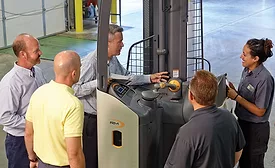
Although the main tasks of a warehouse are to produce and store products, warehouse managers have an even bigger day-to-day goal: safety. For the Industrial Truck Association, safety has taken center stage through its sponsorship of National Forklift Safety Day, which took place June 14.
Looking across all the categories within the beverage industry, observations showcase that the slogan marketers frequently use, “packaging sells,” might be a reality. The validity is not being challenged; however, the package array on the shelves in most retail outlets indicates that packages, containers, closures and even labels are going through frequent changes at some phase in the supply chain.
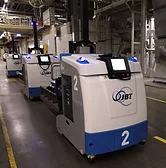
As speed and efficiency become increasingly important in warehouse operations, the use of automated guided vehicles (AGVs) and other autonomous vehicles continue to proliferate.
 RSS
RSS