What happens when the power fails?
Often overlooked, oil and filtration play a major part in keeping plants online
In beverage production, a power loss can be significant, and disruptions rarely happen in isolation. A short disruption can stop a high-speed bottling line mid-run, throw refrigeration systems off target and interrupt clean-in-place (CIP) cycles in ways that might create sanitation concerns. Even a momentary outage can lead to product loss or trigger a series of procedural checks before manufacturing can resume. That risk could increase as plants become more automated and dependent on continuous operation.
Because backup power isn’t a guarantee.
Beverage manufacturers often have backup generators or other measures in place to help safeguard critical operations during power outages. In many facilities, that does not necessarily mean maintaining full production. Backup power might instead support the controlled shutdown of critical processes, protect refrigeration systems, preserve process data, and prevent tank overflows, product loss or equipment damage.
And in theory that should reduce risk, but it does not always work that cleanly.
Backup power is often treated like an insurance policy — critical to have, but largely out of sight until something goes wrong. The challenge is that in an outage scenario, generators are expected to immediately support critical loads. Doing so reliably requires regular maintenance, testing and verification of system performance.
The presence of backup power is not necessarily the same as power resilience. A facility might have generation capacity on-site and still find that it cannot depend on it fully when production is on the line.
What’s stressing modern GenSets
To enhance resilience, many industrial facilities, including beverage plants, are now more dependent on decentralized energy systems such as on-site generators or GenSets. These units are no longer used only as emergency backup. In some operations, they also help manage peak demand, support grid stability, or supplement utility power during periods of strain.
That expanded role also puts more pressure on them. Unlike standby equipment, decentralized generators are more likely to face wear events like sudden ramp-up during an outage, long run times, varying loads linked to production requirements and frequent start-stop cycling.
At the same time, equipment like compressors, chillers and pumps can magnify that stress by delivering rapid, repeated load variations. When problems arise, most of the attention is on the engine itself or the electrical side of the system. But one of the most important factors is also one of the easiest to overlook: the condition of the oil moving through the generator.
Contamination is a significant part of that equation. Oil can accumulate metallic wear particles from internal components, carbon and soot from combustion, oxidation by-products and dirt, or moisture introduced during operation or maintenance. Temperature fluctuations, condensation and broader environmental conditions also can contribute to moisture ingress over time. If left unchecked, these contaminants might degrade lubrication performance, accelerate component wear and increase the risk of a failure that takes the generator offline.
Building more resilient systems
Improving backup power reliability often starts with better maintenance, monitoring and optimization of the systems already in place. For many facilities, the biggest opportunities include:
• Regular maintenance: Test and service GenSets before small issues become failures.
• Oil monitoring: Check oil condition to catch contamination early.
• Fuel quality: Keep fuel fresh and filters clean, especially when generators run infrequently.
• Filtration performance: Treat filters as part of system reliability, not just replacement parts.
• Oil aging: Remember that oil can still degrade while equipment sits idle.
• Periodic testing: Evaluate generators under actual conditions, including quick startups and changing loads.
The goal is to move from reactive maintenance to a more predictive approach based on the core characteristics that make filtration effective:
• Dirt-holding capacity: How much contamination a filter can hold before it needs replacement. Higher capacity can mean longer service life.
• Differential pressure (Δp): How much resistance builds as oil moves through the filter. Keeping Δp in check helps maintain flow and reduce system stress.
• Filtration efficiency: How well the filter captures differently sized particles within a certain micron range that can contribute to wear over time.
What matters in practice is how these factors work together. A filter that captures particles well but slows down flow is not a good outcome. Similarly, a system that keeps flow going but also allows contaminants to circulate can still see long-term degradation.
The goal is to balance contaminant control with stable hydraulic performance, especially when systems are operating continuously or under significant load.
Applying those principles in real systems
For facilities that want to improve reliability, filtration decisions often come down to how well a given solution fits those performance characteristics.
For example, in return-line applications, filter elements may be exposed to high levels of contamination for long periods of time. Eaton’s 01.NR1000 return-line filter elements are designed with these conditions in mind, with a media structure that supports high dirt-holding capacity while helping maintain low differential pressure. In practice, the goal is to preserve oil cleanliness without restricting flow as contamination builds over time.
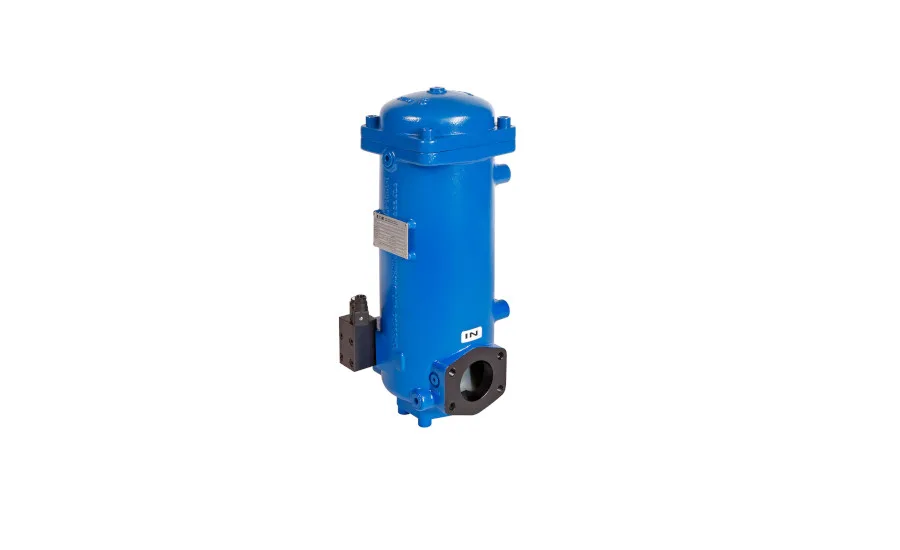
On the pressure side of the system, the priority is maintaining consistent oil flow under higher pressure while minimizing operational pauses. Eaton pressure filter housing configurations such as Simplex (LF series) and Duplex or change-over (DU and TWF series) illustrate how different system needs can be addressed. A simplex filter provides a single-housing solution whereas a duplex configuration allows operators to switch between dual filter elements while the system remains online.
Across these types of solutions, a few common attributes tend to show up:
• Capacity to handle high flow rates typical of large generator systems.
• Filtration in the micron ranges associated with wear-critical particles.
• Designs that maintain stable differential pressure over time.
• Options for monitoring filter condition, such as clogging indicators.
Together, these features reflect the same principle discussed earlier: that filtration has to perform consistently under real operating conditions.
In certain customer applications, Eaton has observed that improved oil-filtration and oil-management practices can help reduce generator-related downtime by approximately 30%-50% and extend engine component life by up to two times or more — driven by cleaner oil, lower wear rates and more stable performance during peak loads. Actual results might vary depending on operating conditions, maintenance practices and system configuration.
Why it matters for beverage operations
Backup power systems are only as dependable as the components behind them. If filtration cannot keep pace with contamination levels or maintain stable flow, the risk shifts back to inside the system, often in ways that are not visible until a failure occurs.
By contrast, filtration solutions built for continuous use and more stable long-term performance can help lower that risk. They can support cleaner oil, make maintenance intervals more predictable and improve the odds that the generator will be available when the plant needs it.
As beverage facilities become more automated and less tolerant of disruption, backup generators are increasingly viewed as essential infrastructure rather than emergency-only systems. In that environment, oil condition and filtration performance can play a larger role in operational resilience than many facilities realize.
Looking for a reprint of this article?
From high-res PDFs to custom plaques, order your copy today!