Palletizer, depalletizer equipment help warehouses adjust with beverage market
Machinery helping address labor concerns
With consumers’ demands changing, the shelves in grocery stores have become more diverse. For shelves to reflect this mix, warehouses also are getting shake-up regarding their inventory. To accommodate this shift, operations need flexible equipment that keeps product flowing.
“The beverage market today is looking for palletizers and depalletizers that are more flexible and can keep up with expanded SKU sets and changing order profiles,” says Hesham Abdelhamed, solutions consultant at DMW&H, Fairfield, N.J. “In the past, a lot of this equipment was built around full pallets, single SKU layers, and more predictable product flow. Those types of palletizers, depalletizers, and layer picking systems still have a strong place, especially when they are tied to production lines, high volume SKUs, or building starter pallets.
“But the demand is changing,” he continues. “As orders become more mixed and more customer/store specific, companies are looking for equipment that can also reliably handle mixed-SKU layers, less-than-full-layer handling, and even single cases and still meet expected performance.”
Alyssa Keeney, solution consultant at Atlanta-based Dematic, explains that in the past operations viewed palletizers and depalletizers as an add-on to an automated solution, but that has changed for today’s automated warehouses.
“These solutions are in higher demand today as they increase speed and reliability amidst a changing labor market, but the most central benefit comes from improved safety,” she explains. “Palletizers and depalletizers reduce the need for repetitive lifting, awkward postures (such as bending, twisting, and reaching), and variable loads for staff.
“Additionally, automated palletizers increase density of the outbound pallets thus reducing transportation costs,” Keeney continues. “We are seeing our customers increasingly requesting these technologies as a base solution for their automated facility because of their reliable throughput.”
These needs for efficient operations are being prompted by a number of trends and shifts in the market.
“Several trends in the beverage industry are increasing demand for palletizing and depalletizing solutions,” Keeney says. “First, beverage manufacturers continue to face labor shortages, particularly for repetitive, physically demanding warehouse tasks such as manual pallet building and unloading. Automation helps facilities maintain consistent throughput despite workforce constraints while improving employee safety.”
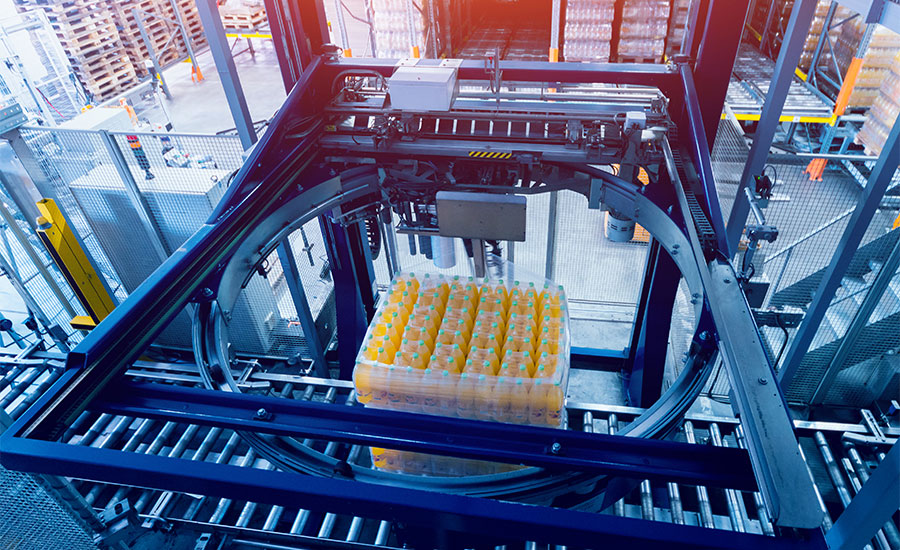
Automation is prompting end-of-line solutions in warehouses.
Photo by romaset/iStock / Getty Images Plus via Getty Images
Keeney also notes how transportation costs are prompting beverage manufacturers to maximize trailer utilization and reduce the cost of moving products.
“Automated palletizers can create denser, more consistent loads that improve cube utilization and reduce shipping expenses,” she says.
Keeney explains that consumers’ demand for more product variety, package sizes and seasonal offerings also are having their impact on operations.
“This greater complexity requires flexible, high-throughput material handling systems that can efficiently manage changing product mixes,” she says. “As a result, palletizers and depalletizers have become an important tool for helping beverage operations improve efficiency, reduce costs, and maintain service levels in an increasingly demanding market.”
DMW&H’s Abdelhamed also notes the complexity impact that SKU proliferation has had on warehouses.
“Beverage operations are handling more SKUs, more mixed-order pallets, and smaller pallet formats like half pallets,” he says. “These give customers flexibility on what they can order and make delivery easier, but they also add more complexity into the warehouse. The right palletizing equipment can address that by handling different pallet sizes, building mixed-SKU orders, and just being able to handle a wider variety of SKUs.”
However, the key to driving interest in palletizing and depalletizing equipment is the influence automation is having on warehouses.
“As companies bring in AS/RS systems, conveyors, AMRs, AGVs, or other automated systems, palletizers and depalletizers are expanding the automation capabilities between inbound, storage, replenishment and order fulfillment,” Abdelhamed says. “Depalletizers can break full or partial pallets down into layers or cases to feed the system, while palletizers can build orders back into the right pallet mix.”
Abdelhamed notes that this equipment can fit into any type of warehouse model whether it be fully automated or as standalone operation.
“As orders become more mixed and more customer/store specific, companies are looking for equipment that can also reliably handle mixed-SKU layers, less-than-full-layer handling, and even single cases and still meet expected performance.”
– Hesham Abdelhamed, solutions consultant at DMW&H
“On the palletizing side, they can take product cases from different sources, whether manual or automated, and build more accurate and stable pallets with little to no human intervention,” he says. “That means fewer errors, less rework, less QC, less product damage, and just fewer issues with shipments.
“On the depalletizing side, they can support a more efficient inbound process as well as a more dense and responsive storage strategy,” Abdelhamed continues. “One approach is to keep product stored at the pallet level as long as possible and, when an order is placed, an automated depalletizer breaks the pallet down on demand to feed fulfillment directly. Another approach is to depalletize and replenish a buffer system, like a case AS/RS or an order release module, where product is staged and ready to release to build orders downstream.”
End-of-line solutions
In the production of beverages, automation often is highlighted for the beginning- and middle-of-line tasks, but end-of-line can play a vital role as warehouses deal with labor shifts.
Kristian Hulgard, general manager at OnRobot for Americas, Irving, Texas, explains that the rise of automation has helped operations address labor challenges.
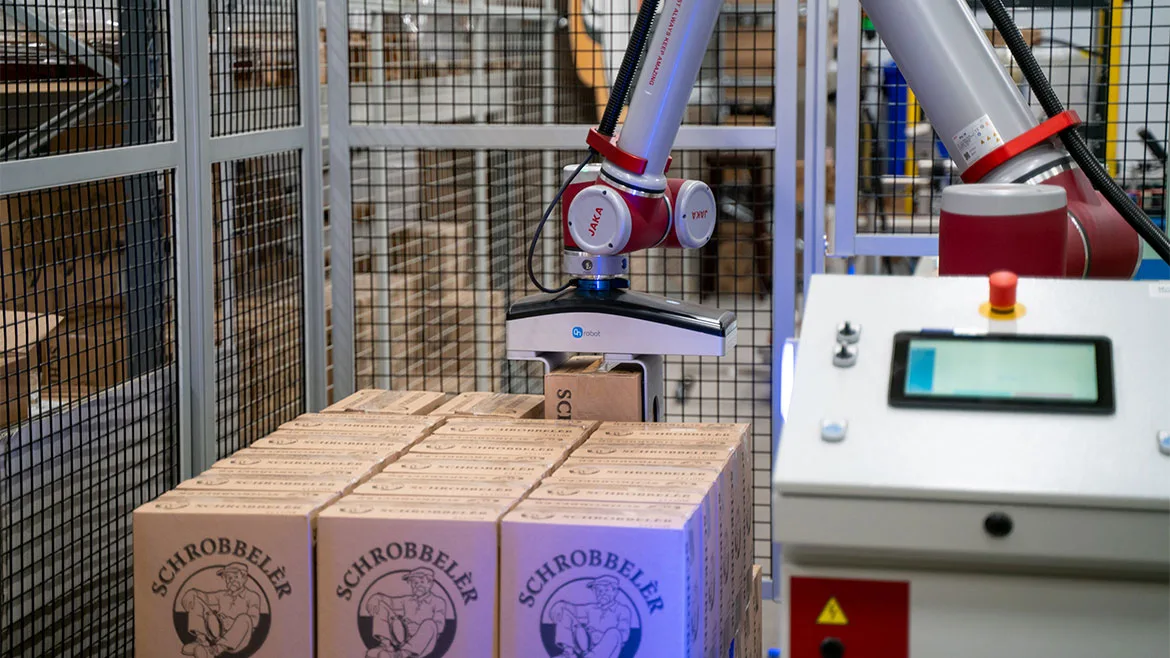
“End-of-line operations are hit by labor shortages as much as other roles in manufacturing,” she says. “So, to fill the labor shortage gap ― and the nature of palletizers being at the end of the line ― (not disrupting the upstream processes and flow of existing production lines) it is a great place to automate for F&B companies.”
Hulgard adds that palletizers typically free up to two to four people in a shift, allowing food and beverage manufacturers to allocate labor in other areas of the manufacturing plant.
DMW&H’s Abdelhamed also points to the impacts that palletizers and depalletizers can serve when addressing labor concerns.
“Palletizers and depalletizers help address labor shortages by reducing reliance on some of the hardest roles to fill in beverage operations,” he says. “Roles that tend to involve a lot of heavy lifting, repetitive motion, reaching, and twisting are the kind of work that can increase the risk of injury, turnover, and overtime. When you automate that, you are not just replacing the heavy lifting. You are making the operation safer and easier to staff.
“There is also a real opportunity to do more with less, either within the same shift or by running during off-hours,” Abdelhamed continues. “These systems require minimal human involvement once they are running, which means they can operate overnight without adding an additional shift. For example, a depalletizer can break down inbound product and replenish storage locations so that the warehouse is already charged and ready to build orders the next day.”
Dematic’s Keeney echoes similar sentiments, highlighting that palletizers and depalletizers can allow operations to direct employees to other tasks.
“Palletizers and depalletizers can help beverage operations address ongoing labor shortages by automating repetitive, physically demanding tasks that often make it difficult to staff and retain workers,” she says. “Rather than eliminating jobs, automation often enables workers to transition into safer, more ergonomic roles focused on monitoring equipment, managing exceptions, and supporting overall workflow. This not only improves productivity per employee but also helps beverage manufacturers attract and retain workers by reducing physically strenuous work and creating more skilled operational positions.”
Investing in the future
As original equipment manufacturers invest in the advancements for palletizing and depalletizing machinery, the market also is seeing it become more affordable for warehouses.
“The market now offers palletizers starting around $100,000, which gives SME F&B manufacturers a great starting point for automation with a sub-two-year ROI,” OnRobot’s Hulgard says.
Hulgard also notes improvements to software is supporting ease of use for operators.
“Software like OnRobot’s D:PLOY, eliminates the need for expert knowledge and engineering when deploying, running, maintaining and redeploying your palletizer,” she says. “This empowers the F&B manufacturer to take control of their own automation journey.”
DMW&H’s Abdelhamed also points to advancements in software as well as other capabilities supporting palletizing and depalletizing machinery capabilities.
“The biggest advancements I am seeing are around vision, modularity, and software,” he says. “On the vision side, better vision means better performance. It means fewer errors, fault recoveries, and more robust handling of exception cases. Better vision gives the system the ability to recognize and react to what actually comes its way.”
Abdelhamed explains that machinery is designed around more of a plug-and-play type setup, allowing it to be up and running in weeks, not months.
“This makes them easier to deploy and quicker to scale, which makes them more practical for many existing facilities, even those with little to no automation,” he says. “Software is also improving in a way that makes these new age palletizers simpler to operate and maintain. They can be easier to adjust as the SKU mix changes.”
Dematic’s Keeney explains that investments to improve palletizing and depalletizing machinery is helping facilities productivity.
“One primary update is in advanced end-of-arm tooling innovations such as hybrid grippers (vacuum, clamp, and fork combinations) and integrated sensors for slip detection,” she says. “These allow fragile items and heavy loads to be handled within the same cell where they would have formerly been managed in distinct pallets. Algorithms to optimize the pallet building plan are more efficient than ever, incorporating optimizations from the food industry as well.”
Like many industries, improved palletizing and depalletizing machinery is seeing the influence of artificial intelligence (AI) where it currently stands and where it’s going.
“AI already helps a lot of companies create patterns and motion for the pallet and robot to eliminate cost for programming,” OnRobot’s Hulgard says. “A great example is OnRobot’s D:PLOY platform that eliminates the need for programming the palletizer. The operator simply adds the box and pallet dimensions, and D:PLOY figures out the robot trajectory.”
In terms of AI’s influence, Dematic’s Kenney notes that it’s less about a single breakthrough but more around technology convergence.
“AI, robotics, vision, software and mobility are working together now more than ever,” she says. “These advancements decrease the rigidity of automation requirements. With AI in the conversation, mixed SKU pallets are now candidates for fully automatic depalletization. Only a few years ago, this would’ve seemed impossible.”
DMW&H’s Abdelhamed adds that AI and machine learning allow palletizing and depalletizing machinery to become less rigid.
“With vision technology acting as the eyes and AI acting as the brain, the equipment will have the ability to react to what is actually happening in front of it rather than following a fixed program or a fixed pallet pattern,” he says. “In certain applications, cases can come in a random or semi random sequence and the system can make decisions in real time, instead of having to control the exact sequence upfront. So, for mixed-case palletizing, for starters, it is almost like solving a real-world game of Tetris on the fly. The same idea applies to depalletizing, just in reverse.”
Abdelhamed also envisions opportunities for AI to test the palletizing/depalletizing scenarios against more unpredictable scenarios.
“That can help save time, reduce surprises, and lower commissioning risk,” he says. “That does not mean AI is going to solve everything. It still needs good system and mechanical design, good data, and the right application. But it can be a big enabler for more flexible and reliable palletizing and depalletizing systems.”
As technology advances, palletizing and depalletizing is prepped to fuel the future of warehousing.
Looking for a reprint of this article?
From high-res PDFs to custom plaques, order your copy today!