Advanced solutions keep case packers, wrappers ahead of the curve
Sustainability, SKU proliferation prompts a greater need for flexible equipment
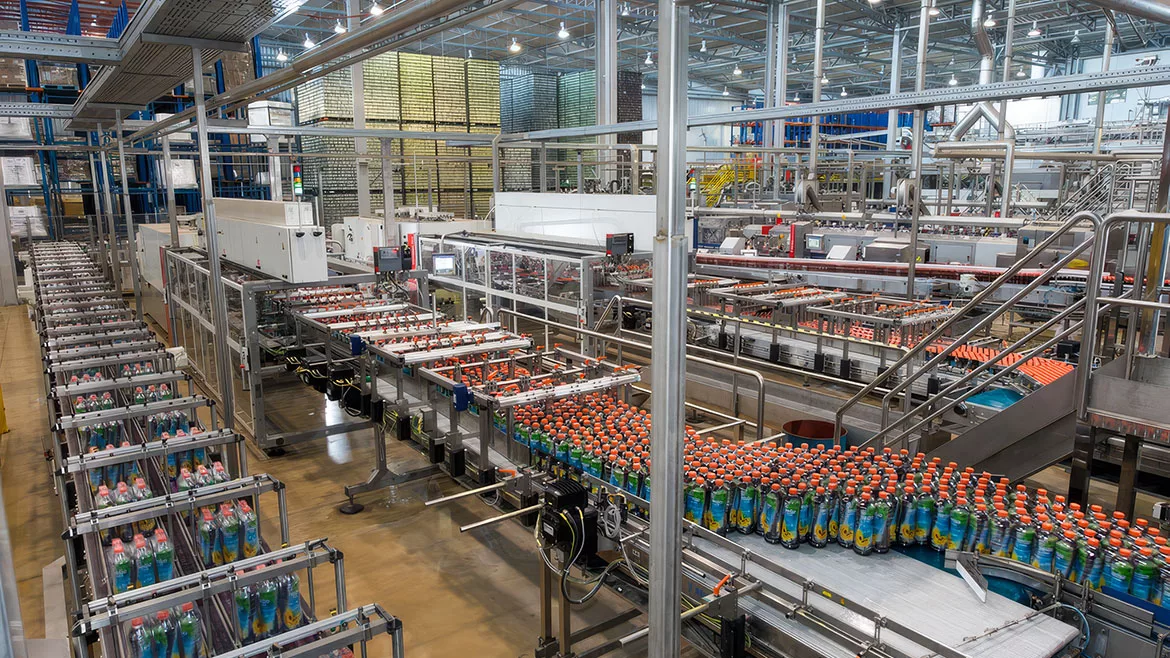
In sports, flexibility enhances performance by allowing athletes to achieve better body positioning and improve overall strength and agility. Similarly, with SKU proliferation impacting the beverage industry, case packing and wrapping equipment requires flexibility to enhance overall line performance.
“The growing number of SKUs and pack configurations is steadily increasing the need for fast, precise and hassle-free changeovers,” says Robert Lindsley, product line manager for case packers and palletizers at Krones Inc., Franklin, Wis. “To address this demand, the industry is placing greater emphasis on automated changeover solutions for both individual machines and complete production lines.
“Krones meets this need with its Unit Express and Line Express systems, which work on two complementary levels: Line Express coordinates product changeovers across the entire line, while Unit Express applies those changeover instructions at the individual machine level,” he continues. “Together, these solutions provide manufacturers with fully aligned, highly efficient changeover automation that delivers substantial value.”
Peter Fox, CEO of SOMIC Packaging Inc., Inver Grove Heights, Minn., considers flexibility and changeovers to be one of the biggest drivers of overall line performance in beverage packaging.
“Beverage producers are running more SKUs, more pack formats and shorter production runs, so the ‘lost time’ during changeovers can quickly become a hidden cost in overall equipment effectiveness (OEE) and throughput,” he says.
Fox points out that the SOMIC 434 SuperFlex is designed to help beverage operators reduce “lost time” and hidden costs by enabling repeatable and recipe-driven format changes while supporting a wide range of case styles and pack patterns on one platform.
“The result is faster changeovers, more predictable restarts, and having the ability to run variety and promotional packaging without sacrificing uptime,” he says.
As far as which beverage trends are contributing to the need for faster changeovers, Fox notes that several trends are accelerating demand for flexible case packing and wrapping.
“It starts with SKU proliferation, which includes more flavors, pack sizes, and seasonal releases,” he explains. “Variety packs are now becoming a major growth driver, and we are seeing growth in ready-to-drink (RTD) and specialty beverages with more frequent changeovers. Retailers are pushing more promotional formats and custom pack configurations, and there is more packaging variety across different channels, such as club, convenience, grocery, and eCommerce.”
Krones’ Lindsley echoes similar sentiments.
“Consumers are increasingly seeking greater variety, including smaller serving sizes and a wider range of mixed or assorted packs, and their preferences continue to shift toward higher quality offerings rather than simple volume,” he says.
“As this trend accelerates, production lines must be capable of switching from one product to the next almost immediately,” he continues. “In practical terms, this means the filler may already be running product number two while the packer is still clearing out the remaining bottles from product number one, making rapid and well-coordinated changeovers essential.”
Daniel Reichert, marketing manager at Tarpon, Fla.-based A-B-C Packaging Machine Corp., says that the need for flexible equipment stems from the consumer shift toward health-oriented drinks.
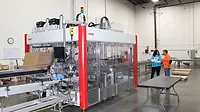
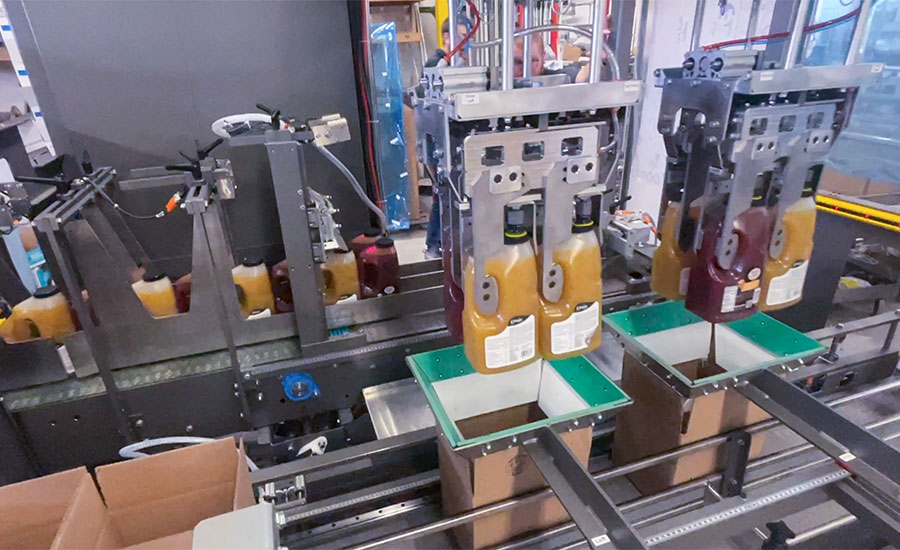 A-B-C’s semi-automatic packers are designed to handle a wide variety of beverage containers, Daniel Reichert notes.
Image courtesy of A-B-C Packaging Machine Corp
“These drinks often go to market in a can or paperboard containers rather than glass,” he says. “Additionally, companies are continually experimenting with SKU proliferation leading to new flavors, seasonal items and smaller runs, which ultimately translates to more changeovers and needing a more flexible machine. Machines need to not only be able to handle the products that a line is currently running, but the products they will be running in two, five or 10 years from now.”
Supporting a circular economy
Alongside beverage trends, sustainability trends are affecting case packing and wrapping equipment.
“Sustainability influences both the packaging materials being used and how equipment needs to handle them,” SOMIC’s Fox explains. “We’re seeing increasing interest with right-sized packaging that is reducing corrugate and film usage, and lightweight materials that still need reliable handling.
“There is also a greater emphasis on minimizing waste, especially during startup and changeover, and equipment designs that support more efficient packaging patterns and reduced material consumption,” Fox continues. “In practical terms, sustainability is pushing the industry toward equipment that is both gentle and precise. This is because lightweight materials and thinner films can be less forgiving.”
A-B-C’s Reichert echoes similar sentiments, noting that with a shift away from traditional rigid plastic and glass materials the company is seeing an increase in paper-based products and other flexible formats.
“Due to the different packaging material types, a different product handling method is required to collate and manipulate the products,” he explains. “Less material is continuously used in the product shipping methods, leading to improvements in sustainability, a decreased carbon footprint, and an increase in cost savings.
“We’re also seeing a shift in paperboard multipack alternatives replacing shrink wrapping, which is leading to more wraparound or carton-based multi-packing,” Reichert continues.
Patrick Nelson, engineering director at Standard Knapp (EOL Group), Portland, Conn., notes that many of the glues, cardboards, and plastic films have changed over the years and continue to evolve.
“Thinner films and more biodegradable materials generally require more accurate and consistent mechanical and software controls,” he explains.
Krones’ Lindsley says that with consumers showing a strong preference for packaging solutions that emphasize sustainability, this shift is accelerating the adoption of fiber-based packaging in Europe driven by brand value considerations.
“A key factor behind this movement is the growing focus on circular economy principles,” Lindsley says. “In many European regions, particularly countries located near bodies of water such as the Mediterranean, there is increased pressure to reduce single-use plastics because fiber-based materials are viewed as having stronger circularity than plastic.
“Alongside this transition, packaging trends continue to evolve toward minimalist design, improved recyclability, and clear, authentic communication that aligns with consumer expectations,” he continues. “Krones is uniquely positioned to support this development by offering both conventional single-use plastic packaging and paper-based alternatives on the same machine platform for cans and PET containers, giving producers flexibility as sustainability demands continue to rise.”
Lindsley adds that Krones offers a fully developed portfolio, highlighting the bulk of the company’s packaging solutions.
“The continuous motion Variopac Pro processes bottles, cans and fiberboard cartons in shrink film, trays, wraparound corrugated cartons and the Litepac Top provides sustainable options by using a corrugated clip and paper band to secure PET bottle packs,” he says. “To strengthen its expertise in fiber-based and flexible paper packaging, Krones is collaborating with DS Smith, a member of International Paper, and Mondi. Although this partnership is rooted in Europe, customers in North America also benefit from the expanded knowledge and material development it enables.”
Additionally, Lindsley points to Krones’ modular Varioline system as enhancing production flexibility by offering a wide range of pick and place configurations tailored through its customizable module layout.
“Together, the Variopac Pro and Varioline provide complete end-of-line packaging solutions directly from the discharge conveyor,” he says. “Krones also supports specialized applications with standalone equipment, including the Variocart carton erector for RSC boxes, the Variocol carton sealer, the Linapac II pick and place packer, and the Smartpac NXT pick and place caser and uncaser.”
SOMIC’s Fox notes that, alongside the 434 SuperFlex, SOMIC offers a portfolio of case packing and wrapping solutions that can be configured to match different beverage requirements.
“This is true whether the priority is maximum speed, high format flexibility, or is related to specific case and tray styles,’ he says. “Our approach is to match the system to the beverage operator’s reality involving pack style, speed targets, changeover frequency, and upstream/downstream integration requirements. The 434 SuperFlex is a strong example of that modular, scalable platform approach.”
A-B-C’s Reichert calls attention to the company’s broad range of flexible case and tray packing solutions that help maintain consistent throughput and package quality.
“A-B-C’s robotic, horizontal, wraparound, and semi-automatic packers are designed to handle a wide variety of beverage containers — including cans, bottles, cartons, multipacks and flexible packages — while providing gentle, controlled handling to protect labels, graphics and package integrity,” he says. “Features such as automatic product accumulation and orienting, precision pick-and-place or horizontal packing, interchangeable end-of-arm tooling, and recipe-based changeovers help reduce downtime, lower labor dependence, and ensure securely packed cases and trays for distribution.
Reichert adds that with scalable configurations for both growing and high-volume beverage operations, A-B-C’s case packing solutions support efficient end-of-line performance while giving manufacturers the flexibility to evolve as product mixes and market demands change.
Standard Knapp’s Nelsen echoes similar sentiments, noting that many customers need to package their products in multiple formats.
“Standard Knapp with our EOL sister companies are able to supply a variety of case, wrap-around, and film wrapping solutions,” he says. “Drop packers, wrap around packers, tray packers, shrink film wrappers, variety packers, palletizers, depalletizers, and conveyor systems.”
A promising future
Although automation is expected to impact the future of case packing and wrapping operations, experts note that AI solutions continue to grow and augment processing around the packaging industry.
“In case packing, the primary impacts could be the ways that AI could augment machine changeovers, predictive maintenance, and machine problem diagnostics,” A-B-C’s Reichert says. “Additionally advanced vision systems could help robotic solutions in guiding the packing process, or vision quality checks for completeness, damage, barcoding presenc,e and SKU tracking.
SOMIC’s Fox notes that AI is poised to significantly improve case packing and wrapping operations, especially in the areas of uptime, maintenance, and troubleshooting.
“In the near term, the most practical AI impact will likely involve predictive maintenance to reduce unplanned downtime,” he says. “Also, there will be faster root-cause identification for micro-stops and recurring faults, smarter performance monitoring that helps plants improve OEE over time, and automated pattern recognition across alarms, sensors and production data.
“Longer term, AI could help optimize changeover performance and improve the overall line stability by continuously learning from production behavior,” Fox continues.
Krones’ Lindsley echoes similar sentiments, noting that AI is set to significantly enhance overall line performance.
“Krones is advancing these capabilities through solutions such as the Shopfloor Guidance system, which uses condition monitoring to detect anomalies at an early stage, and the Line Observation system, which provides real time insight into production conditions,” Lindsley says. “With the support of live streaming, video analysis and AI enhanced diagnostic functions, these tools help identify malfunctions, evaluate equipment utilization and initiate targeted corrective measures.
“These services are also available within the Krones Ingeniq platform, a revolutionary line concept providing customers with an integrated, AI-driven process optimization platform to reduce downtime and increase overall equipment effectiveness (OEE),” he continues.
As far as what’s in store for packers and wrappers in the years to come, Lindsley says the outlook is “highly promising.”
“We anticipate a new phase of progress marked by fully automated machinery, broader application of robotics, deeper integration of AI, and autonomous material handling systems that efficiently supply packaging components and consumables,” he says.
A-B-C’s Reichert anticipates that primary equipment advancements will be material and product driven, noting that as machinery changes it will need to be modified to adapt to the different packaging handling and package characteristics.
“But producers will continue to configure different ways to augment their products with AI, as well as creating more modular end-of-line packaging cells that allow for interchangeable and adaptable solutions,” he says. “We expect more equipment to be designed around paperboard multipacks and recyclable materials as sustainability is increasingly important. Additionally, we expect a deeper integration for machines like ours to be connected through IOT to MES/ERP systems for scheduling, recipe control, and automated reporting and increased OEE.”
SOMIC’s Fox expects several advancements to continue shaping the next generation of beverage case packing and wrapping equipment.
“It starts with more modular machine platforms that can scale with changing product demands,” he explains. “There will likely be increased use of servo-driven motion control for smoother, more repeatable handling, and more intuitive HMI and recipe management to reduce training time and operator error.”
Fox also expects to see better integration with plant-level systems for real-time performance visibility, and continued improvements in changeover speed and repeatability as flexibility will remain a core requirement.
“Ultimately, the direction is clear,” he says. “Beverage operations need equipment that is not only fast but also adaptable, easy to run, and dependable in high-mix environments.”
Looking for a reprint of this article?
From high-res PDFs to custom plaques, order your copy today!