Robotics support beverage brands in operations, warehouse settings
As robotics technology advances, beverage brands find new ways to benefit
In the first book of the children’s series “The Wild Robot,” a robot named Roz adapts to living on an island with animals. Despite her technical abilities, Roz requires guidance from the animals.
Like the way Roz must adapt, the beverage industry has adapted to SKU proliferation through the use of robotics.
Drew Eubank, executive vice president at Zion Solutions Group, Covington, Ky., shares how SKU proliferation within the beverage industry has influenced automation in warehouses.
“As with most growing operations, more SKUs equals more space and more complexity,” he says. “With FDA regulations, this oftentimes means more space and headcount. Automation helps to supplement both, providing more efficient retrieval of inventory and a more predictable headcount base, while optimizing footprint (less long-term fixed costs) as inventory and SKU count grows.”
Jane Heffner, vice president of sales for Universal Robots and Mobile Industrial Robots (MiR), Novi, Mich., says that SKU proliferation has accelerated the adoption of automation, especially collaborative robotics.
“Higher mix automation with traditional solutions (like traditional multi-layer palletizing) [is] too rigid and less cost efficient; therefore, reliance on manual labor in end-of-line packaging is a challenge,” she explains. “Collaborative palletizers address that very well, as they provide short ROI, even in this high-mix environment.”
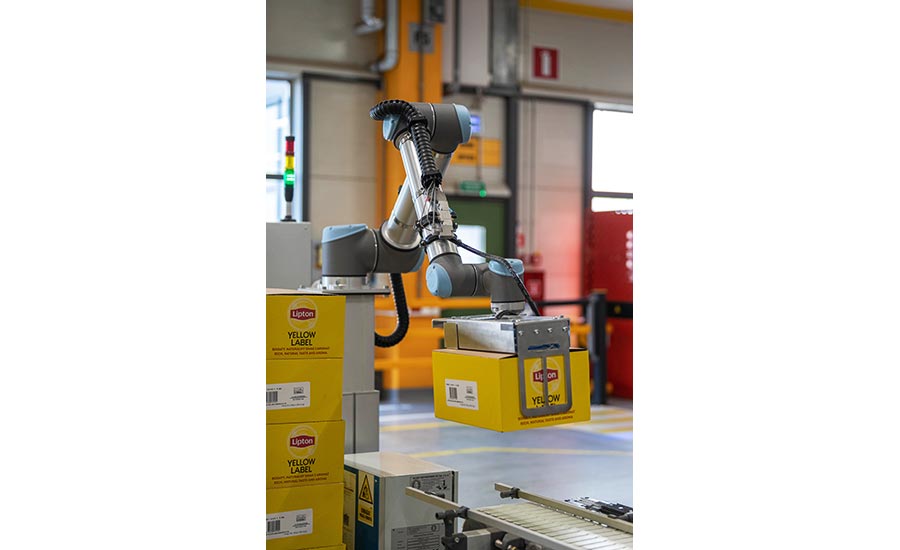
Universal Robots’ cobots are being deployed for end-of-line palletizing, case packaging and labeling and sorting stations, Heffner says. The flexible programming of the cobots means operators can quickly reconfigure a robot for shifting SKU portfolios, she adds.
“Cobots also help warehouses optimize space and labor — by automating repetitive tasks across diverse SKUs, they reduce manual errors, speed up order fulfillment and enable denser storage layouts, addressing complexity without expanding footprint or headcount,” Heffner states. “Ultimately, SKU proliferation is making agility and scalability non-negotiable — and collaborative robotics are proving indispensable for end-of-line packaging and storage areas looking to keep pace with ever-changing consumer demands while maintaining efficiency and safety.”
James Taylor, chief commercial officer at OnRobot, says SKU proliferation has influenced the need for more flexible and adaptable automation in warehouses.
“Historically, traditional automation systems, even those referred to as ‘turnkey,’ were better suited for low-mix production and required costly, time-consuming custom programming by system integrators for every workpiece or product change,” Taylor states. “This made it impractical and expensive for manufacturers, especially those with diverse product lines and frequent changeovers, to automate tasks like palletizing or machine tending.”
For beverage products, he shares that dealing with various bottle sizes and different packaging formats means constant adjustments are needed.
“SKU proliferation exacerbates this by introducing more complexity and the need for frequent line reconfigurations,” Taylor explains. “As a result, many manufacturers have been ‘stuck with the challenges’ of optimizing production for high-mix scenarios that are often considered too complex and expensive to automate.”
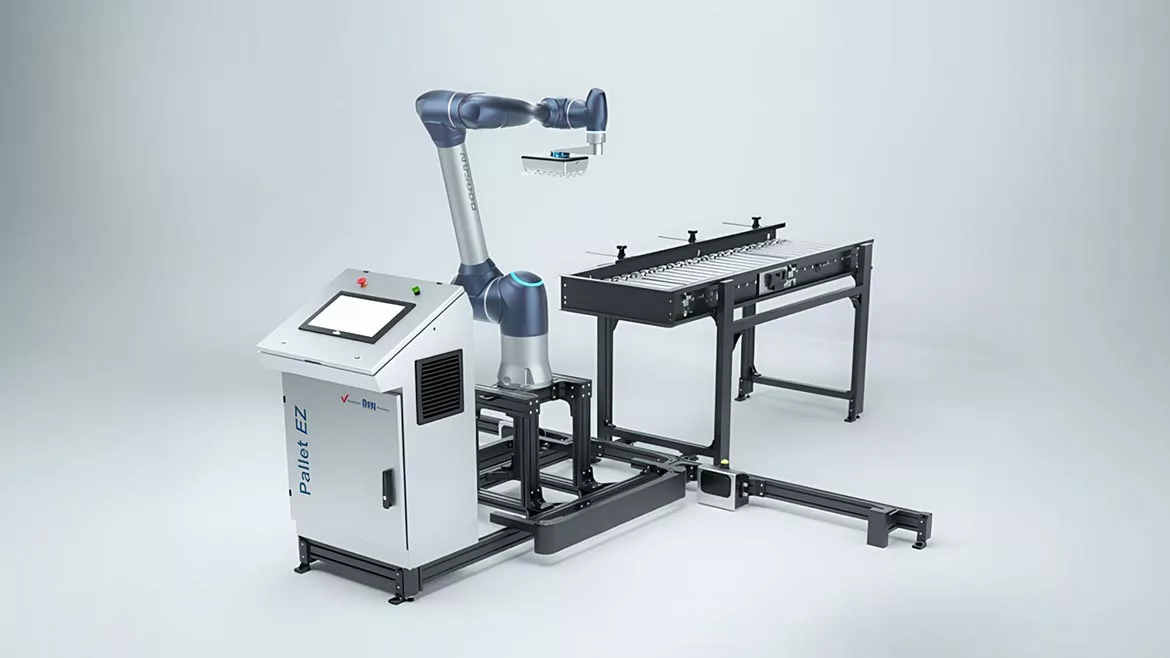
However, the emergence of automated programming platforms like OnRobot’s D:PLOY is directly addressing this, he says. D:PLOY enables the creation of flexible, affordable and easy-to-use robotics systems specifically designed to automate high-mix tasks, according to Taylor.
“This allows manufacturers to manage product variations and perform changeovers in-house, making automation viable where it wasn’t before,” he adds.
Embracing robotics
The beverage industry has adopted robotic technology in a variety of ways.
Zion’s Eubank shares that layer picking/stacking was adopted early on as beverage manufacturers realized that the speed and support to the human was highly inefficient, due to the bulkiness and heaviness of beverage SKUs.
“As manufacturers have increased inventory, pallet shuttles, pallet and case AS/RS has become more popular,” he says. “Conveyance remains a highly used automation along with the robotic segments. Point-to-point AMRs have allowed for better flow in brownfield operations with limited availability to put in higher-end automation.”
Universal Robots’ and MiR’s Heffner says that Universal Robots has seen the beverage industry become one of the most exciting growth areas for automation.
“Across breweries, soft drink producers and packaging facilities, companies are under pressure to deliver higher output, maintain consistent quality and meet rapidly changing consumer demands — from smaller batch runs to sustainable packaging,” she describes. “Our cobots are being deployed on tasks such as end-of-line palletizing, case picking and labeling.”
Unlike traditional automation, Heffner notes that Universal Robots’ cobots are lightweight, space-saving and safe to operate alongside people, which enables users from global beverage leaders to local craft producers to scale automation without restructuring facilities or adding complex guarding.
“Importantly, we’re seeing adoption expand beyond efficiency gains,” she adds. “Beverage companies are using cobots to reduce workplace injuries from repetitive motions like lifting heavy cases or loading bottling lines, while freeing employees to focus on quality control and customer-facing roles.”
The beverage market’s adoption of robotic technology is evolving rapidly, OnRobot’s Taylor states. This rapid adoption is driven by pressing needs to address ergonomic challenges, labor shortages and the demand for increased efficiency, he adds.
“Historically, companies in the beverage sector, particularly small to medium-sized ones, have faced hurdles in adopting robotics due to the complexity, high cost and lack of flexibility of traditional systems,” Taylor says. “Robot arms alone are just components. Integrating them into a complete system often involved significant additional costs, weeks or months of work, and specialized programming expertise.”
However, he notes there is a clear move toward more accessible and “off-the-shelf” solutions.
“We see examples like Schrobbelèr B.V., a beverage producer, who automated their palletizing tasks because manual handling of heavy 6-bottle boxes was physically demanding and affected productivity,” Taylor shares. “They found traditional systems daunting due to complexity and ongoing integration costs for product changes. The successful implementation of an off-the-shelf palletizing solution, powered by D:PLOY, demonstrates a growing readiness in the market for automation that offers same-day installation, clear pricing and easy in-house changeovers without programming expertise.”
Moreover, Taylor says that while high-volume industries have been leaders in autonomous operations due to their resources and scale, the availability of solutions like D:PLOY now is making automation an accessible entry point for a broader range of manufacturers — including those previously held back by capital challenges and expertise constraints.
“This signifies a shift toward a more widespread and successful robotic adoption in the beverage industry,” he adds.
Robotics can offer beverage warehouses a variety of benefits.
OnRobot’s Taylor lists the following advantages of robotics with advanced automated programming platforms:
- Solution to labor challenges
- Increased throughput and efficiency
- Cost-effectiveness and price transparency
- Flexibility for high-mix production
- Immediate availability and same-day installation
- Low-risk investment
Universal Robots’ and MiR’s Heffner echoes similar sentiments, noting that cobots and autonomous mobile robots (AMRs) provide a comprehensive suite of benefits for beverage warehouses.
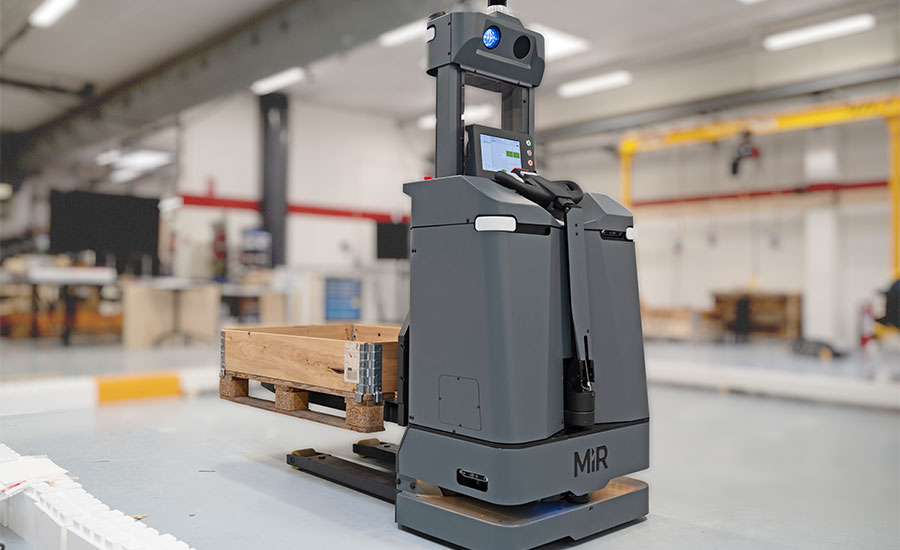
“AMRs are transforming the way warehouses operate by taking on the repetitive, heavy and time-sensitive tasks that have traditionally burdened employees,” she says. “From an MiR perspective, we see two solutions making an immediate difference in beverage logistics: our MiR Deckloads and MiR Pallet Jacks.”
The MiR AMRs are highly adaptable transport platforms designed to move cases, kegs or mixed loads, Heffner explains, while the MiR Pallet Jack AMRs take automation a step further by automating full pallet movements.
She notes benefits such as painless palletizing and improved ergonomics, increased productivity and efficiency, and faster return on investment (ROI) and lower total cost of ownership (TCO). Flexibility and adaptability, compact design and space utilization, and ease of use and programming are other advantages Heffner lists.
“Thanks to intuitive palletizing control software solutions, cobots are easy to deploy regardless of prior robotics experience,” she states. “This significantly reduces downtime, speeds up ROI and eliminates the intimidating programming costs often associated with traditional automation. Our own PolyScope software, with its graphical user interface and software wizards, allows new systems to be deployed in hours and product changeovers in minutes.”
Technology improvements beyond artificial intelligence (AI) have aided the robotics market.
“Competition between OEMs has driven more robust offerings from the same organizations as they compete for market share,” Zion Solutions’ Eubank says. “The ability to use software to integrate multiple robotic systems has eased pain that was the ‘siloed’ approach that was prominent as recent as COVID-19.”
OnRobot’s Taylor states that several significant technological improvements have greatly helped the robotics market, including simplified software platforms.
“Revolutionary software like OnRobot’s D:PLOY platform is a game-changer for accessibility,” he says. “These platforms automate programming and adapt for various pallet patterns or product sizes with an intuitive, no-code interface, enabling easy in-house deployment and changeovers for new workpieces in minutes, even without programming expertise.”
Additionally, Taylor points to improvements like easy-to-use and flexible robot arms, grippers and tools, safety, AMRs and enhance interoperability have helped the robotics market.
“The push for industry-wide standards for communication between devices is crucial and will continue to accelerate adoption by simplifying the integration of new technologies with existing legacy systems,” he adds. “OnRobot’s ‘One System, Zero Complexity’ platform significantly enhances interoperability by providing a unified experience across all major robot brands. This means that tool changes can happen in seconds without the need for rewiring or reprogramming, making it easier for manufacturers to easily connect end-effectors to any robot arm.”
Universal Robots’ and MiR’s Heffner lists similar advancements, noting that cobots with increased payload capacities and greater reach are suitable for a wider range of applications and heavier products.
As for what’s next for robotic systems, Zion Solutions’ Eubank says continued advancement of software driven decisions will help make the physical operation more robust and create better flow.
“Being able to pre-build trailer loads prior to waving, helping with both operational labor costs and more dense and accurate transportation modes will continue to be an attractor — those companies which utilize those capabilities along with their physical system will rise to the front of conversations even when costs are slightly higher,” he states.
Meanwhile, Universal Robots’ and MiR’s Heffner anticipates several key advancements, from advanced AI decision-making to next-generation sensors. She also expects to see energy-efficient robotics and digital twins and simulation.
“The widespread use of real-time virtual models of production environments (digital twins) will enable the optimization of autonomous systems even before physical deployment, thereby reducing risks and costs associated with implementation,” Heffner states.
On the horizon, OnRobot’s Taylor suspects a new generation of “off-the-shelf” automation that promises to fundamentally change market expectations.
“This entails a shift toward universally available, complete, pre-built and pre-configured robotic systems with immediate availability and transparent pricing, moving significantly beyond the limitations of traditional ‘turnkey’ solutions that still require extensive customization,” he concludes. “This will empower manufacturers and integrators with powerful new options, driving individual success and overall industry growth.”
Artificial intelligence affecting robotics market
Aside from SKU proliferation and other beverage trends, the advancement of artificial intelligence (AI) capabilities has affected the robotics market within the beverage industry, experts note.
Drew Eubank, executive vice president at Zion Solutions Group, Covington, Ky., expresses his thoughts on the topic.
“AI has allowed for better slotting and machine learning, which allows for better pallet builds on mixed case-loads, which leads to better utilization and cheaper transportation costs,” he says. “Advancements in AI driven wave logic has created better batch capabilities leading to less errors. The ability for point-to-point AMRs to learn ‘new paths’ leads to decreased travel and more efficient paths.”
The advent of the digital operating twin has allowed for operations to find “tweaks” in process that drive real unit level savings and increased service levels, Eubank notes.
James Taylor, chief commercial officer at OnRobot, Novi, Mich., says that, while there is a lot of buzz surrounding AI, he suspects the value it could create is something the industry still is trying to figure out.
“There are some obvious uses, especially around coding and programming, where AI as a tool can help engineers be more efficient and productive in product development, but when it comes to improvement in how applications perform, the picture is maybe a bit more aspirational than reality yet,” Taylor shares. “The conversation becomes even more clear when you consider that AI is also a very widely used, but poorly defined term. What is the ‘I,’ really? Right now, it seems to be mostly complex algorithms and sophisticated machine learning, which has been evolving, but not really new.”
Although AI has the potential to enable more sophisticated automation, Taylor believes that its full potential in making robotic systems truly autonomous and adaptable across all manufacturing contexts is “still a way out on the horizon.”
“There is so much opportunity to improve operational efficiency with technology already available today without waiting for the future,” he says.
Jane Heffner, vice president of sales for Universal Robots and Mobile Industrial Robots (MiR), feels as though AI advancement has “fundamentally transformed” the robotics market, having created unprecedented opportunities for beverage producers to automate smarter, faster and more flexibly.
As artificial intelligence and machine learning become embedded in collaborative robots, Heffner says Universal Robots and MiR see beverage industry customers leveraging these technologies to tackle challenges once thought out of reach, with a variety of solutions.
“The MiR PalletJack AMR stands out in this AI-driven era by leveraging advanced visual sensors and machine learning algorithms to transform pallet handling,” she states. “Its AI-based pallet detection system recognizes pallets even if they are damaged, mislabeled or wrapped in stretch film, something traditional automated solutions cannot do reliably.”
Heffner also notes unique tasks enabled by AI robotics, including flexible pallet identification, automated, consistent movement and continuous learning and adaptation. As for collaborative robots, she says AI delivers benefits such as smarter, adaptive automation and enhanced quality control and efficiency.
“AI-driven robotics enable real-time decision-making, greater accuracy and adaptability in beverage warehouses and production environments,” Heffner describes. “Systems powered by machine learning can automatically adjust to changing SKUs, recover from technical hiccups and optimize picking, palletizing or sorting processes — even as product configurations and orders change dynamically.”
This means beverage facilities now can automate complex tasks without constant reprogramming, supporting frequent new launches and seasonal spikes, she adds.
Looking for a reprint of this article?
From high-res PDFs to custom plaques, order your copy today!