Beverage Industry logo
search
cart
facebook twitter linkedin youtube
  • Sign In
  • Create Account
  • Sign Out
  • My Account
Beverage Industry logo
  • NEWS
    • R&D News
    • Supplier News
  • PRODUCTS
    • New Products
    • Reader's Choice Poll
  • CATEGORIES
    • Alternative Drinks
    • Beer
    • Bottled Water
    • Cannabis Beverages
    • Carbonated Soft Drinks
    • Energy Drinks & Shots
    • Juice & Juice Drinks
    • Plant-Based Beverages
    • Sports Drinks
    • Tea and Coffee
    • Wine & Spirits
  • R&D
    • Beverage R&D Features
    • Ingredient Spotlight
  • PACKAGING
    • New Packages
    • Packaging Equipment
    • Packaging Material
  • OPERATIONS
    • Distribution
    • Plant Focus
  • TOP LISTS
    • Beer Market Report
    • Executive of the Year
    • State of the Beverage Industry
    • Top 100 Beverage Companies
    • Truck Report
    • Wholesaler of the Year
  • MEDIA
    • eBooks
    • Podcast
    • Polls
    • Videos
    • Webinars
  • DIRECTORIES
    • Annual Manual
    • Contract Packaging Guide
    • Take a Tour
  • MORE
    • Classifieds
    • Channel Strategies
    • Newsletters
    • Events
      • Membrane Technology Forum
    • Interactive Product Spotlights
    • Market Insights
    • Sponsor Insights
    • Store
    • White Papers
  • EMAG
    • eMagazine
    • Archived Issues
    • Advertise
  • SIGN UP!
OperationsDistribution

When it comes to cleaner fuels, electric isn’t the only game in town

Alternative fuels offer fleet managers more options in emission-reduction goals

By Jeff Cioletti
Jeff Coletti_Distribution
October 2, 2024

For those not ready to make the electric vehicle (EV) leap in any significant way — and that’s most of you, since EV deployment in delivery fleets remains a drop within a drop in the fuel bucket — there are a number of emissions-reducing alternatives that are scalable for your operations. Here’s a bit of a primer of some of the more unsung, though often more practical, alternative fuels on the market.


Compressed Natural Gas (CNG)

Compressed Natural Gas (CNG) typically is a bit less expensive than gasoline. As we noted in a column this past summer, the most recent national average price for CNG was $2.90 for a gasoline gallon equivalent (GGE), compared with $3.65 for a gallon of gasoline, according to the Alternative Fuels Data Center. There’s also a lot less volatility in CNG prices, as it’s generally sourced through fracking, while gasoline is tied to global petroleum prices, which are very sensitive to major world events (wars, embargoes, you name it). CNG vehicles also have been known to reduce carbon monoxide emissions by more than 90%, according to auto insurance information site Compare.com.

However, there are some notable disadvantages to CNG vehicles. The biggest is the availability (or lack thereof) of fueling infrastructure. You’ll likely find a significant number of stations in the country’s biggest cities — New York, Los Angeles and their ilk — but you’d be hard-pressed to find sufficient fueling locations in mid-size and smaller cities. The vehicles themselves tend to cost more than their conventionally fueled equivalents.

That could be offset to some extent through the Renewable Natural Gas Incentive, a bi-partisan federal bill introduced in May that would provide a $1 a gallon tax credit for vehicles that use natural gas.


Biodiesel

Biodiesel can be produced from vegetable oils, animal fats and spent restaurant grease and has a couple of major variants, B20 and B99-B100. The numbers correspond with the percentage of biodiesel in the fuel — B20 is 20% biodiesel and 80% petroleum diesel, while B100 is pure biodiesel. B20 is more common.

Most existing diesel engines manufactured in the past 30 years can use some concentration of biodiesel — most OEMs approve blends up to B5, some B20, but a very limited number are equipped to handle B100.

Biodiesel’s biggest drawback is production cost. Additionally, because it’s coming from items in our existing food sources, there could be an impact on that supply chain. It’s by far a cleaner, lower-emissions fuel than standard diesel, but there’s little difference in price. A B20 biodiesel averaged $3.94 a gallon in spring 2024, versus $4.07 per gallon for petroleum diesel. A B99-B100 fuel cost about 50 cents more per gallon than traditional diesel.
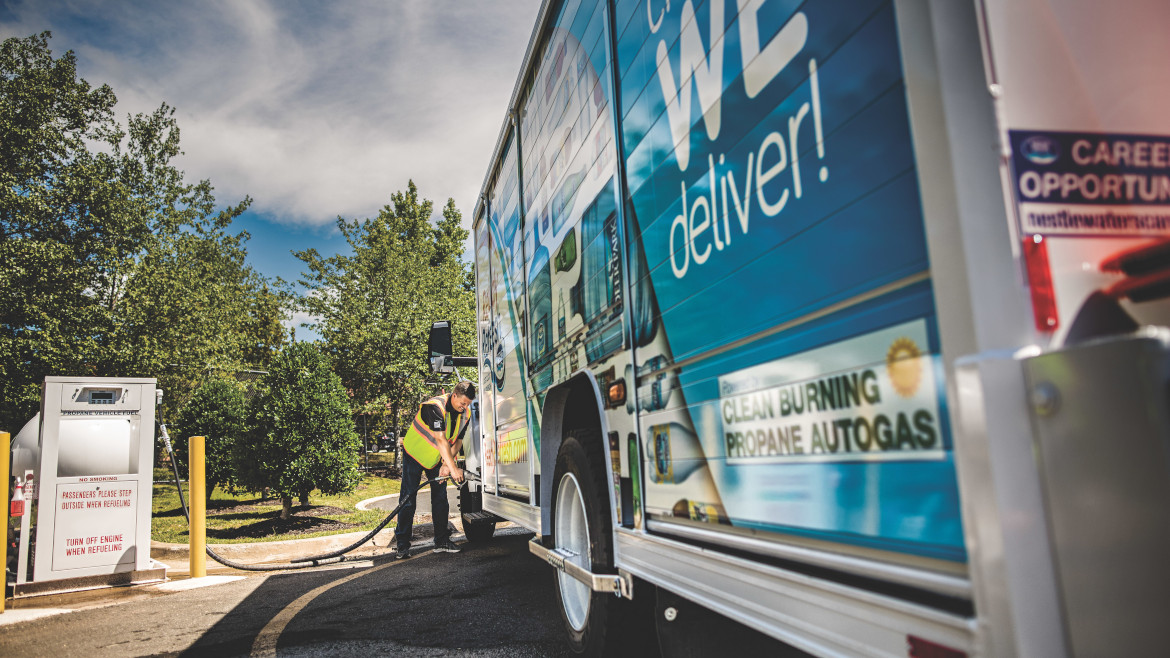
Propane fueling Nestle truck
Image courtesy of PERC


Propane

Price-wise, liquefied propane gas is a little less expensive than gasoline — $3.45 a gallon to gasoline’s $3.65 a gallon — so fleet managers would be able to realize an ROI in a moderate amount of time to offset the relative higher cost for propane-fueled vehicles. Propane also can result in longer engine life, thanks to its high octane rating and low carbon features.

Its main downside is that it’s a petroleum product and, like gasoline and diesel, it’s sensitive to the usual outside forces — supply chain issues, geopolitical unrest, etc. — that affect conventional petroleum-based fuel prices.

Interestingly, propane is actually playing a role in EV fueling infrastructure. Propane Education & Research Council (PERC) notes that propane-powered charging solutions are available to fleets. The charging solutions have capacities of up to 500 kW per unit and are designed to be portable or permanently installed.

The technology allows EVs to be recharged independently of the electric grid and without the time and capital investments needed for new electricity-based charging stations.

KEYWORDS: trucks

Share This Story

Looking for a reprint of this article?
From high-res PDFs to custom plaques, order your copy today!

Recommended Content

JOIN TODAY
to unlock your recommendations.

Already have an account? Sign In

  • top 100 beverage companies

    Top 100 Beverage Companies of 2024

    For the global beverage market, mergers and acquisitions...
    Sports Drinks
  • Chocolate, Strawberry, Vanilla shakes

    Classic flavors provide reliable, consistent results for beverage-makers

    Classic flavors of chocolate, vanilla and strawberry...
    Ingredient Spotlight
    By: Chloe Alverson
  • Free Spirits Instant Bar Bundle

    Lifestyle trends drive growth for non-alcohol category

    As lifestyle trends continue to drive growth for the...
    Wine & Spirits
    By: Lauren Sabetta
Manage My Account
  • Newsletters
  • Online Registration
  • Subscription Customer Service
  • eMagazine Subscription
  • Manage My Preferences

More Videos

Sponsored Content

Sponsored Content is a special paid section where industry companies provide high quality, objective, non-commercial content around topics of interest to the Beverage Industry audience. All Sponsored Content is supplied by the advertising company and any opinions expressed in this article are those of the author and not necessarily reflect the views of Beverage Industry or its parent company, BNP Media. Interested in participating in our Sponsored Content section? Contact your local rep!

close
  • Woman in Coat
    Sponsored byApplied Food Sciences

    Opportunity for Hormone Support in Functional Beverages

Popular Stories

Pepsi Prebiotic Cola

Pepsi offers limited online release of Prebiotic Cola

Airheads Soda

AIRHEADS enter beverage market

Buffalo Trace Distillery

Buffalo Trace Distillery pays homage to its region’s heritage and history

making connections webinar

Events

April 16, 2025

2025 State of the Industry Series: Alcoholic Beverages

On Demand In Beverage Industry’s annual State of the Industry: The Alcohol Beverage Market, analysts at S&D Insights LLC delve into these trends and how they’re shaping the industry.

View All Submit An Event

Poll

Retail Coffee Segment

What retail coffee segments will fare well into the next year?
View Results Poll Archive

Products

Milk and Dairy Foods Nutrition, Processing and Healthy Aging

Milk and Dairy Foods Nutrition, Processing and Healthy Aging

See More Products

Related Articles

  • Young woman shopping in the supermarket

    Transparency key for US consumers when it comes to price hikes

    See More
  • Navistar International Corp

    2023 Trucks Report: Electric vehicles continue to make most of the news in the fleet equipment space

    See More
  • 40-Hacker.jpg

    Weissbier comes to the United States in 16.9-ounce cans

    See More
×

Elevate your expertise in the beverage marketplace with unparalleled insights and connections.

Join thousands of beverage professionals today. Shouldn’t you know what they know?

JOIN NOW!
  • RESOURCES
    • Advertise
    • Contact Us
    • Directories
    • Store
    • Want More
  • SIGN UP TODAY
    • Create Account
    • eMagazine
    • Newsletters
    • Customer Service
    • Manage Preferences
  • SERVICES
    • Marketing Services
    • Reprints
    • Market Research
    • List Rental
    • Survey/Respondent Access
  • STAY CONNECTED
    • LinkedIn
    • Facebook
    • YouTube
    • X (Twitter)
  • PRIVACY
    • PRIVACY POLICY
    • TERMS & CONDITIONS
    • DO NOT SELL MY PERSONAL INFORMATION
    • PRIVACY REQUEST
    • ACCESSIBILITY

Copyright ©2025. All Rights Reserved BNP Media.

Design, CMS, Hosting & Web Development :: ePublishing