Safety, product diversity impact forklift operations
Beverage warehouse operators rely on automated machinery
The saying, “a spill, a slip, a hospital trip,” is commonly used in reference to wanting children to play safely, but today’s SKU-driven warehouse operators also follow that direction. The safe handling of forklifts is vital to beverage operations and experts note safety, product diversity, sustainability and automation are key factors impacting the industry.
“A forklift is more than just a machine, it’s an investment for the good of your business,” says Vincent Halma, president and chief executive officer at KION North American Corp., Summerville, S.C.
Choosing a model that best suits your material handling needs takes time and careful thought, he continues. KION Corp. suggests warehouse operators take a few things into consideration before purchasing forklift equipment:
- What is my budget?
- Should I purchase a new or used forklift?
- Should I rent or lease?
- Will I be driving the forklift inside or outside?
- What are the maintenance costs?
- Does the brand of forklift matter?
- Should I request a demo before I buy?
By asking these questions and speaking with a knowledgeable industry professional, warehouse operators can be sure they are making an ideal investment for their business, the company says.
Safety first
Experts agree safety is a top priority at any beverage manufacturing operation. Prioritizing safety is how productive operations accomplish business goals and protect their bottom line, says Gijo George, food and beverage industry director for Yale Materials Handling Corp., Greenville, N.C.
“According to the Occupational Safety and Health Administration (OSHA), businesses spend about $170 billion per year on costs related to occupational injuries and illnesses and these expenditures come directly out of company profits,” he continues.
Approximately 34,900 forklift injuries occur each year, from equipment and operator error, with operator error accounting for 70 percent of the accidents, OSHA statistics indicate.
“Hiring the right people and implementing proper training is a great way to highlight safety,” George says. “Not all lift trucks are the same, meaning previous lift truck operator experience doesn’t necessarily ensure proper qualification. It’s the responsibility of employers to carefully evaluate and match a candidate’s experience level to the type of trucks they are expected to operate.”
KION’s Halma also notes the importance of safety when operating lift truck machinery. “Going home safe is the most important thing for anyone in the workplace,” he says.
When it comes to developing products, Linde Material Handling, a manufacturing brand of KION North American, implements high global safety standards, it says. “Our forklifts have the highest residual capacity in their segment to increase safety at higher lift heights,” he says.
Both KION’s Halma and Yale’s George explain that forklift operators should receive operator training that adheres to OSHA standards and training specific to their site, truck and application. “For example, a lift truck operator who works mainly in narrow aisles should receive training on narrow aisle trucks in that intended work environment,” George says.
Product diversity
Although safety is among the top priorities within a beverage warehouse, SKU proliferation also plays a pivotal part in operations. “It challenges operators to find the best combination of space, process and technology in order to manage a more expansive inventory,” George says.
“Slotting strategies also play an essential role,” he continues. “They’re more important now than ever when it comes to increasing capacity and picking efficiency. Allocating this increased capacity requires expanding storage density by building up and locating storage aisles more closely together.
“VNA (very narrow aisle) trucks offer a solution to increased storage density by enabling narrower aisle widths and higher storage heights,” George explains.
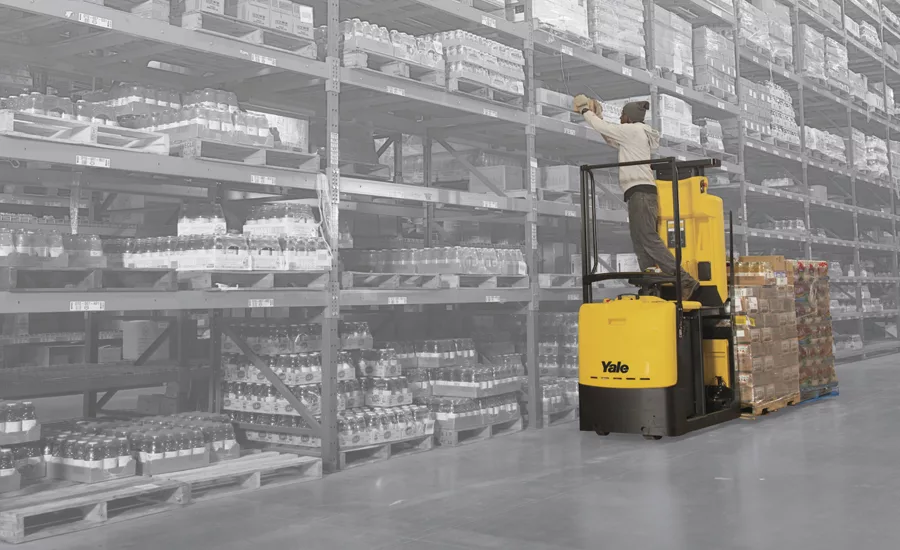
Multi-level trucks like the Yale MO25 can broaden the so-called “golden-zone” of the pick face, which allows operators to more easily access products stored at increased heights, he says. Along with a slotting strategy optimized for a certain picking range, the use of multi-level trucks can reduce pick time, labor and rack requirements, and overall cost-per-case, he adds.
KION’s Halma also highlights the greater demand for forklift systems that can handle the increased complexity of product diversity. “Increased complexity (like SKU proliferation) and consolidation are causing the automation demand to be more interesting,” he says.
KION manufactures the Linde 1120 series: a VNA truck with seven different versions, all designed to operate in narrower, higher-stacked aisles. “Linde trucks are robust, torsion-resistant and compact due to their reduced chassis length,” the company said in a statement. “They set new standards in rapid guide wire acquisition and aisle transfer in order to reduce end-aisle widths.”
In addition to adapting to SKU proliferation and trends, experts note that even in the forklift industry, sustainability is important. “Sustainability-focused features of forklifts include electric lift trucks, hydrogen fuel cells and lithium-ion batteries,” Yale’s George says.
“Hydrogen fuel cells and lithium-ion batteries are proven to reduce environmental impact as well as protect the bottom line by reducing the impact while concurrently increasing productivity and convenience,” he continues.
To leverage these technologies, George suggests that operations’ personnel utilize their local materials’ handling dealer. As an example, lithium-ion batteries are particularly well-suited for direct-store-delivery applications, he adds.
KION’s Halma also notes the increased popularity of lithium-ion batteries in warehouse operations. “We see a trend toward electrification and technologies like lithium-ion batteries, especially in electric counterbalanced truck lifts,” he says.
At Modex 2018, KION introduced the Linde 1131-MT12, a direct-store-delivery machine that offers as much as three hours of use and a load capacity of 2,600-pounds. Powered by a lithium-ion battery, the MT12 is designed for low-hour applications in small retail stores, production lines, warehouses or goods transport sectors, the company reported.
Along with lithium-ion batteries, hydrogen fuel cells also help reduce the environmental impact of forklifts, Yale’s George says. “Because hydrogen fuel cells produce zero emissions, with only heat and water as byproducts, it makes the perfect fit for companies looking to reduce their environmental stress,” he says.
“On average, companies generating hydrogen on-site can expect about a 33 percent reduction in greenhouse gas emissions, in comparison to lead acid battery systems charged from the electrical grid,” George continues. “Additional benefits of implementing hydrogen fuel cells includes freeing up valuable indoor space. When considering the effect of SKU proliferation and its requirements for extra storage capacity, this is of significant value.”
Advanced automation
Because beverage manufacturers and distributor demands always are influx, those in the warehouse and operations industries must shadow a similar path. With businesses looking to anticipate changing needs based on customer demands, fleet flexibility continues to play a growing role in supply chain operations across all industries, George says.
For example, the Yale MX ICE counterbalanced forklift offers the versatility, reliability and flex performance that fleet managers need to face other external pressures, he says. “The MX is adaptable for manufacturing, retail and distribution to get the job done indoors or outdoors.”
The Yale MX offers flex performance technology to match performance characteristics to application demands, the company says. It adjusts to deliver extra boosts of performance to power through peaks, or optimize fuel economy and control costs, and its versatility enables fleet managers to make informed decisions about fleet size and application performance, it adds.
Similarly, New Bremen, Ohio-based Crown Equipment Corp. engineered its C-5 Series LPG forklifts for reliability and application flexibility to meet most warehouse operator’s needs. “With pneumatic and cushion models, plus dozens of options, attachments and accessories, the C-5 Series can face even the most demanding and specialized applications,” the company says.
New technological developments also are fostering more control within beverage warehouses. The advanced technology is enabling electric-powered forklifts to have longer run times, which, in the end, makes converting to these new machines more economical, KION’s Hamla says.
“There has been an increased interest in automated forklifts and complete warehouse systems,” he continues. “For example, systems that include voice picking controls can significantly increase the accuracy and speed of the machine.
“Voice controls improve picking productivity and accuracy, require less training to operate and bring a higher return-on-investment,” he says. “They can track operations in real-time and allow for easy communication with other warehouse distribution channels.”
Columbus, Ind.-based Toyota Material Handling USA also sees value in complete warehouse systems. In today’s supply chain, warehouse management systems (WMS) are vital to any company’s operations, says Kenny Trusnik, marketing systems and eCommerce specialist at Toyota.
“As an example, WMS can help develop and manage the route’s warehouse workers and forklift operators for picking and putting away products,” he says. “This allows you to create safer, more efficient routes for all warehouse employees.”
Harnessing data from lift truck fleets can help operations identify zones of high-risk and adjust routes accordingly, Yale’s George says.
“Robotics automate certain tasks with superior productivity and reduce long-term operating costs when compared to manual operations,” he says. “Robotic lift truck models can be used for basic, repetitive, point-to-point material transport to enable the reassignment of labor to more engaging, value-added positions.”
As product complexity continues, the need for better automation solutions will continue to grow. “Automated forklifts can help resolve labor shortages and increase overall productivity,” KION’s Hamla says. BI
Looking for a reprint of this article?
From high-res PDFs to custom plaques, order your copy today!