Tips for improving today’s brewhouse
Detailed processing steps vital to streamlining success
Efficient utilization of equipment is a concern in any brewery because saving time means saving money. The brewhouse is the heart of the brewery and holds the most opportunity for time-saving and, with the right equipment, not all suggested solutions require major overhauls or new purchases.
Whether a brewery has two or five vessels, five key process steps must follow proper procedures at all times: milling and weighing up; mashing, wort extraction (including spent grains removal); wort boiling; and wort cooling (including tub separation). Generally speaking, these steps create one linear brew cycle. In the first of a two-part series, we’ll explore mash and lauter activities and the ways to increase production in the brewhouse.
Step 1: Mash in
(combo Mash/Lauter vessel)
Hydrated milled grains should fill the vessel: This process involves strike water, which must be consistent in flow and temperature. Balancing the strike water with a consistent flow of milled grains also is important. The end result should be well-distributed, hydrated grains at the target temperature.
To speed up this process, consider reviewing the following:
Capacity of existing grist conveying equipment: This can be as simple as a speed increase or, worst case, a larger conveyor.
Capacities of existing hot and cold liquor pumps: This also can be as simple as an impellor change or a larger pump. In both cases, it’s important to ensure the completion of the grain transfer ahead of the mash in water, so as to effectively purge the hydrator.
Drop pipe: For systems using a gravity drop from the grist case to mash mixer or mash lauter tun, involve a larger drop pipe to work in tandem with item No. 2 above.
Hydrator design: In most cases, this design would need a review process to ensure that it has the capability to present a fully homogenous mash to the respective vessel at the increased “mashing in” rates.
The relationship between hot and cold liquor is critical to strike water temperatures and flows, and can be fine-tuned when using two pumps rather than relying on fluctuating city water pressure. The temperature of cold liquor also is consistent compared with city water, which will change with season and usage.
Step 1a: Mash in
(dedicated mash mixer)
In the case of a dedicated mash mixer, small deficiencies in the hydrator or unexpected lower strike temperatures can be compensated during the residence time in the mash mixer. This is because of the steam jackets, which should be sized for a 1 degree Celsius temperature rise a minute. Mash mixers, hydrators and agitators should have the ability to easily create a homogenous mix and temperature without imparting shear to the mash.
The following are items to review:
Agitator design and speed: This is crucial to avoiding shear, providing adequate mixing and uniform temperature. Speed is a function of the agitator diameter. The use of a variable speed-control drive is highly recommended.
Step 1b: Mash transfer
(dedicated mash mixer)
Opportunities for time-saving measures can be gained by looking at the mash transfer system.
The following are items to review:
A larger pump and transfer piping: The design needs a maximum pump speed and line velocity to make sure the mash is presented to the lauter tun in optimal condition for wort extraction. We consider 10-15 minutes as the ideal transfer time.
Step 2: Lauter tun
Of all the brewhouse vessels, the lauter tun generally has the longest residence time and presents greater challenges for time-saving. The goal is to provide exceptional wort quality and efficient extraction of the sugars within a reasonable timeframe.
Bed loading, grist spectrum (grind), uniform distribution of the mash, design of the raking machine, the wort collection system and false bottom all play their part in achieving the goals. Although not easy, this can be handled by starting with a clean sheet of paper.
However, certain things should be considered with an existing installation:
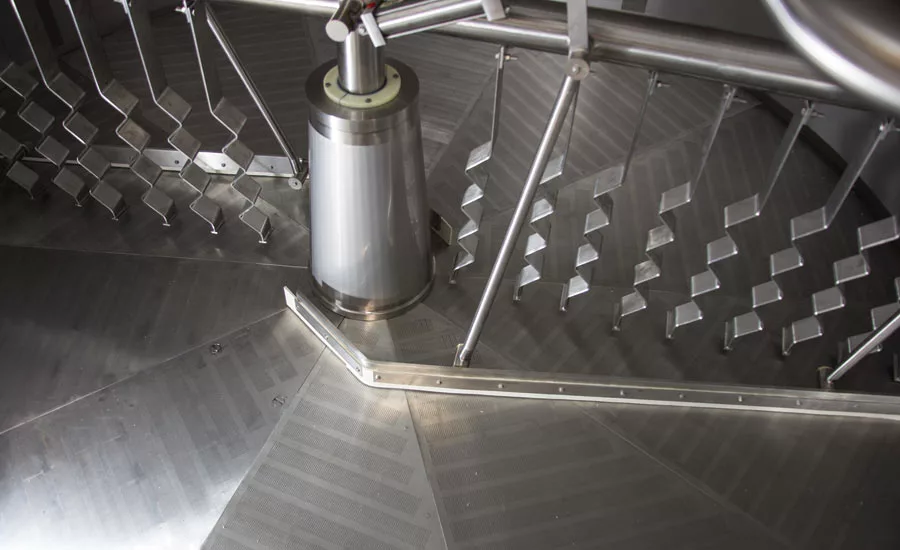
Check condition of the false bottom: Excessive radial and circumferential gaps between the plates will allow solids to migrate into the wort stream. This is detrimental to quality, time and efficiency.
A large under-plate void: If one exists, it could impact extraction efficiency.
Rake design and density: This affects wort collection time and extraction efficiency.
Number of wort runoff points and the collection header: If not balanced or sized correctly, this will affect time and efficiency.
Variable speed rakes: With the ability to be raised and lowered, the rakes only will serve to enhance quality, time and efficiency.
Step 3: Vorlauf
With a dedicated mash mixer and lauter tun, the vorlauf step can be started around the mid-point of mash transfer.
However, there is one improvement to consider:
Add turbidity meters: These meters provide an analytical method to determine when acceptable clarity has been achieved and initiate forward flow to the kettle. They also provide an actual quantitative value that notifies the brewer when it’s time to start runoff or automatically take the brewhouse to the next process.
Step 4: Runoff/wort collection
(combo mash/lauter vessel)
To ensure the sparge system has the ability to match the wort collection flow rate(s) and that the sparge distribution is even on the grain bed, it’s recommended to review the following:
Run high gravity first: Consider running off the higher gravity and viscous first worts at a slower rate to reduce the rise of differential pressure across the grain bed. As the gravity and viscosity decline, it should be possible to increase wort flow rate resulting in a net time saving.
Runoff ports: Below the screen, plenty of runoff ports should be present so the wort has a direct path to the collection ring(s).
False bottom: The screen design here is important. Subject to bed loading within an existing lauter tun, the process of upgrading to a milled screen could provide quality, efficiency and cycle time benefits.
Differential pressure: This should be controlled through pressure transmitters above and below the screen. This gives the brewer and automation a good reference for the runoff capabilities of the entire setup for any given recipe. BI
Looking for a reprint of this article?
From high-res PDFs to custom plaques, order your copy today!