Laser coding technology gains favor in beverage industry
Beverage packaging trends challenge coding technology manufacturers
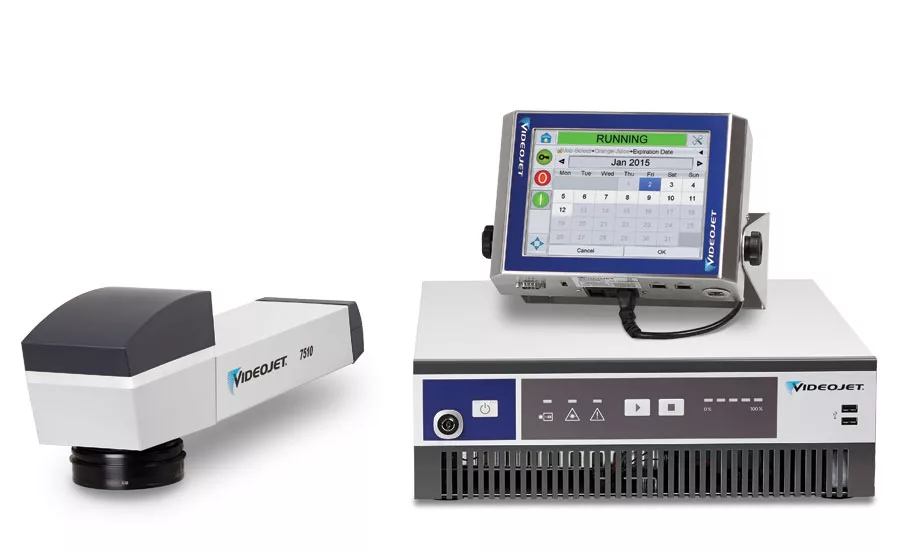

Trends come and go, a fact that many beverage manufacturers know all too well. Determining which trends will stick can be difficult — especially when it comes to trends within operations. Historically, ink jet coding technology has been the top solution in coding, however, the beverage industry increasingly is embracing laser technology, recognizing that the technology is more than a passing trend, experts say.
“Beverage companies are looking for more efficient ways to package and commercialize products. This includes a greater emphasis of laser technology on PET bottles and aluminum cans, as well as utilizing thermal transfer on flexible packaging (shrink films),” says Tara Abbott, marketing manager for North America at Gurnee, Ill.-based Domino Amjet. “… The past 15 years has seen a significant evolution of technology.”
Chirag Sheth, vertical marketing manager at Wood Dale, Ill.-based Videojet Technologies Inc., also notes this evolution as the biggest trend occurring within coding equipment with respect to the beverage industry. “This is really occurring at multiple levels,” he says. “It just used to be the very large multi-national beverage manufacturers that were engaged in this sort of transition to laser technology, but that’s sort of trickling down into different-size companies as well. … And the primary reason for that is [that] in a beverage plant, a lot of customers are trying to remove the inks and different solvents that need to be used for ink jet coding.”
Laser coding technology offers several benefits for beverage facilities, according to Sheth. Because ink jet coders require inks and solvents, which often require special storage because of the chemical composition and/or regulations, significant overhead is required; however, this is not the case with laser coders, he says. Additionally, laser coders can be adjusted for various substrates and require minimal maintenance compared with ink jet equipment, Sheth adds.
By applying a permanent code, laser printers also are a solution for manufacturers concerned with anti-counterfeiting and diversion, another major trend, according to Sheth.
“A lot of customers use different sorts of anti-counterfeiting technologies, and this is a combination of strong software and your printer,” he explains. “For example, at Videojet, we have software where we’re able to specially code, let’s say a whiskey bottle for example, and the code is ABC123; what we’ll do is with the B, where the two curves meet in the middle, we’ll remove the dot in the middle of that connection. Purposely it’ll be an incomplete B. But to someone who’s trying to counterfeit it, they might just print the true B, but to [the retailer], who knows that the B is supposed to be incomplete, they’re able to identify the counterfeit products.”
Domino’s Abbott notes that the company offers laser printers that are designed to produce high-quality codes on high-speed PET and labeling lines. “Our D-Series lasers can be integrated into blow molders, high-speed labeling applications or installed directly onto a production line to accommodate the customer’s specific needs,” she says. “The i-Tech scan head, combined with unique mirror beam control and optimized cooling, ensures no limitations on performance in any production environment.”
However, laser coding equipment also has its drawbacks, Videojet’s Sheth notes. “[Y]ou have to be sure you have the right enclosures and protections to protect the operator from the laser light,” he says. “So, if something happens and you need to move the laser, it’s very difficult to do versus if something happens when there’s an ink jet coder. All you do is wheel it from one line to another, hook it up and bam, you’re ready to go in about five or 10 minutes. The flexibility just isn’t available with a laser coder, and the other thing is with an ink jet coder, you can print on almost anything.”
Sheth says that although laser coders can code various materials, the chemical makeup, even from one PET bottle supplier to another, can vary, and the laser coder needs to be set for the specific packaging.
“The key thing with the laser coder is that you can use it on a variety of substrates, but you have to be very mindful of how that substrate is manufactured, because a few percentage points different in the chemicals in how they’re manufactured can affect the kind of quality of code you get,” he says. “Again, you don’t have these sorts of challenges with an ink jet coder.”
Additionally, ink jet printers offer opportunity for colored inks, benefiting manufacturers that use colored or dark packaging. “There’s been some development in pigmented printers, in terms of being able to provide these sorts of colored inks,” Sheth says. “For example, Videojet has the 1710 pigmented ink [printer], and the way the system works is different than our regular black ink printers just because the chemistry of colored inks is different than regular black inks.”
Managing changes
Although both ink jet and laser coders are effective on nearly any beverage package, the increasing varieties of packaging has contributed to SKU proliferation, resulting in more hurdles for coding manufacturers, they say.
“SKU proliferation remains a challenge; however, it can certainly be managed by the right vendor with the experience and network of partners to support the growing number of SKUs,” Domino’s Abbott explains “Domino’s coding technology has been designed to work with all substrates, and our coding automation solutions allow for easy management of the SKU proliferation at the touch of a button.”
She notes that packaging trends within the beverage industry, including smaller package sizes and plastic substrates, have resulted in innovations from coding equipment manufacturers. “The ability of our D-series lasers to control wave lengths and power concentration has revolutionized coding onto thin-wall PET bottles and paperboard substrates,” Abbott says. “Domino’s fiber lasers can code on a domed surface with excellent print quality and pinpoint locations. This provides beverage producers with an [alternative] option to traditional ink jet technology.
“Many beverage companies are working hard to remain profitable in a difficult economy,” she continues. “This requires that they push their lines harder, and [they] often sacrifice maintenance for line production. The demands on equipment suppliers are greater than ever before to help them meet these challenges. It’s paramount that suppliers provide high-quality equipment, continuous training and superior service support to help beverage companies get production out the door.”
When it comes to packaging formats, Videojet’s Sheth adds that pouches are another growing option that has been challenging coding technology manufacturers.
As beverage-makers incorporate more packaging formats, line changeovers will increase, presenting a challenge for brand owners and suppliers, Sheth says. “From a coding perspective, we’re able to code on almost anything … but where the challenge occurs is for our customers, and their challenge is our challenge,” he says.
To offer a solution to this challenge, Videojet developed CLARiSUITE, a fully integrated code-assistance solution that links on-product coding to a centralized message database, according to the company. Designed to mitigate coding inaccuracies, the software solution reduces the chance of human error through the message setup process, it adds.
“You hit ‘Enter,’ and boom, [the codes] go straight to the printers, [and] the printers know exactly what they need to do,” Sheth says. “You’re not hoping that the operator updated the code at the printer and didn’t make an error because when you have constant changeovers ... it’s the principle that the more human hands touch a system, the higher the probability of error.”
Looking for a reprint of this article?
From high-res PDFs to custom plaques, order your copy today!