AGVs allow for easier adoption in beverage operations
Shifting warehouse workflows, operational efficiency call for AGVs
In reality competition TV shows, participants face off in challenges. The difficulty level depends on the type of show, and sometimes grants participants immunity from being voted off the program.
Those in the beverage industry, specifically in the warehouse division, face a different type of challenge: labor challenges.
Chase Turkstra, senior automated guided vehicle (AGV) sales specialist at Grand Rapids, Mich.-based Dematic, says the biggest impacts he has observed are labor shortages and high turnover among lift truck drivers.
“These can put pressure on warehouse operations, as the struggle to hire and retain staff can lead to slower order fulfillment and increased strain on existing teams,” he explains. “Also, labor shortages can mean that wages will rise, which increases operational costs. High turnover also requires warehouses to continually invest time and resources into onboarding and training new employees.”
Such challenges could negatively impact safety, Turkstra notes.
“Understaffed teams or teams with lots of new or temporary labor can lead to greater risk of errors, delays or incidents,” he adds.
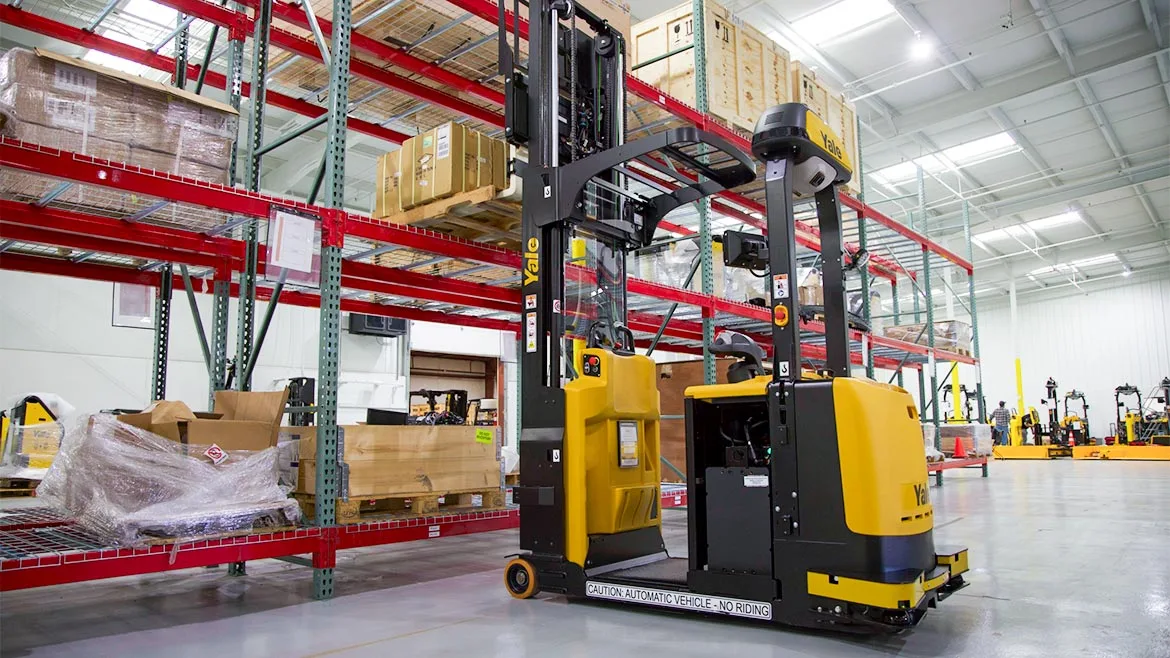
Kyle Smart, sales manager of technology solutions at Yale Lift Truck Technologies, Greenville, N.C., states that labor challenges continue to significantly impact operations, especially in high-throughput environments like beverage distribution.
“As demand for warehouse space and material handling capacity grows, many operations are struggling to find and retain qualified lift truck operators,” Smart explains. “The warehouse workforce has more than doubled since 2015, but that is still not nearly enough to keep pace with demand.”
The result is increased pressure on productivity, safety and labor costs.
“Warehouses are often forced to rely on less experienced operators, which can contribute to higher turnover, training costs and the potential for product or equipment damage,” Smart says. “These challenges are especially important in beverage facilities, where repetitive point-to-point material movement and multi-shift operations are common. As a result, more warehouses are evaluating automation as a way to reduce dependence on scarce labor and improve operational consistency.”
Many warehouses are investing in automated lift trucks to improve efficiency and productivity while lessening dependence on scarce labor, he notes.
“Newer automation solutions are reducing implementation complexity and helping operations address labor shortages without requiring extensive software engineering resources for implementation and ongoing changes,” Smart says.
Demand for automated solutions has influenced the AGVs market, he notes.
“Demand for automation is driving growth, flexibility and ease-of-use in the AGV and automated lift truck market,” he shares. “As warehouses face persistent labor shortages, rising operating costs and increased throughput demands, many are moving automation from a long-term consideration to an immediate operational priority. These trends have many operations re-evaluating their timeline for warehouse automation, from an opportunity for tomorrow to an essential for today.”
Operations are searching for solutions that are easier and faster to deploy than traditional AGVs, Smart says.
“This shift is influencing the market toward more flexible, user-friendly automation platforms that use technologies such as autonomous mapping and navigation, and intuitive drag-and-drop software interfaces that allow both quick implementation and easy changes to workflows without the need for complex coding or programming,” he explains. “As a result, demand is growing not just for automation itself, but for solutions that lower the barriers to adoption through faster implementation, simplified management and reduced upfront cost.”
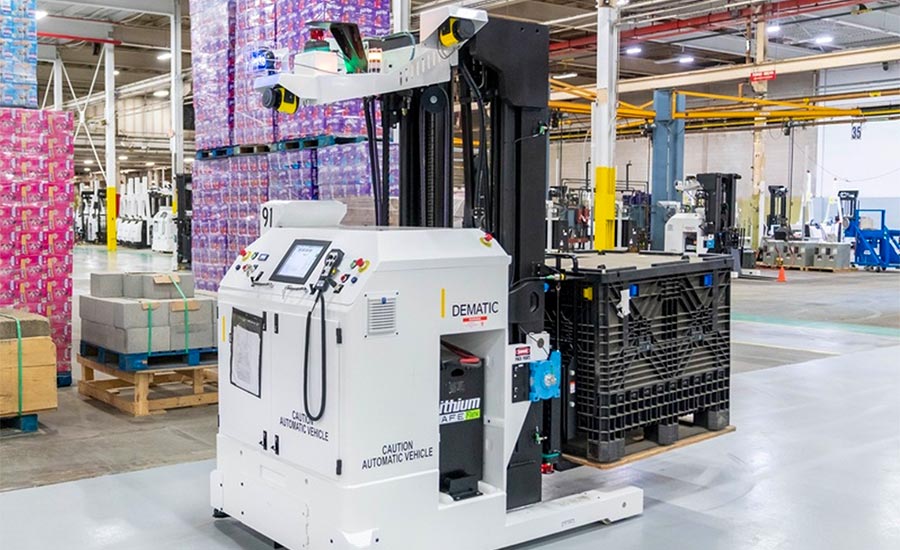 Image courtesy of Dematic
Dematic’s Turkstra says that, historically, warehousing is not an industry with high levels of automation investment.
“However, ongoing labor challenges, onshoring of manufacturing and rising operational costs are accelerating demand for automation solutions across the supply chain,” he notes. “As companies look for technologies that can deliver ROI and remain flexible for future growth, AGVs have become an increasingly attractive option. Their ability to scale and adapt to changing operational needs and integrate into both brownfield and greenfield facilities is driving continued growth in the AGV market.”
According to Turkstra, the beverage industry is evolving in two different directions.
“Beer, wine and spirits producers are looking to cut costs as demand softens, while other categories, such as energy drinks, waters and healthier beverage alternatives, are continuing to expand,” he shares. “However, one thing these two segments have in common is they’re both investing in automation. Companies in growing categories are turning to automation to keep pace with increasing demand.”
For other companies, Turkstra says that they want to automate operations to stay profitable amid shifting market conditions.
Yale’s Smart notes that one beverage trend that will “likely always be a factor” affecting the AGV market is the continued expansion of product variety.
“Beverage manufacturers tend to introduce new SKUs at a rapid pace, creating very complex warehouse environments,” he says. “This trend often requires frequent adjustments to storage locations, picking strategies and material flow patterns. As a result, beverage operations increasingly look for automation solutions that can adapt quickly to changing layouts and requirements.”
This drives demand for modern automated lift truck systems that can be easily updated with new routes and workflows as business needs evolve, Smart notes.
“These capabilities equip warehouses to respond to layout changes and shifting operational requirements without extensive reprogramming,” he adds.
Bringing the benefits
As facility managers turn to AGVS, experts highlight the benefits they can provide for beverage warehouses.
Dematic’s Turkstra notes that an advantage of AGVs is their ability to automate the movement of high-volume, heavy pallet loads with minimal disruption to existing operations.
“For beverage distributors, AGVs improve safety by reducing manual material handling, help address ongoing labor shortages and provide the flexibility to scale operations as demand fluctuates,” he explains. “Together, these benefits enable warehouses to increase efficiency while maintaining consistent reliable operations.”
“Companies in growing categories are turning to automation to keep pace with increasing demand.”
– Chase Turkstra, senior AGV sales specialist at Dematic
Yale’s Smart states that AGVs offer beverage warehouse operations a practical way to improve productivity while reducing dependence on a constrained labor pool.
“Applications such as point-to-point transfers are well-suited for automation, which can allow employees to be reassigned to tasks that require greater decision-making and operational oversight,” he explains. “Beyond hourly labor rates, automation can also drive savings in other indirect ways by potentially reducing costs associated with employee turnover, retraining and workplace safety incidents, such as workers’ compensation and lost time due to illness or injury.”
In industries like warehousing, where average employee turnover is high, Smart notes that finding and replacing employees also involves considerable time and expense. Meanwhile, inexperienced operators are more prone to costly damage to the facility, equipment and product, he adds.
“For beverage warehouses, the result is a more predictable material handling operation that can support changing demands while making better use of available labor,” Smart shares.
Over the years, AGVs have gone through various advancements. One of the biggest advancements, according to Smart, has been the industry’s focus on making automation easier to deploy, more cost-effective to adopt and more reliable to operate.
“Historically, many automation solutions required extensive infrastructure, custom programming and specialized technical expertise, creating barriers for warehouses interested in automation,” he says. “Today, ease of use has become a major differentiator. … The emergence of a rental model like what Yale offers helps alleviate upfront cost and allows operations to get real-world data on how automated lift trucks work in their facility prior to making a larger investment.”
The rental model allows warehouses to start with one or two automated trucks with no large, upfront capital investment, Smart notes. This can be especially attractive for beverage operations looking to test automation before scaling across a larger fleet.
Reliability has advanced through technologies such as LiDAR-based navigation, cloud-based fleet monitoring and automated charging capabilities, helping automated vehicles operate consistently while minimizing downtime and manual intervention, Smart explains.
“Together, these improvements are making automation more accessible to a broader range of warehouse operations,” he adds. Dematic’s Turkstra notes that, over the years, the chassis of an AGV has remained very similar.
“However, the controls, sensors and capabilities of the vehicles have made huge advancements in recent years, allowing them to better detect obstacles, optimize travel paths and operate safely alongside people and equipment,” he says. “They also integrate more seamlessly with WMS and WES, enabling [for] more coordinated, real-time material movement.”
Artificial intelligence (AI) has recently accelerated the development of new capabilities, enabling AGVs to make smarter, data-driven decisions in real time, Turkstra adds.
“AI can help optimize routing, anticipate congestion and prioritize tasks based on operational needs,” he explains.
Turkstra expects the future for AGVs within beverage warehousing to be bright.
“Over the next few years, we will likely see large advancements with the decision-making process, which allows us to create a more efficient warehouse,” he says. “This advanced capability will also allow for companies to increase throughput through planning while simultaneously making the warehouse a safer place.”
Yale’s Smart feels that the future will likely be defined by greater accessibility, flexibility and expanded capabilities.
“While labor challenges remain a key driver, the next phase of automation adoption will be less about proving the technology works and more about making it practical for a wider range of applications within the warehouse,” he states.
Smart anticipates continued expansion of automated equipment offerings.
“As automation platforms mature, warehouses will be able to deploy different types of automated trucks to address a broader range of tasks,” he adds.
Automation should be viewed as a phased journey, with solutions that can adapt as warehouse layouts, workflows and business requirements evolve, Smart says.
“For beverage distributors managing changing product mixes and warehouse configurations, that flexibility will become increasingly important,” he concludes.
Looking for a reprint of this article?
From high-res PDFs to custom plaques, order your copy today!