Voice pick technology helps warehouses adapt to growing SKU counts
Cloud-based software, language support keeps technology advancing with beverage needs
In the rainforest, large epiphytes like ferns or orchids will make homes on tree branches and trunks. According to the Smithsonian Institute, the main reason these plants do so is to get sunlight, which is not easy to come by at the bottom of the forest. Epiphytes’ ability to adapt in order to survive exemplifies how growth can come when modifications happen.
Beverage warehouses contending with fixed space and a growing SKU proliferation are doing their own forms of adapting and growing by turning to the latest in technology. Brandon Duba, solution consultant at Dematic, Grand Rapids, Mich., highlights how voice picking technology has served as a vital solution for beverage facilities.
“There continues to be a strong interest in voice-picking technology from beverage operations,” he says. “The interest stems from the need to be efficient and accurate, even as operations grow and adapt.
“Voice picking remains to be a vital and valuable hands-free technology that increases warehouse productivity in picking and replenishment while improving ergonomics and operator safety,” Duba continues. “Due to its ability to easily integrate with WMS or ERP systems, voice technology quickly provides beverage operations with a strong ROI, especially sites with large and complex order profiles.”
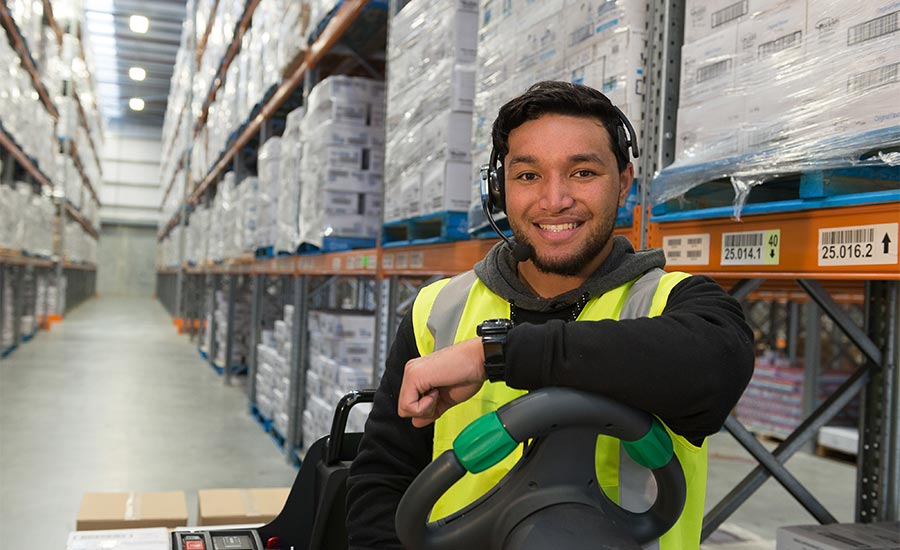
This productivity is vital as warehouses deal with an influx of SKUs. Duba explains that SKU proliferation can lead to smaller units for each line and greater lines per for each, creating complex and mixed pallets, thereby presenting challenges to maintain efficient operations. However, voice picking solutions can help operations reduce errors and improve efficiency.
“Voice picking reduces reliance on memory or visual aids as it directs the operator to the next pick location,” he explains. “The voice method keeps the operator picking and not looking at paper or screens, increasing the pick rate of the user. When SKU counts rise, so does the number of locations. Voice technology utilizes verbal confirmation to ensure accuracy and reduce mis-picks.”
Duba notes that the growth in SKUs also is impacting the temperature within facilities as consumer trends have resulted in interest in cold-storage beverages. This also is prompting voice picking technology to ensure its hardware and software can function in these varying temperatures.
“With a wide variety of SKUs entering warehouses, beverage operations face rising demand for temperature-controlled storage, particularly as ready-to-drink and dairy alternative products grow,” Duba says. “Meeting this need requires investment in cold storage solutions as well as technologies, like voice picking, that can function effectively in such environments.”
Beyond SKU proliferation, Duba highlights the impact that packaging and omni-channel shopping can have on beverage warehouse operations.
“[I]nnovations in packaging materials and designs are prompting the need for optimized storage layouts and more careful handling to avoid damage — especially as crushability becomes a risk factor,” Duba says. “Voice picking technology helps adapt to these changes by seamlessly adjusting pick-paths and workflows.
“Beyond storage, adaptability is also critical for order fulfillment, as growth in direct-to-consumer and eCommerce channels drives more frequent, smaller and higher-mix orders,” he continues. “Craft beverages and varied drink options heighten this complexity, but voice picking provides the flexibility and control needed to manage fulfillment efficiently.”
Advancing solutions
Although voice picking technology might be well-known for its productivity and accuracy benefits, Duba also touts the technology’s ability to onboard and train new users.
“Voice systems can support multiple languages, and instruction is clear and simple reducing training from weeks down to days,” he says. “This dramatically reduces challenges with workforce turnover and labor shortages. The enhanced safety and ergonomics that comes with voice picking technology also keeps turnover limited as operators are hands-free and eyes free, allowing for full focus when lifting heavy product.”
Duba adds that voice picking technology offers beverage operations scalable solutions. But scalability is not the only variance available through these technologies that has helped the warehouse solution evolve.
“Device variability has been a key advancement within voice pick as the equipment can be combined with scanning systems, both wearable and handheld, visual screens and even smart glasses,” Duba says. “The addition of other devices creates a secondary pick method and can improve learning times as well pick rate and accuracy.”
He notes that many voice solutions use cloud-based platforms to deploy the system quickly and effortlessly to provide updates.
“With the cloud platform it becomes a simpler integration with the host WMS and ERP systems and can be quickly scaled to multiple sites across the network,” Duba says. “Data analytics from voice technology provide quick visibility into worker productivity, inventory status, error rates, bottlenecks, and many other KPIs that can help identify areas of improvement and stronger decision making by leadership.”
However, voice picking technology still is prime for more advancements. Duba calls attention to suppliers finding more ways to integrate artificial intelligence (AI) in the platform.
“AI technology will be a strong tool to predict order patterns, while dynamically reassigning users to tasks based on changing warehouse conditions, ultimately creating optimized pick paths,” Duba says. “With the power of AI and additional technologies, voice solutions will be used in conjunction with mobile vehicles such as AMRs, to create a higher automated warehouse to further improve speed and ergonomics.
“Looking ahead, voice picking systems will support different languages and dialects, improving the ability to be used on a global scale,” he concludes. “Systems that can detect different accents will further reduce errors as operators train and utilize the equipment.”
Looking for a reprint of this article?
From high-res PDFs to custom plaques, order your copy today!