Artificial intelligence affecting robotics market
Advancements in AI stirs shift in robotics technology
Aside from SKU proliferation and other beverage trends, the advancement of artificial intelligence (AI) capabilities has affected the robotics market within the beverage industry, experts note.
Drew Eubank, executive vice president at Zion Solutions Group, Covington, Ky., expresses his thoughts on the topic.
“AI has allowed for better slotting and machine learning, which allows for better pallet builds on mixed case-loads, which leads to better utilization and cheaper transportation costs,” he says. “Advancements in AI driven wave logic has created better batch capabilities leading to less errors. The ability for point-to-point AMRs to learn ‘new paths’ leads to decreased travel and more efficient paths.”
The advent of the digital operating twin has allowed for operations to find “tweaks” in process that drive real unit level savings and increased service levels, Eubank notes.
James Taylor, chief commercial officer at OnRobot, Novi, Mich., says that, while there is a lot of buzz surrounding AI, he suspects the value it could create is something the industry still is trying to figure out.
“There are some obvious uses, especially around coding and programming, where AI as a tool can help engineers be more efficient and productive in product development, but when it comes to improvement in how applications perform, the picture is maybe a bit more aspirational than reality yet,” Taylor shares. “The conversation becomes even more clear when you consider that AI is also a very widely used, but poorly defined term. What is the ‘I,’ really? Right now, it seems to be mostly complex algorithms and sophisticated machine learning, which has been evolving, but not really new.”
Although AI has the potential to enable more sophisticated automation, Taylor believes that its full potential in making robotic systems truly autonomous and adaptable across all manufacturing contexts is “still a way out on the horizon.”
“There is so much opportunity to improve operational efficiency with technology already available today without waiting for the future,” he says.
Jane Heffner, vice president of sales for Universal Robots and Mobile Industrial Robots (MiR), feels as though AI advancement has “fundamentally transformed” the robotics market, having created unprecedented opportunities for beverage producers to automate smarter, faster and more flexibly.
As artificial intelligence and machine learning become embedded in collaborative robots, Heffner says Universal Robots and MiR see beverage industry customers leveraging these technologies to tackle challenges once thought out of reach, with a variety of solutions.
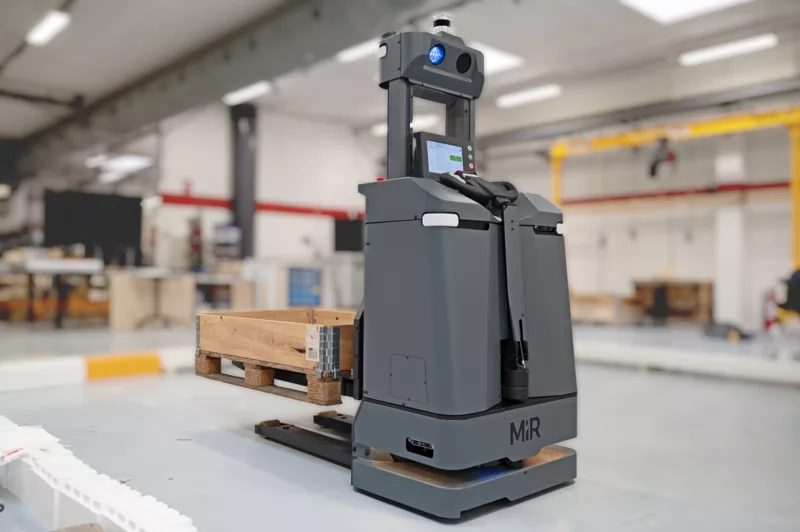
“The MiR PalletJack AMR stands out in this AI-driven era by leveraging advanced visual sensors and machine learning algorithms to transform pallet handling,” she states. “Its AI-based pallet detection system recognizes pallets even if they are damaged, mislabeled or wrapped in stretch film, something traditional automated solutions cannot do reliably.”
Heffner also notes unique tasks enabled by AI robotics, including flexible pallet identification, automated, consistent movement and continuous learning and adaptation. As for collaborative robots, she says AI delivers benefits such as smarter, adaptive automation and enhanced quality control and efficiency.
“AI-driven robotics enable real-time decision-making, greater accuracy and adaptability in beverage warehouses and production environments,” Heffner describes. “Systems powered by machine learning can automatically adjust to changing SKUs, recover from technical hiccups and optimize picking, palletizing or sorting processes — even as product configurations and orders change dynamically.”
This means beverage facilities now can automate complex tasks without constant reprogramming, supporting frequent new launches and seasonal spikes, she adds.
Looking for a reprint of this article?
From high-res PDFs to custom plaques, order your copy today!