Reusable containers help beverage operations support sustainability metrics
Traceability technology helps companies track reusable containers

The TV show “The Gentle Art of Swedish Death Cleaning” sees “death cleaners” Johan Svenson, Ella Engström and Katarina Blom guide Americans to pare down the items in their home so that their loved ones do not have to when they pass. Although many shows like this have become popular in the past decade, the unique aspect of their guidance comes with the reminder that only 1% of trash in Sweden ends up in landfills, exemplified by the Death Cleaners showing Americans how others can reuse their items.
Although beverage operations don’t need to get as creative as Swedish death cleaners to reuse materials, the durability of returnable containers is allowing manufacturers and distributors to support their sustainability goals.
“Returnable packaging addresses sustainability in two key ways,” says Matthew Lochmann, product manager at ORBIS Corp., Oconomowoc, Wis. “For starters, it eliminates one-way packaging, removing single-use waste altogether. Secondly, returnable packaging, after many turns through the supply chain, and at the end of its useful life, can be recycled and used in future returnable packaging.”
Andrew Resler, vice president of sales of supply chain solutions at Rehrig Pacific Co., Monterey Park, Calif., also highlights how the beverage industry’s use of reusable plastic shipping materials is supporting a sustainable supply chain.
“The beverage industry has been a pioneer in the circular plastics economy for decades with the continual reuse of plastic beverage crates, pallets, top frames, and bulk bins,” Resler says. “The beverage industry’s consistent production and distribution systems create an environment where these plastic packages can be filled, shipped, emptied, collected, and brought back to start that process over and over again until they reach their end of life. That can easily be 10-plus years of reuse.
“And it gets better,” he continues, “at the end-of-life, these plastic packages are recycled and made into brand new reusable packages that can start the circularity journey again.”
Resler adds that beverage operations managers can employ a life cycle analysis (LCA) tool to capture sustainability data from reusable packaging systems, and compare that to one-way packaging data to see the impact.
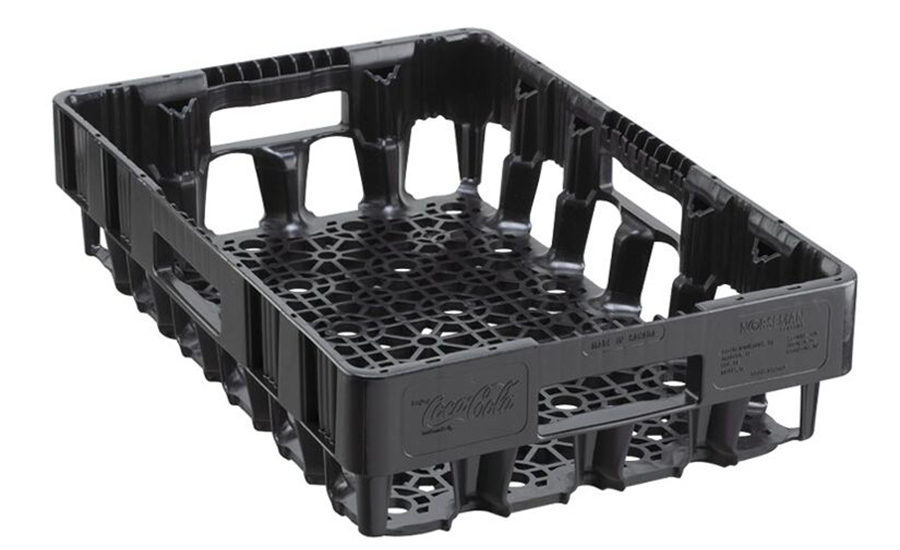
But that’s not the only way that reusable packaging containers are helping beverage companies support their sustainability objectives.
“Reusable packaging also allows beverage companies to decrease their use of virgin plastics and increase their use of recycled material,” Resler says. “Most reusable plastic packaging allows for a large percentage of recycled material content, which can vary based on performance requirements.
“The recycled material can be from packaging that has reached end-of-life … or from other post-industrial and post-consumer sources,” he continues. “Beverage companies can capture and quantify the use of recycled materials in their reusable packaging to support their sustainability metrics.”
Yet, Resler notes that collaboration between packaging manufacturers and beverage-makers also can offer opportunities to develop packaging that improve on sustainability metrics.
“Redesigning a package may allow for weight reduction, where less plastic can be used to produce each reusable package,” he says. “Innovation may also allow for improved trailer use or cubing, where the beverage company can get more crates, pallets, or bins on each trailer. Weight reduction and cubing will directly and positively influence the LCA data of a reusable packaging system, which will also improve the beverage company’s sustainability metrics.”
Given all this, ORBIS’s Lochmann notes that reusable containers will continue to support a more sustainable supply chain.
“As we continue to focus on sustainability and waste elimination from manufacturing to end customers’ doorsteps, returnable packaging will continue to be an increasingly larger part of the supply chain,” Lochmann says. “Through new ideas and solving new problems, to superior designs and manufacturing and improving current solutions, the future is very bright for returnable packaging.”
No shortage of benefits
Although reusable containers’ sustainability impact continues to aid beverage operations, experts also highlight the other ways that these reusable materials are lending a hand.
“Increased automation is increasing the demand for returnable packaging systems,” Lochmann says. “As automation gets faster and more precise, high quality, durable, and consistent returnable packaging is becoming a necessity through many automation lines.”
Rehrig’s Resler notes that capital expenditures, dedicated warehouse automation and autonomous mobile robots (AMR) or automatically guided vehicles (AGV) have prompted operations managers to turn to plastic containers for long-term durability benefits.
“With these investments, consistency of pallet quality and performance matters, and beverage companies continue to invest in plastic pallets to achieve this level of consistency,” he says. “We also see an increase in automated storage and retrieval systems (ASRS) and high-capacity warehouse projects. Again, these high-performance systems require a high-performance pallet to operate smoothly. Plastic pallets provide beverage companies and integrators with the consistent dimensions, weight, flatness, and cleanliness that these systems demand.”
Resler anticipates that automation will continue to grow throughout the beverage industry, particularly given the labor challenges of today, and reusable containers could see their products being looked at as a system solution versus a product solution.
“With labor challenges at all levels of the supply chain, suppliers and retailers will need to evolve and work more collaboratively to solve these problems,” he says. “We can expect more automation to extend to the store level, how products are merchandised to radically change, and where the packaging will be part of a system solution versus a product solution.
“As mentioned above, with automation and the reduction or repositioning of employees, service-related work tied to reusable asset management will see increased demand,” he continues. “Sorting, storing, cleaning, and validating reusable assets will be required, and companies may turn to third-party service providers for this work.”
Additionally, to support the needs of today’s manufacturers and distributors, original equipment manufacturers (OEMs) of reusable containers are equipping containers with the latest technology to support traceability needs.
“RFID, individual removable barcodes, and individual product QR codes for mobile traceability are all active technology used to accurately trace both food products and non-food packaging,” ORBIS’s Lochmann says. “New technology innovations will continually enter the supply chain through regulatory requirements and cost justification avenues.”
Rehrig’s Resler explains that using barcodes as well as RFID tags with reusable containers allows personnel to scan assets at defined points, creating a traceability receipt.
“Once the asset is captured, the user can track that asset through their system and can also track an order that has been associated with the asset,” he says.
He notes that GPS tracking also can be enabled on reusable containers.
“Reusable assets can be outfitted with active and passive GPS tracking units or tags that can be used to track the asset outside of defined read points within the supply chain,” Resler says. “These can be used to track shipments while in transit or to find assets that may have fallen out of the defined supply chain due to loss or theft.”
Other forms of tracking available include temperature, humidity, and impact. “Reusable assets can be outfitted with other sensors and GPS technology to detect and communicate other critical variables that need to be monitored during transportation, such as temperature, humidity, impact, and vibration,” Resler says.
Like many aspects of beverage manufacturing, artificial intelligence (AI) as well as vision and machine learning are finding a place within reusable containers.
“As assets move through your system, vision technology can be used to capture images of the assets,” Resler says. “These images can be used to count moving inventory and to identify non-compliant or damaged packaging that needs to be removed. As you capture data tied to your reusable packing, technologies like AI and machine learning can be used to derive trends, strengthen vision platforms, create predictive analytics, automate inventory management, and develop AI-driven reporting.”
ORBIS’s Lochmann adds that reusable containers continue to be a vital asset to beverage manufacturers and the investment pays off in many ways.
“All beverage manufacturing and distribution channels have steps where returnable packaging will help drive profitability,” he says. “The most significant hurdle is always the return loop for the packaging system. Improvements through understanding of the entire supply chain and bringing returnable packaging through the supply chain as far as possible, is what helps make new solutions financially feasible.”
Looking for a reprint of this article?
From high-res PDFs to custom plaques, order your copy today!