Automated storage and retrieval systems create cost-effective solutions
Complementary goods-to-person technologies can reduce operating costs

Image courtesy of Yale Materials Handling Corp.
With the rising number of online shoppers following the outbreak of COVID-19, sales in eCommerce has exerted immense pressure on businesses to deliver a vast number of products within a stipulated time. Whereas many warehouses and distribution centers operate on the principle of operator-to-goods, where the operator must travel to get the product, automated storage and retrieval systems (ASRS) operate on the goods-to-person principle, which can automatically bring the product to the operator, eliminating picker travel time to retrieve items to fill orders.
Additionally, by deploying automated storage and retrieval technologies, warehouses and distribution centers can maximize their available labor’s productivity, experts note.
“Automated storage and retrieval systems and complementary goods-to-person technologies are excellent options to consider when looking to reduce labor and increase efficiency within distribution centers,” says Michael Roe, senior account executive at DMW&H, Fairfield, N.J.
Moreover, ASRS capabilities manage a diverse mix of SKUs, large SKU ranges and lead time, allowing companies within the beverage industry to better fulfill the growing consumer demand in an efficient way, Roe says.
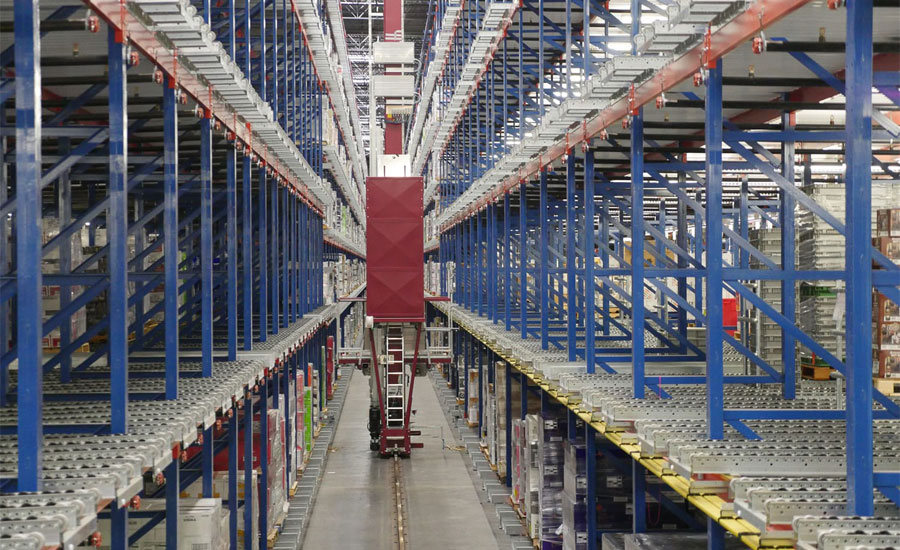
Image courtesy of Westfalia Technologies Inc.
“Consumers demand a wide variety of choice in the beverage industry, which leads to higher SKU counts,” he explains. “Introducing more SKUs into the distribution network can lead to higher labor requirements and lower efficiencies without appropriate design and automation.”
As consumer demand continues to drive unprecedented levels of SKU proliferation, operations not only are tasked with distributing larger and larger inventory assortments, but also have the task of housing such inventory, explains Mark Koffarnus, director of major accounts at Greenville, N.C.-based Yale Materials Handling Corp.
“This is true across the warehousing sector, including in the beverage industry,” Koffarnus says. “For beverage warehouse operations, this growth in product assortment means picking more frequently to fulfill these new order profiles ― rapidly changing picking and slotting methodologies.
“In addition to adjusting workflows to meet more intense picking demands, this product proliferation also pushes distributors to optimize their storage capacity, especially as increases in the cost of warehouse space make efficient space utilization even more essential,” he continues. “According to real-estate firm CBRE, prices to lease industrial warehouse space are up an average of 25% over the rates at the end of five-year contracts that expired this year.”
As increasing storage density and improving pick efficiency are two key levers for accommodating the surge in SKUs, certain equipment can enable more efficient slotting strategies, Koffarnus notes.
“For instance, a Yale low-level order picker truck with an operator platform that lifts and lowers can help increase accessible pick faces up to 400% and slot capacity up to 140% within an operation’s existing footprint,” he says. “Operations have also gone vertical — converting otherwise unused cubic space for more storage by deploying reach trucks capable of servicing second and third level storage locations.”
Mitigating labor shortages
As the COVID-19 pandemic impacted almost all industries across the world by disrupting the supply chain and hindering various industrial operations, automation has provided the increase in productivity, while dealing with current and future labor shortages, experts note.
ASRS has created faster, more reliable, and more accurate order processing from start to finish, says Dan Labell, president of Westfalia Technologies Inc., York, Pa.
“With improved software and machine control capabilities, storage systems are more flexible with the influx of SKUs than ever before and can integrate a variety of tools such as picking robotics and more traditional storage systems,” Labell explains. “Automated storage systems are also not limited to a 50-foot height limit, provide inventory optimization by consolidating date codes and stage pre-picked orders, and allow the operation to run 24/7 without much added support.
“That’s a really big deal, especially because labor for second and third shifts is so hard to find,” he continues. “When designed properly, the system can also perform at higher rates during the day shift, leaving replenishment and optimization, load preparation, and staging activities for the third shift with far fewer people. That enables a smooth morning start to load out operations and greater productivity day-in and day-out.”
Although the difficulty finding and retaining qualified labor already was one of the top challenges facing beverage distributors, the past 18 months or so have become even more of a factor as warehousing operations grapple with an intense labor shortage and high turnover, Yale’s Koffarnus says.
“In fact, a survey of warehousing leaders found that 59% of [distribution center] (DC) operations named finding labor as their top concern, up from 53% last year, and the highest in the past four years,” he explains. “With beverage warehouses stretched to piece together the necessary labor, it’s become even more imperative that lift truck technology and other storage solutions are optimized to maximize the productivity of the labor distributors do have on hand.
“As operations work to maximize productivity at every turn, maintaining a strict focus on lift truck best practices and facility-specific traffic rules can be a challenge,” he continues. “With so much riding on the performance of lift truck operators, it’s imperative to build and support safe, effective habits through proper, comprehensive training.”
Automation requires a change in culture
Experts note that as the COVID-19 pandemic has highlighted the need for agile and fast supply chains that keep humans safe, increased automation and artificial intelligence within warehouse operations are only tools, not total solutions to improved operations.
Within beverage operations, automation, including robotic lift trucks, can help streamline processes by picking up, transporting and dropping off pallets independently and reliably, Yale’s Koffarnus notes.
“In this way, robotic lift trucks not only optimize these workflows but can help free up workers for the value-added responsibilities that have the most to gain from human capabilities, and that can better engage and retain top talent compared to highly repetitive or injury-prone tasks that are most susceptible to attrition,” he explains. “For example, robotic reach trucks are an automated solution for beverage distributors because they can help address the labor shortage and help achieve greater storage density.”
As storage systems within the beverage industry continue to become more automated, especially at the single case pick level, beverage companies will have to become more capable in maintaining and operating these systems, which has been more of a challenge for beverage distributors than beverage manufacturers, according to Koffarnus.
“Distributors often don’t have the technology infrastructure in place,” he explains. “This has to be added both physically and culturally within their organizations to ensure success in the years ahead.”
Oftentimes, the consolidation of distributors and brand owners creates a different dynamic when it comes to distribution, DMW&H’s Roe notes.
As automation can take some of the guesswork out of the picking and packing operations while creating a common vision and outcome, it can be a challenge to have all parties adapt and adopt a common distribution philosophy, Roe explains.
“For example, cost, distribution footprint, SKU volume ― all of these topics are important when considering automation. A common misconception in our industry is that automating requires a clean slate to improve operations,” Roe says. “While that is sometimes the best option, a good partner can take some of the existing equipment and practices in the distribution center and use them to complement newer technologies added to the system.
“At DMW&H, we call these retrofits ‘open heart surgery’ because the operation is required to ‘stay alive’ and operational while we add the necessary improvements,” he continues. “We combine existing technology with new technology to create a custom and cost-effective solution for our partners.”
Although supply chain challenges have become a constant source of stress for beverage companies, beverage operations are benefiting from the advancements that ASRS technology delivers, experts note.
“Investments in technology like operator assist systems and robotics can help beverage operations get the most out of mission-critical labor resources and keep pace with demand,” Yale’s Koffarnus points out.
Westfalia’s Labell notes that when investing in ASRS technology, the operational data drives the design, which drives the cost, which drives the justification analysis.
“Other tangible benefits are taken into consideration as well, such as land cost or location and enabling growth to occur at a facility that otherwise would need to move or expand elsewhere. We see that investments in automated warehousing allow space for manufacturing to grow,” Labell says. “This can create big dividends, particularly if production is coupled with the automated warehouse, and does not require shipment of products to another distribution facility.”
Looking for a reprint of this article?
From high-res PDFs to custom plaques, order your copy today!