No-idle solutions for fleet temperature control
Saving energy and fuel consumption
With fuel prices seemingly anchored around $4 a gallon, most beverage fleets remain quite proactive about reducing fuel consumption. Between route/load
|
optimization and updating to the latest drivetrain technology, the low-hanging fuel-economy fruit has been thoroughly harvested. Among the more common fuel-saving strategies reported is the use of factory-installed idle shutdown timers to reduce unnecessary engine idling. Not only does idling put a significant dent in fuel economy numbers, but it also adds wear to the engine, speeding up overhaul intervals.
There is, however, a downside to limiting the amount of engine idling time, such as the inability to maintain a comfortable cab temperature when the truck’s engine is shut off. In some parts of the United States, open windows are sufficient to keep the cab comfortable during the summer months, but in the South and West, that’s not entirely practical. The same goes for the Northern states in the winter.
Already popular in the long-haul truckload freight sector, no-idle solutions for maintaining cab temperatures are beginning to find a home in local/regional delivery trucks.
For cold weather, one of the simplest solutions is to add a fuel-fired engine heater to the truck’s engine cooling system. Not only do these heaters provide virtually instant heat/defrost capabilities in the cab, they also keep the engine warm enough for easy starting and optimum operating temperature. Although engine idling can burn as much as a gallon of fuel an hour, the fuel-fired heaters can last up to 10 hours on that same amount of fuel.
Keeping a cab cool in the summer is a bit more complex, but there are still off-the-shelf solutions available. With long-haul truckers needing to keep a sleeper cab cool for mandatory rest periods, a lot of engineering has gone into filling that need without idling for 8-10 hours.
Most sleeper solutions involve some large packaging, but lessons learned on these units have been applied to day-cab solutions. By adding a few extra deep-cycle batteries to the truck’s electrical system, these no-idle AC systems store energy while the truck is moving and then use battery power to keep the cab cool when the truck’s engine is shut off.
For fleets operating in the dairy, fresh juice and draught beer segments, maintaining cargo temperatures is as important as keeping the driver comfortable. Here again there are off-the-shelf solutions available for maintaining cargo temperature without idling the truck’s engine or running an engine to power a refrigeration unit.
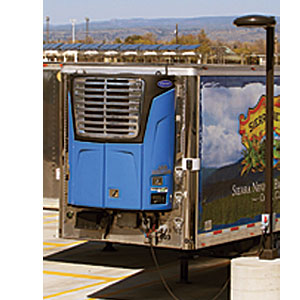
Manufacturers of trailer refrigeration units are beginning to offer “hybrid” models that can be run off AC electric “shore power” when parked, using only their on-board engines while en route. Rather than having the unit’s engine power the refrigeration compressor directly, the engine is used to generate electricity that powers a sealed electric compressor. This split-system architecture not only enables the shore-power option but also dramatically reduces compressor maintenance.
Based in Chico, Calif., Sierra Nevada Brewing’s refrigerated trailers are equipped with Vector hybrid refrigeration units from Carrier, part of UTC Climate Controls & Security, a unit of United Technologies Corp. Because loaded trailers can routinely sit parked on-site for as much as six hours before departing, the company recently completed the electrification of a staging area that can accommodate more than 40 trailers.
“We have installed electrical outlets powered from our solar panels to cool our beer as it waits for the truck to haul it to the distributor,” says Carrier Operations Manager Stan Cooper. “This is much better than running the refrigeration units on diesel when parked at the brewery.”
In straight-truck applications, the advent of hybrid drivetrain technology gives new life to the long-popular “cold-plate” refrigeration hardware. One of the downsides to cold-plate technology is that its ability to maintain temperature decreases over the course of a day’s deliveries. With the truck’s hybrid system generating and recapturing energy to be stored in a battery pack, the cold-plate’s “charge” can be boosted throughout the day.
PepsiCo’s Tropicana brand has deployed two unique hybrid trucks in its Chicago direct-store-distribution fleet. Along with an Eaton hybrid drive system, a Kidron Ultra Temp hybrid-powered cold-plate refrigeration system also is used.
Volvo testing practical bio-fuel
Volvo recently unveiled a dimethyl ether (DME)-powered truck that shows potential for bio-based fuels. The non-toxic DME can be produced from a variety of bio-based feedstocks and from natural gas. DME appears to address the cost, scalability and material handling issues that have long been the downside to many alternative fuels.
DME’s biggest advantage is that it can be produced from waste products, including animal manure, food waste, wastewater byproducts and landfill gas. Most regions have an excess supply of at least one of these feedstocks. Pipeline-sourced natural gas can balance out any variation in the supply of these feedstocks.
On the low-end, a small DME processing plant can cost-effectively produce fuel for a fleet as small as 50-60 trucks. Volvo is partnering in its DME testing with the Safeway grocery chain, which, in addition to running a large truck fleet, also generates a consistent supply of food waste, putting production and consumption of the DME fuel “under one roof.”
Looking for a reprint of this article?
From high-res PDFs to custom plaques, order your copy today!